

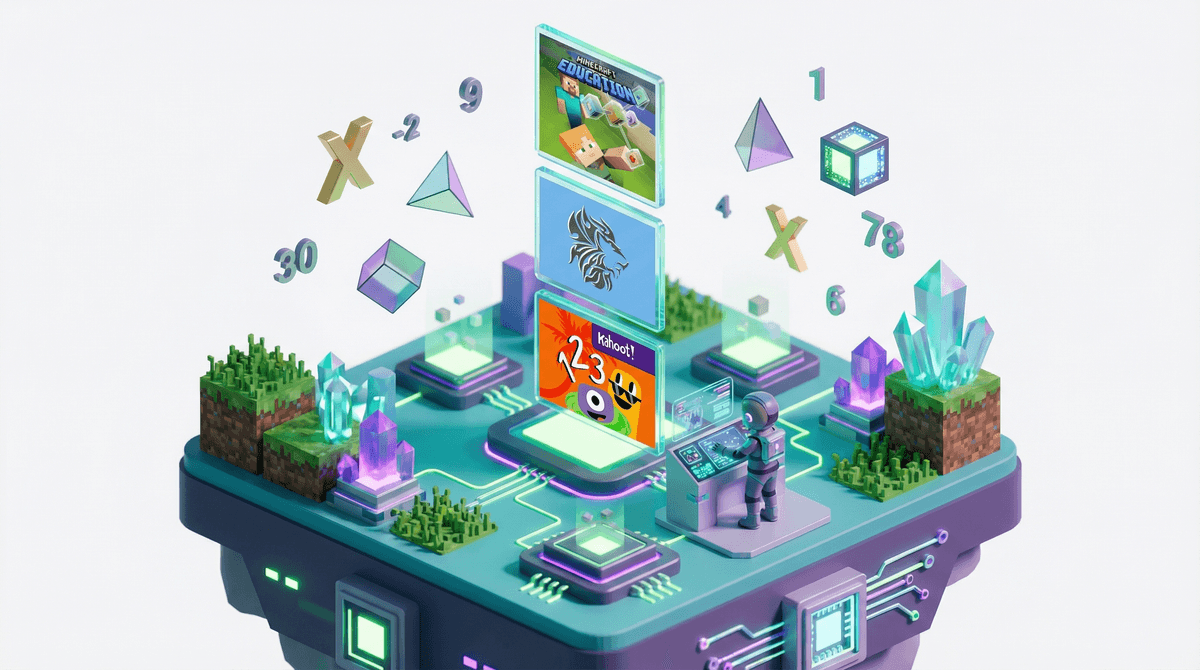
Let's be real: 6th grade math is where things get spicy. This is the year kids transition from "I can multiply fractions!" to "Wait, what's a variable and why does it have feelings?" We're talking pre-algebra concepts, ratios, negative numbers, and the kind of problem-solving that makes even some adults break into a cold sweat.
Math games for this age aren't those cutesy counting apps from elementary school. These are digital tools that disguise actual mathematical thinking as gameplay—and when done right, they can turn "I hate math" into "Wait, let me try one more problem."
The good ones build algebraic reasoning, strengthen number sense, and develop the kind of logical thinking that'll serve kids way beyond their next test. The mediocre ones? They're basically digital worksheets with sound effects.
Here's what's happening in 6th grade math: kids are building the foundation for everything that comes next. Algebra 1, geometry, eventually calculus if they go that route—it all stems from whether they truly understand concepts like proportional relationships, integers, and how to think through multi-step problems.
And here's the thing: 6th grade is when a lot of kids decide they're "not math people." The content gets abstract. The homework gets harder. Suddenly math feels less like solving puzzles and more like memorizing rules that make no sense.
Good math games can interrupt that narrative. They provide:
- Low-stakes practice where failing is just "try again" not "you're bad at math"
- Immediate feedback that helps kids understand why something works
- Conceptual understanding instead of just procedure memorization
- Intrinsic motivation (the game is interesting) vs. extrinsic motivation (do this or else)
Plus, let's be honest: sometimes your kid will practice math on a game for 30 minutes but acts like you've asked them to climb Everest when you suggest doing 10 homework problems.
This is the one your kid's classmates are probably already playing. It's a fantasy RPG where you battle monsters by solving math problems. The free version is solid; the paid membership adds pets and cosmetics but doesn't gate actual math content.
The good: It adapts to your kid's level, covers 6th grade standards pretty comprehensively, and kids genuinely want to play it. The game mechanics are engaging enough that the math doesn't feel like a chore.
The reality check: The constant upselling of the premium membership can be annoying. Some kids get more into collecting pets than actually learning. And yes, it's a bit grindy—but so is learning math.
Best for: Kids who like RPGs and respond well to leveling-up mechanics. Ages 10-13.
This is the elegant, Scandinavian-designed approach to math learning. DragonBox Algebra teaches algebraic thinking through visual puzzles that don't even look like math at first. By the time kids realize they're solving equations, they already understand the concepts.
The good: It builds genuine conceptual understanding. The progression is brilliant. No ads, no subscriptions after purchase, no data harvesting.
The reality check: It's not free (about $8-15 per app), and it's focused specifically on algebraic thinking rather than being a comprehensive 6th grade math tool.
Best for: Kids who hate "math" but love puzzles. Ages 9-14.
Yes, really. The education version has actual math challenges and lessons built in, covering everything from geometry to ratios to coordinate planes. If your kid already loves Minecraft, this leverages that obsession for learning.
The good: It's Minecraft, so engagement is not a problem. The math is embedded in building and problem-solving, making it feel purposeful rather than arbitrary.
The reality check: Requires a school or institutional license for the full Education Edition, though some math concepts can be explored in regular Minecraft with parent guidance.
Best for: Minecraft-obsessed kids who need to see math in context. Ages 10+.
From the Art of Problem Solving folks, this combines comic-book-style lessons with game-based practice. It's challenging—like, actually challenging—and teaches problem-solving strategies rather than just computation.
The good: Develops mathematical thinking, not just answer-getting. The comic format makes concepts accessible. Excellent for kids who are ready to be pushed.
The reality check: It can be hard. Some kids find it frustrating rather than engaging. Monthly subscription required for full access.
Best for: Kids who like a challenge and respond well to comic/story-based learning. Ages 8-13.
Not exactly a "game," but the gamification elements (points, badges, energy) are surprisingly effective. Completely free, comprehensive coverage of 6th grade standards, and the mastery-based progression is solid pedagogy.
The good: Free. Comprehensive. Actually aligned to what they're learning in school. The explanatory videos are genuinely helpful.
The reality check: It's not as game-like as true games. Some kids find it dry. It's better as a supplement to struggling with specific concepts than as a primary engagement tool.
Best for: Kids who are motivated by progress tracking and don't need elaborate game mechanics. Ages 8-18.
Not all math games are created equal. Here's what separates the good from the glorified flashcard apps:
Adaptive difficulty: The game should meet your kid where they are and adjust based on their performance. Too easy and they're bored; too hard and they're frustrated.
Conceptual focus: Look for games that build understanding, not just speed. Being able to quickly multiply fractions is great, but understanding why you multiply fractions matters more.
Minimal extrinsic rewards: Some rewards are fine, but if the game is more about collecting coins than learning math, that's a problem. The math itself should be somewhat intrinsically interesting.
Actual 6th grade content: This means ratios, proportions, integers, basic equations, coordinate planes, area and volume, statistics. Not just multiplication drills.
Here's the thing: math games are not magic. They're not going to replace good teaching, homework practice, or working through confusion with a real human. They're a tool, and like any tool, they work better in some situations than others.
Some kids will love them and genuinely learn. Some kids will game the system (literally), clicking through to get rewards without engaging with the math. Some kids will play for a week and then never touch them again.
And that's okay.
The goal isn't to find the perfect app that solves all math struggles. The goal is to provide another entry point, another way to engage with mathematical thinking, and maybe—just maybe—interrupt the "I'm bad at math" story before it becomes permanent.
Also worth noting: screen time doing Prodigy is still screen time. If your family has limits, math games count toward them. Don't let "but it's educational" become a loophole that leads to 3 hours of gaming. (Though 30 minutes of engaged math practice? That's probably a better use of screen time than scrolling TikTok or watching someone else play Minecraft on YouTube.)
Don't just download and disappear: Play with your kid for the first session. Understand how the game works. Talk about the math they're doing.
Check in on progress: Most of these apps have parent dashboards. Use them. Not to helicopter, but to understand what your kid is working on and where they might need support.
Connect to homework: If your kid is struggling with ratios in class, point them to that specific section in Khan Academy or Prodigy. Make the connection explicit.
Set reasonable expectations: "Play for 20 minutes three times a week" is more sustainable than "complete all of 6th grade math by spring break."
Watch for avoidance patterns: If your kid suddenly loves math games but their actual math grades are tanking, they might be using the games to avoid harder work. The games should supplement, not replace.
6th grade math games can be genuinely useful tools for building confidence, practicing skills, and developing mathematical thinking. They're not a replacement for good teaching or hard work, but they can make that work more engaging and less intimidating.
Prodigy is probably your best all-around bet—it's free, comprehensive, and kids actually like it. DragonBox is brilliant for algebraic thinking. Khan Academy is perfect for targeted practice on specific struggling areas.
Try one. See if your kid engages. If they do, great. If not, that's fine too. Math learning happens in lots of ways, and not every kid needs a game to make it click.
But for the kid who's starting to believe they're "bad at math"? A game that makes them feel successful and capable while actually building skills? That might be worth way more than you'd think.
Start simple: Pick one app or game and try it for two weeks. Don't download five things and overwhelm everyone.
Talk to your kid: Ask what math topics feel hard right now. Choose a game that addresses those specific concepts.
Check your school's resources: Some schools have subscriptions to math platforms you might not know about. Ask the teacher what they recommend.
Remember the goal: It's not about completing levels or earning badges. It's about building genuine mathematical confidence and understanding. If the game does that, even a little bit, it's working.
Want to explore more options? Check out our guide to educational games for middle schoolers or learn about balancing educational and entertainment screen time .
.