

First grade math is where the magic happens—kids transition from counting on their fingers to actually understanding numbers. We're talking addition and subtraction within 20, place value, measuring things, telling time, and basic geometry. And here's the thing: first graders learn math best through play, not worksheets.
Math games for this age can be digital apps, physical board games, card games, or just creative activities you do together. The goal is making number sense feel natural and fun, not like "math time" (cue the groans). When kids play games that involve counting, pattern recognition, or strategic thinking, they're building mathematical reasoning without realizing they're doing homework.
First grade is a critical window for math confidence. Kids who develop number sense early—understanding that numbers represent actual quantities, not just symbols—tend to have less math anxiety later. But here's what's tricky: the line between "educational game" and "screen time" can feel blurry, especially when your kid is begging for "just one more level" of an app.
The research is pretty clear that interactive math games work—but they work best when they're actually teaching concepts, not just drilling flashcards with cartoon characters. And honestly? Sometimes the best math game is Uno or a dice game you play together at dinner.
Let's talk apps and games that aren't just digital worksheets with badges.
Prodigy Math is hugely popular with the elementary school crowd—it's a fantasy RPG where kids battle monsters by solving math problems. The adaptive learning is solid, and it aligns with curriculum standards. The catch? The free version constantly pushes kids toward a paid membership with better gear and pets. It's not predatory, but it's definitely designed to make your kid feel like they're missing out. Still, for 15-20 minutes of daily practice, it's pretty effective.
Osmo uses physical manipulatives with iPad games, which is brilliant for first graders who still need that hands-on learning. The Numbers game has kids arrange physical tiles to make quantities, bridging concrete and abstract thinking. It's pricey (you need the base and game tiles), but it genuinely feels like play, not school.
DragonBox Numbers is one of those rare apps that teaches actual number sense—combining and splitting quantities, understanding parts and wholes—without feeling like a lesson. No ads, no subscriptions, just a one-time purchase. Your kid is literally building numbers as characters. It's weird and wonderful.
Endless Numbers is great for early first grade or kids still building number recognition. Cute monsters, simple animations, and it teaches counting and number sequences. Not super deep, but solid for building confidence.
Here's where things get good—you probably already own some of the best math games and didn't realize they were teaching anything.
Uno is secretly a math powerhouse. Number recognition, sequencing, strategic thinking about what to play when. Plus it's fast and doesn't feel educational at all.
Yahtzee teaches counting, addition, and probability (which first graders understand intuitively even if they can't name it). Rolling dice, counting dots, adding up scores—it's all math.
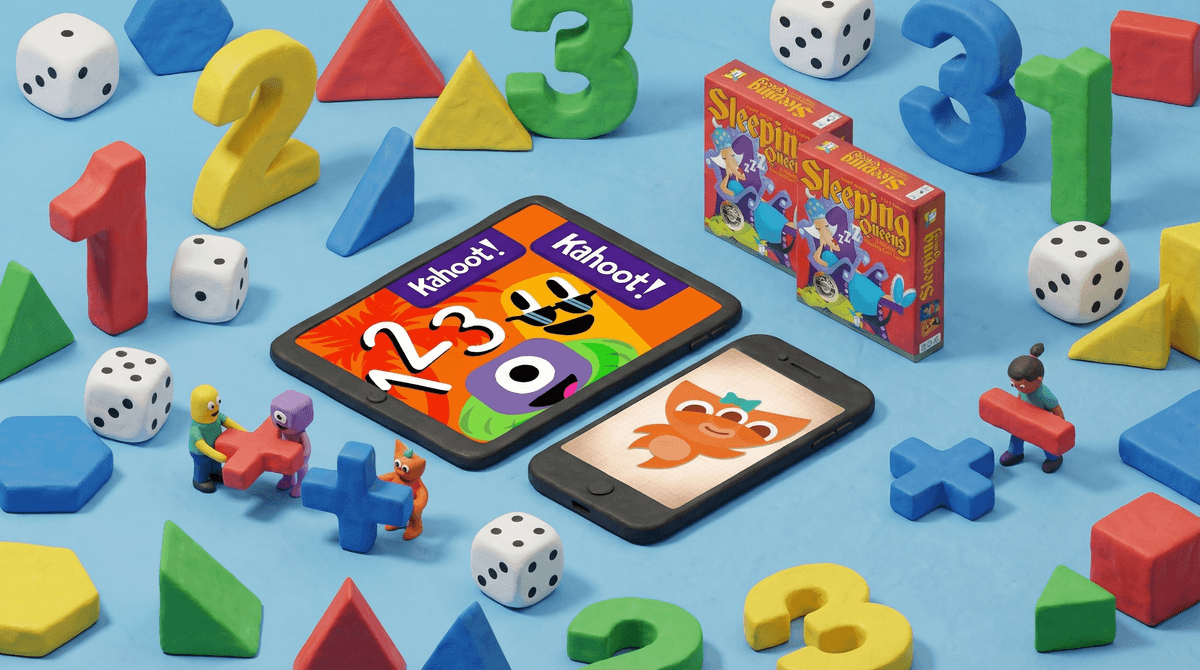
Sleeping Queens was literally invented by a kid and it's perfect for first grade. You're adding and making number combinations to wake up queens. It's got strategy, memory, and basic arithmetic all wrapped up in a silly theme.
Qwirkle builds pattern recognition and strategic thinking. You're matching shapes and colors, which is geometry and logical reasoning. Plus it scales well—you can play with younger siblings too.
Dice games are your secret weapon. Get some fun dice and play "Race to 20" (take turns rolling and adding to a total) or "Dice War" (each person rolls, higher number wins, keep score). Zero prep, maximum learning.
Not all "educational" games are created equal. Watch out for:
Apps that are just digital flashcards. If it's just "solve 10 problems, get a sticker," that's not a game, that's a worksheet with sound effects. Your kid will burn out fast.
Games with heavy monetization. Some math apps are designed to frustrate kids into asking for purchases. If your first grader is talking about needing gems or coins to "do better at math," that's a red flag.
Anything that feels like punishment. If math games become "you have to do this before screen time," you've just made math the enemy. Keep it playful.
Early first grade (ages 5-6): Focus on number recognition, counting, and basic addition/subtraction within 10. Games should be short (10-15 minutes max) and highly visual. Physical manipulatives are still really important—dice, counters, actual objects to count.
Late first grade (ages 6-7): Kids can handle addition and subtraction within 20, simple word problems, and basic strategy games. They can play longer (20-30 minutes) and start understanding turn-taking and rule-following in more complex games.
For all first graders: They're still building executive function, so games with clear rules and quick turns work better than long, complicated strategy games. And they need to see you playing too—modeling that math is fun and you're not always perfect at it.
The best math games for first graders are the ones they'll actually play. Sometimes that's a carefully designed app, sometimes it's Monopoly Junior where they're handling money and counting spaces. Sometimes it's making up a dice game at the dinner table.
Mix it up. Use apps when you need 15 minutes of focused practice, play board games for family time, and don't underestimate the power of cooking together (measuring cups = fractions, timers = time concepts, doubling recipes = multiplication foundations).
And here's the thing about screen time and math apps: 20 minutes of Prodigy is not the same as 20 minutes of YouTube. If your kid is actively problem-solving and learning, that's quality screen time. But if they're just clicking through to get rewards without thinking, it's time to switch it up.
Start here: Pick one digital game and one physical game from the lists above. Try them for a week and see what clicks with your kid. Some kids love the independence of apps, others need the social connection of playing with you.
Make it routine, not a reward: Math games work best when they're just part of life, not something earned or withheld. "We're going to play a game before dinner" beats "if you're good, we'll play a game."
Talk about the math: When you're playing, narrate what you're doing. "I need to make 10, so if I have 7, I need 3 more." You're modeling mathematical thinking out loud, which is exactly what first graders need to hear.
Check out alternatives to screen-based learning if you're feeling like the app balance is off. Sometimes the best math game is building a block tower and counting how many blocks tall it is.
And if you want to dig deeper into whether a specific app is worth it, See if a specific math app is actually educational and get a real breakdown of what it's teaching (or not teaching).