

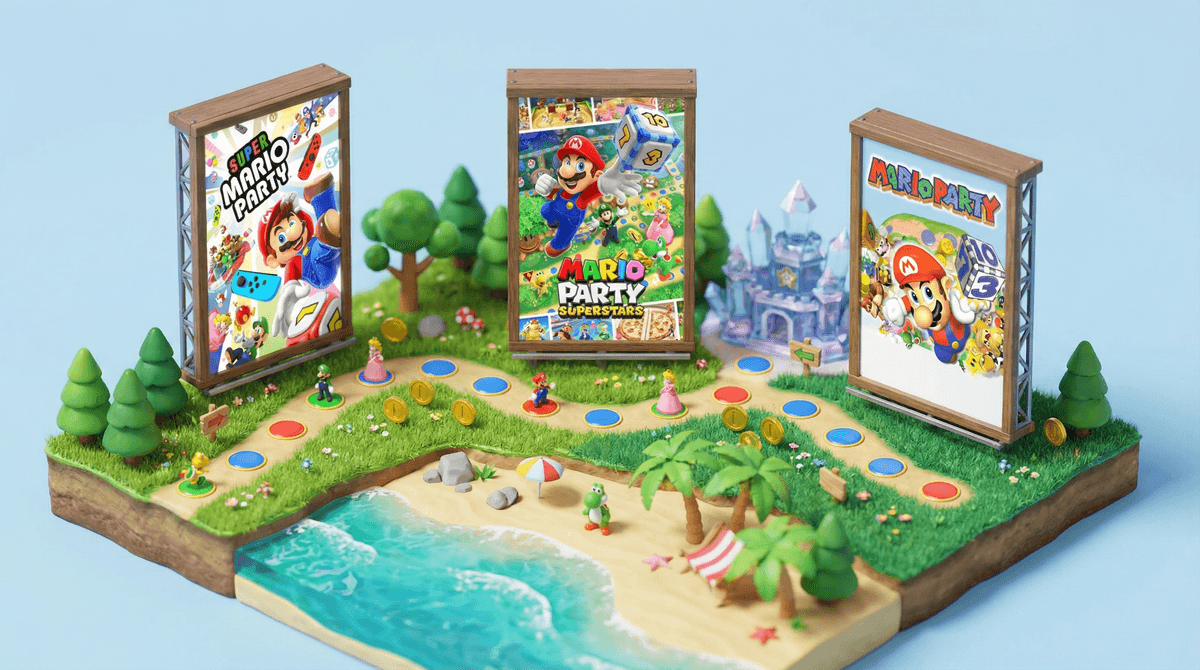
Mario Party is Nintendo's long-running party game series that's basically a digital board game mixed with mini-games. Think Monopoly meets Minute to Win It, but with Mario characters and way less likely to end in family feuds (mostly). Players move around a board collecting stars and coins, and between turns everyone competes in quick 10-30 second mini-games that test different skills—button mashing, timing, memory, teamwork, or just pure chaos.
The series has been around since 1998, so there's a good chance you played it as a kid yourself. The newest versions (Mario Party Superstars and Super Mario Party on Nintendo Switch) have refined the formula and brought back classic boards and mini-games that hit the nostalgia button for millennial parents while being totally fresh for kids.
For a 7-year-old, Mario Party sits in this sweet spot of being genuinely fun for the whole family without requiring the gaming skills of a Fortnite player or the reading level needed for more complex games.
It's chaos they can actually handle. Unlike games that require quick reflexes or complex strategies, Mario Party levels the playing field. A well-timed button press or lucky dice roll can let a 7-year-old beat their older sibling or even a parent. The unpredictability is part of the appeal—bonus stars at the end can completely flip the rankings, which keeps everyone engaged until the final seconds.
The mini-games hit different skills. Some mini-games are about speed, some about memory, some about cooperation. Your kid might struggle with the racing ones but absolutely dominate the "remember which shell hid the coin" games. This variety means they're not constantly losing at the same thing, which is huge for maintaining interest and confidence.
It's social without being online. In an age where so much gaming involves headsets and strangers on the internet, Mario Party is refreshingly local. Up to four players can sit on the same couch, see each other's reactions, and actually interact. For 7-year-olds who are just developing social skills around winning and losing, this face-to-face component is valuable.
Mario is a known quantity. Most kids this age already know Mario from Super Mario Bros, Mario Kart, or just cultural osmosis. The characters are colorful, non-threatening, and rated E for Everyone for good reason.
Reading requirements are minimal. Most of what happens in Mario Party is visual and explained through demonstrations before each mini-game. A 7-year-old who's still building reading skills won't be lost. That said, some mini-game instructions go by quickly, so younger players might need a round or two to figure things out.
Game length is adjustable. You can set games to 10, 15, or 20 turns. For a 7-year-old's attention span (and honestly, for busy parents), the 10-turn option is your friend. It takes about 30-45 minutes, which is long enough to feel like a complete experience but short enough that you're not trapped for two hours when you just wanted "a quick game before dinner."
Controller complexity varies. Most mini-games use simple controls—one or two buttons, maybe a joystick. A 7-year-old can definitely handle this, especially if they've played other Switch games. Some mini-games require button mashing, which is actually a great equalizer (little fingers can be surprisingly fast).
The competitive element is real but manageable. Yes, there's winning and losing. Yes, someone getting a star right before your turn can feel devastating. But the game's randomness and the fact that rankings change constantly helps soften the blow. Still, if your 7-year-old struggles with losing, be prepared for some big feelings, especially in those first few games.
This is actually a solid family game night option. I'm not just saying this—Mario Party is one of those rare games where everyone from age 5 to 50 can play together and have genuine fun. The mini-games are short enough that nobody gets bored waiting for their turn, and the variety means different family members will excel at different things.
It teaches turn-taking and sportsmanship. Your 7-year-old will get practice waiting for their turn, celebrating others' successes (or at least tolerating them), and handling disappointment when the bonus stars don't go their way. These are real skills that transfer beyond gaming.
You can adjust the difficulty. In Mario Party Superstars, you can add a "bonus" mode that gives struggling players extra dice or advantages. This can help level the playing field if you're playing with kids of different ages or if your 7-year-old is getting discouraged.
It's not educational, but it's not brain rot either. Let's be real—this isn't teaching math or reading. But it does involve some light strategy (which path to take, which items to use), quick decision-making, and memory skills. It's entertainment that happens to exercise some cognitive muscles without feeling like homework.
The online mode exists but isn't necessary. Mario Party Superstars has online play, but for a 7-year-old, you absolutely don't need to enable this. The local multiplayer is where the magic happens anyway. If you're curious about online gaming safety for this age , that's a whole separate conversation.
It's a one-time purchase. Unlike many modern games (looking at you, Roblox), Mario Party doesn't have in-app purchases, loot boxes, or constant upsells. You buy the game, you own the game, you're done. This is refreshing and means you won't deal with your kid asking for Robux or V-Bucks.
Start with a short game. Seriously, 10 turns max for the first few sessions. You can always play again if everyone's having fun.
Play on the same team initially. Some mini-games are 2v2, and pairing yourself with your 7-year-old for the first few games helps them learn the ropes without the pressure of solo competition.
Narrate the strategy. "Oh, I'm going to use this mushroom to roll two dice because I really want to land on that star space" helps your kid understand the decision-making without being a formal lesson.
Prepare for the "that's not fair" moments. When Bowser steals their star or someone else gets three bonus stars at the end, acknowledge the frustration: "Yeah, that is frustrating! The game can be really random sometimes." Validation without fixing teaches emotional regulation.
Use it as a reward or special activity. Because games take 30-45 minutes minimum, Mario Party works well as a weekend activity or a "yes, we can play one game before bed" treat rather than a daily default.
Mario Party for 7-year-olds is a solid choice that sits in the "good enough parenting" sweet spot. It's not going to teach them Spanish or how to code, but it's genuinely fun, encourages family time, and won't have you explaining why they can't spend real money on digital cosmetics.
The game's randomness means your 7-year-old has a real shot at winning, which builds confidence and keeps them engaged. The variety of mini-games means they're exercising different skills without it feeling like work. And the face-to-face multiplayer means you're actually connecting as a family instead of everyone staring at separate screens.
Is it perfect? No. Some kids will struggle with the competitive element, and if your household has a kid who melts down over losing, you'll want to prep for that. But compared to most gaming options for this age, Mario Party delivers actual family fun without the usual digital parenting headaches.
If you're considering Mario Party: The two main options on Switch are Super Mario Party and Mario Party Superstars. For a 7-year-old, Mario Party Superstars is generally the better choice—it has more classic boards, better mini-game selection, and slightly more polished gameplay.
If you want to explore other family-friendly Switch games: Check out other couch co-op options that might fit your family's vibe.
If you're thinking about gaming boundaries in general: Consider taking the Screenwise survey to understand how your family's gaming habits compare to your community and get personalized recommendations for games that match your values and your kids' ages.
The reality is that gaming is part of modern childhood, and Mario Party is one of the better options in the landscape. It's the kind of game where you might actually find yourself saying "okay, one more round" instead of counting down the minutes until screen time is over. And honestly? That's a win.