

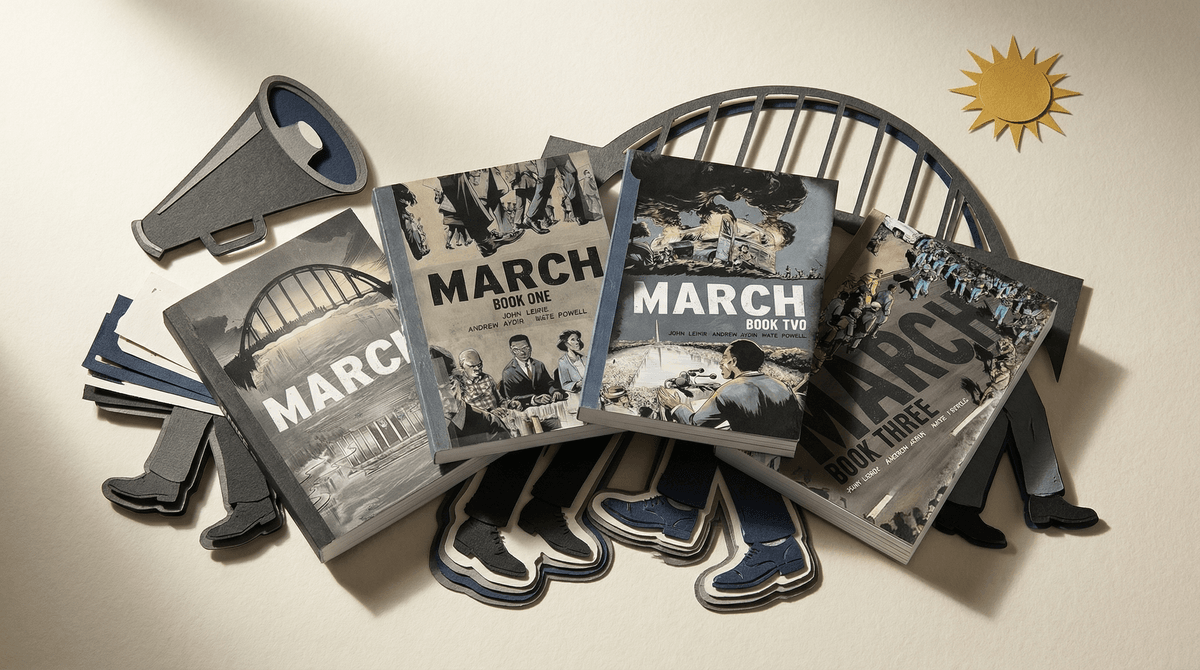
The March trilogy by John Lewis is a three-volume graphic novel memoir that chronicles the life and activism of the late Congressman John Lewis during the Civil Rights Movement. Co-written by Lewis and Andrew Aydin, with stunning artwork by Nate Powell, these books document Lewis's journey from a sharecropper's son in rural Alabama to his role as one of the "Big Six" leaders of the Civil Rights Movement alongside Martin Luther King Jr.
The trilogy covers Lewis's participation in lunch counter sit-ins, the Freedom Rides, the 1963 March on Washington, the Selma voting rights campaign, and the brutal events of "Bloody Sunday" on the Edmund Pettus Bridge. It's not a sanitized history lesson—this is a firsthand account of what it actually took to fight for voting rights and equality in America.
Here's what makes it different from a typical history textbook: It's told in the format kids are already comfortable with (graphic novels), by someone who was actually there, and it doesn't shy away from the violence and injustice that marked this period. The black-and-white illustrations are powerful and sometimes intense, which is exactly the point.
In an age where your kids are getting their information from TikTok videos and YouTube shorts—some accurate, many not—the March trilogy offers something rare: a primary source that's actually engaging.
This isn't about screen time per se, but it's absolutely about media literacy and information quality. The same intentionality you bring to evaluating whether Roblox is teaching entrepreneurship or just draining your wallet? That same energy applies to how your kids learn about history and current events.
The trilogy has won basically every award a book can win (three Eisner Awards, a Coretta Scott King Book Award, and the National Book Award—yes, a graphic novel won the National Book Award). It's been adopted in schools across the country, and for good reason: it works. Kids who might zone out during a traditional history lesson will actually read these books cover to cover.
Ages 10-12 (Upper Elementary/Middle School Start): This is the sweet spot for Book One. The content is serious but accessible. There are depictions of discrimination and some violence (people being arrested, pushed, yelled at), but it's not gratuitously graphic. This age can handle the concepts and will likely have lots of questions—which is exactly what you want.
Ages 12-14 (Middle School): Books Two and Three get more intense. There are depictions of beatings during the Freedom Rides, police violence during protests, and the brutal attack on Bloody Sunday. The violence isn't glorified, but it's real and it's drawn in a way that conveys the horror of what happened. Most middle schoolers can handle this, especially with some context and conversation.
Ages 14+ (High School): By this age, students should definitely be reading all three volumes. The complexity of the political strategy, the moral questions about nonviolent resistance, and the emotional weight of the story all become richer with a more mature reader.
Important note: Some families might be ready earlier, some later. You know your kid . If they're asking questions about racism, justice, or what they're seeing in the news, they're probably ready for at least Book One.
The violence is purposeful, not exploitative: Yes, there are scenes of people being beaten by police and angry mobs. But Powell's artwork never sensationalizes it. The violence is shown to document what happened and to honor the courage of those who faced it. That said, you might want to preview the books yourself first, especially Books Two and Three.
It's a conversation starter, not a conversation ender: The trilogy raises questions about when it's right to break unjust laws, what it means to commit to nonviolence even when you're being attacked, and how change actually happens. These aren't easy topics, but they're essential ones. Learn more about talking to kids about activism and social justice.
The format matters: If your kid devours Dog Man or Amulet but struggles with traditional chapter books, the graphic novel format might be the gateway to engaging with serious nonfiction. Don't discount it because it has pictures—the visual storytelling here is sophisticated and powerful.
It's not just Black history, it's American history: This is everyone's history. The March trilogy documents a pivotal moment when ordinary people changed the course of a nation through organized, strategic, nonviolent action. That's a lesson every kid needs.
Current events will come up: Your kids are seeing protests and activism in the news and on their social feeds. The March trilogy provides historical context for understanding how social movements work, why people protest, and what effective activism looks like. It's actually the perfect antidote to the decontextualized outrage cycle of social media.
Co-reading with younger kids (10-12): Consider reading Book One together, pausing to answer questions and provide context. What's a lunch counter? Why couldn't Black people vote? What does "nonviolent resistance" mean?
Check-ins with middle schoolers (12-14): They can probably read it independently, but schedule some time to talk about it afterward. Ask open-ended questions: What surprised you? What made you angry? What would you have done?
Discussion with teens (14+): At this age, they might want to read it on their own, but they'll still benefit from conversation. Connect it to current events, to their own experiences with injustice (even on a smaller scale), to questions about when and how to take a stand.
Classroom context: Many schools are using the March trilogy in social studies or English classes. If your kid is reading it for school, ask about what they're discussing in class. The classroom conversations can be surprisingly deep.
If your kids are interested in the March trilogy, they might also like:
- The Hate U Give by Angie Thomas (novel, ages 13+)
- Stamped: Racism, Antiracism, and You by Jason Reynolds (nonfiction, ages 12+)
- New Kid by Jerry Craft (graphic novel about microaggressions, ages 8-12)
- The documentary "John Lewis: Good Trouble" (available on various streaming platforms, appropriate for ages 10+)
In a digital landscape where your kids are constantly consuming content—some meaningful, much of it not—the March trilogy represents something worth prioritizing. It's not competing with Fortnite or Instagram for entertainment value; it's offering something those platforms can't: a deep, firsthand account of how ordinary people created extraordinary change.
This is the kind of media that actually deserves the word "content"—it has substance, purpose, and the power to shape how young people understand justice, courage, and their own potential to make a difference.
-
Get Book One: Start there. See how your kid responds before committing to all three volumes.
-
Preview it yourself: Spend 30 minutes flipping through before handing it to your child, especially if they're on the younger end of the age range.
-
Create space for conversation: Don't just hand them the book and walk away. Let them know you're available to talk about what they're reading.
-
Connect it to your family's values: Whether you're raising kids to be activists, thoughtful citizens, or just kind humans, the March trilogy provides a powerful example of putting values into action.
-
Follow up with the documentary: After they've read the books, watch "John Lewis: Good Trouble" together to see the full arc of his life and legacy.
The March trilogy isn't just a book recommendation—it's an investment in raising kids who understand that change is possible, that ordinary people can do extraordinary things, and that standing up for what's right often requires courage, strategy, and community. That's a lesson worth every minute they spend with these books instead of scrolling.