

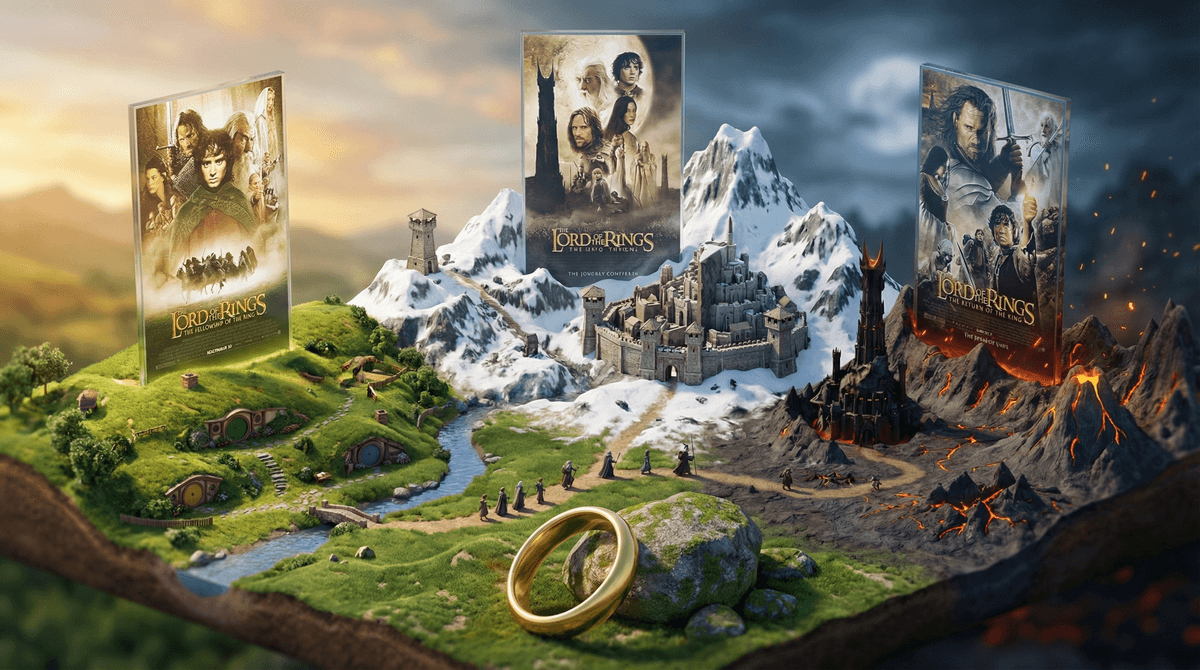
Let's be clear: The Lord of the Rings trilogy isn't just three movies. It's a 9+ hour commitment to Middle-earth, and that's the theatrical versions. The extended editions clock in at nearly 12 hours. We're talking about Peter Jackson's epic adaptation of J.R.R. Tolkien's beloved fantasy novels, released between 2001-2003, and honestly? They hold up remarkably well.
The trilogy follows Frodo Baggins, a hobbit tasked with destroying a powerful ring before the dark lord Sauron uses it to enslave all of Middle-earth. Along the way: massive battles, terrifying creatures, intense friendships, and more walking than you'd think possible in a fantasy epic.
These films won a combined 17 Academy Awards. They're genuinely great cinema. But that doesn't automatically make them right for your 8-year-old who loved Harry Potter.
If your kid is asking about LOTR, it's probably because:
They're into fantasy worlds. Minecraft players, D&D kids, and anyone who's read Percy Jackson will be drawn to the world-building here. Middle-earth is the template for modern fantasy.
Their friends have seen it. By middle school, you'll start hearing "wait, you haven't seen Lord of the Rings?!" It's become a cultural touchstone, especially for kids who identify as nerds (affectionate).
They want something "grown-up." LOTR carries a certain prestige. It's not a "kids' movie" — it's an epic that adults take seriously. For tweens especially, that matters.
The memes. "One does not simply walk into Mordor." "And my axe!" Legolas shield-surfing. The movies have serious internet staying power, and kids want to understand the references.
Here's where I'm going to give you the nuanced answer you probably don't want: there's no magic number.
The MPAA rating is PG-13, which is actually pretty accurate for once. But PG-13 covers a huge range, and LOTR sits on the intense end of that spectrum.
What Makes It Intense
The violence is frequent and sometimes graphic. We're talking:
- Decapitations (mostly orcs, but still)
- Arrows through throats and eyes
- A character getting pincushioned with arrows while trying to protect hobbits
- Prolonged battle sequences with hundreds of deaths
- Shelob the giant spider wrapping Frodo in webbing (this scene alone has traumatized many a 10-year-old)
The scary factor is real. The Ringwraiths are terrifying. The Balrog is nightmare fuel. Gollum is deeply unsettling. These aren't jump scares — they're sustained dread and atmospheric horror.
It's emotionally heavy. Characters you care about die. The ring's corruption of Boromir is genuinely tragic. Gollum's split personality is disturbing. The ending is bittersweet and deals with themes of loss and letting go.
The length is no joke. Even theatrical versions require serious stamina. I've watched plenty of kids tap out halfway through Fellowship because they're just... done.
Age-by-Age Breakdown
Ages 7-9: Probably Not Yet Even mature 9-year-olds will likely find this too intense and too long. The scary scenes will stick with them, and they won't have the emotional framework to process the heavier themes. If they're asking, try The Hobbit animated movie from 1977 first — it's gentler and shorter.
Ages 10-11: Maybe, With Caveats This is where it gets individual. A 10-year-old who's read the books, loves fantasy, and has handled intense content before? Could work, especially if you:
- Watch together
- Start with Fellowship and see how they handle it
- Be ready to pause and discuss
- Skip the extended editions (seriously, save those for later)
- Fast-forward through Shelob if needed
But if your 10-year-old is sensitive to scary content or gets overwhelmed by violence? Wait.
Ages 12+: Generally Ready Most middle schoolers can handle LOTR, both content-wise and attention-span-wise. They'll appreciate the story complexity, understand the themes, and be less traumatized by the scary parts. This is also when the social currency of having seen it starts to matter more.
High School: Prime Time This is honestly the sweet spot. Teens can fully appreciate the filmmaking, the moral complexity, the allegory, and yes, the extended editions. They'll catch references they missed as younger kids. And watching LOTR is basically a rite of passage for fantasy-loving teens.
The representation is... very white and very male. Éowyn is basically the only female character with a real arc, and Middle-earth is overwhelmingly white. The films have been criticized for some problematic racial coding with the orcs and the Haradrim. Worth being aware of and discussing with older kids.
The books vs. movies debate will start immediately. If your kid loves the movies, they'll want to read the books. Fair warning: Tolkien's writing style is dense and archaic. Many kids bounce off the books even if they loved the films. The Hobbit book is more accessible as a starting point.
The extended editions are for superfans only. An extra three hours of content sounds great until you're on hour 11 and your kid is melting into the couch. Theatrical versions first, always.
Peter Jackson's Hobbit trilogy is NOT the same. If your kid loves LOTR, they'll want to watch The Hobbit movies. Those films are much more kid-friendly in tone but also much less good. Like, significantly worse. Just setting expectations.
This might spark a whole fantasy phase. Be prepared for requests about D&D, fantasy book series, more epic movies, and possibly a very expensive trip to New Zealand.
If you're greenlit for Middle-earth, here's the play:
Start with Fellowship. It's the most accessible and least intense of the three. If they struggle with it, you have your answer.
One movie at a time. Don't try to marathon all three in a weekend unless your kid is specifically asking for that. Space them out.
Watch together, especially the first time. You can gauge reactions, pause for questions, and provide context. Plus, honestly, these movies are better with company.
Talk about the scary parts beforehand. "There are going to be some really frightening creatures and intense battle scenes. If it's too much, we can pause or stop." Giving kids an out makes them more likely to speak up.
Discuss the themes. LOTR is rich with talking points: corruption and power, friendship and sacrifice, environmentalism, the cost of war. These are conversations worth having with older kids and teens.
The Lord of the Rings is a masterpiece of fantasy filmmaking, but it's not for young kids. The violence is significant, the scares are real, and the emotional weight is heavy.
Most kids will be ready around age 11-12, though some mature 10-year-olds can handle it with parental support. If your kid is younger and asking, there are gentler entry points to Middle-earth, or you can try other fantasy adventures like The Princess Bride or Willow.
But when they are ready? Watching LOTR together can be a genuinely special experience. Just stock up on snacks, clear your schedule, and maybe keep the lights on for bedtime.
And for what it's worth: if your teen hasn't seen these yet and wants to, just say yes. They're old enough, and you'll probably enjoy the rewatch.
Not sure if your kid is ready? See if your child is ready for Lord of the Rings about your specific situation — their age, sensitivity to scary content, and what they've handled before.
Looking for fantasy alternatives? Check out this guide to age-appropriate fantasy movies for options that might be better fits.
Want to know what other parents are doing? Screenwise can show you exactly what percentage of kids your child's age have watched LOTR in your community. Sometimes it helps to know you're not the only one saying "not yet."