

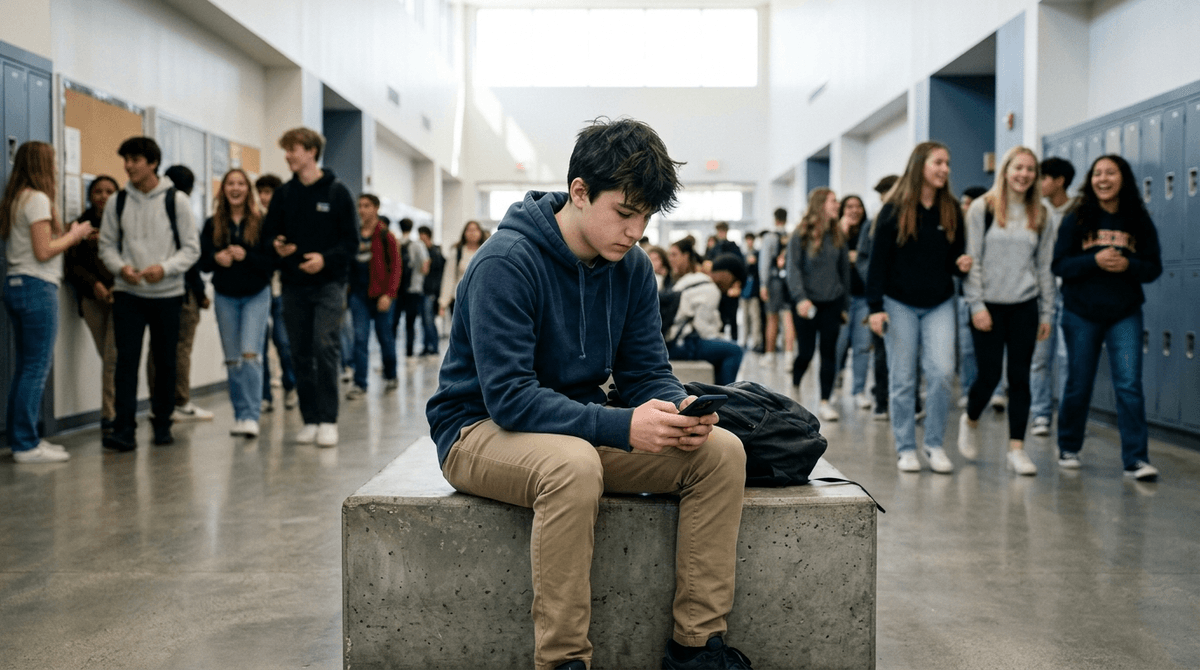
Social media and gaming are rarely the primary cause of your child’s mental health struggles; instead, they are usually secondary players in a drama that begins in the school hallway. While digital habits receive the lion's share of parental blame, new data suggests that the damage caused by social exclusion happens regardless of how much time a teen spends behind a screen.
While school-based isolation and being "left out" significantly damage adolescent mental health, social media and gaming do not act as the primary drivers of this relationship. For the vast majority of teens, digital habits are a minor factor compared to the raw impact of physical social rejection.
Parents often have a "blame the screen" reflex when a child’s mood tanks or their behavior shifts toward aggression. It is tempting to assume that a "screen detox" will solve the underlying anxiety, but this research suggests that the root cause is almost certainly offline. If a child feels ostracized during the school day, banning TikTok or Roblox won't fix their internalizing symptoms—it might actually remove their only remaining bridge to social connection.
Understanding the hierarchy of these stressors allows you to prioritize the right intervention. Instead of fighting over minutes of phone use, your energy is better spent investigating the social dynamics of the lunchroom or the classroom. This finding changes the "parenting math" from managing digital consumption to managing social belonging.
Researchers were testing the "mediation" hypothesis—the idea that social exclusion at school leads to digital overuse, which then causes mental health issues. There is a persistent fear that lonely kids retreat into digital worlds that only make them more depressed or aggressive. This study sought to fill the gap by determining if screens are the "smoking gun" that turns school-based pain into clinical symptoms like anxiety, depression, or outward hostility.
School-based disconnection is the heavy hitter, while digital habits are secondary in almost every statistical model. The researchers looked at 1,742 adolescents and found that the link between being left out and having mental health symptoms was robust, but the digital "bridge" between the two was surprisingly weak.
- Digital use is a weak predictor. Social media use and gaming showed only minimal correlations with school-based loneliness and negative mental health outcomes.
- The mediation is mostly missing. For most students, digital behaviors did not explain why lonely kids develop symptoms like anxiety or depression; the loneliness itself was doing the work.
- Gender-specific nuances exist. For girls, social media was a small but measurable link between feeling ostracized and feeling anxious. For boys, gaming was a minor path through which loneliness translated into internalizing symptoms (like withdrawal).
- Externalizing symptoms (aggression) are separate. Digital habits did not explain the link between social exclusion and acting out or aggressive behavior.
The study suggests that screens are more of a "smoke signal" than the fire itself. If your child is spending ten hours on a game or scrolling endlessly, they aren't necessarily becoming depressed because of the screen; they are likely on the screen because they feel invisible or rejected in their physical lives.
When academics talk about "weak mediation," they are essentially saying that if you removed the digital element entirely, the mental health problems would likely still exist. The digital world is where the symptoms manifest, but it isn't the engine generating them. For many lonely kids, gaming and social media might even serve as a "less-than-perfect" coping mechanism rather than a primary toxin.
The data is cross-sectional, meaning it captures a single snapshot of these teens' lives. This makes it impossible to prove that loneliness caused the digital behavior—it’s possible that digital habits came first, though the researchers suspect the opposite. The findings rely on self-reported data from Finnish students, and while the sample size of over 1,700 is large, the results might vary in different cultural contexts or with kids who have pre-existing clinical diagnoses.
- If your daughter is being excluded by her peer group at school... monitor her social media use more closely than usual, as the combination of being "left out" and digital scrolling is the one area where social media does slightly worsen anxiety.
- If your son seems lonely and is retreating into hours of gaming... treat the gaming as a signal to investigate his school social life rather than the primary cause of his withdrawal; the gaming is likely a response to the isolation, not the cause of it.
- If you are considering a "screen detox" to improve your child's mental health... investigate whether the root issue is social ostracism at school first, as removing the screen will not solve the pain of being ignored by peers.
- If your child is showing signs of aggression or "acting out"... ignore the gaming or social media metrics for a moment and look at their relationships with classmates, as digital habits were found to have zero "mediating" effect on these externalizing behaviors.
Address the hallway, not just the handheld. While digital habits can play a minor role in how kids process social pain, the real damage to adolescent mental health is rooted in the physical environment of the school. You have permission to stop treating the phone as the primary source of their distress and start focusing on their real-world social belonging.
Bruneel S, Sjöblom J, Lagerström M et al. (2026). Exploring the Mediating Role of Social Media and Gaming in the Relationship between Adolescents' Feelings of Loneliness, Ostracism and Internalizing and Externalizing symptoms. Child psychiatry and human development. doi:10.1007/s10578-026-02027-1 — https://pubmed.ncbi.nlm.nih.gov/42159978/