

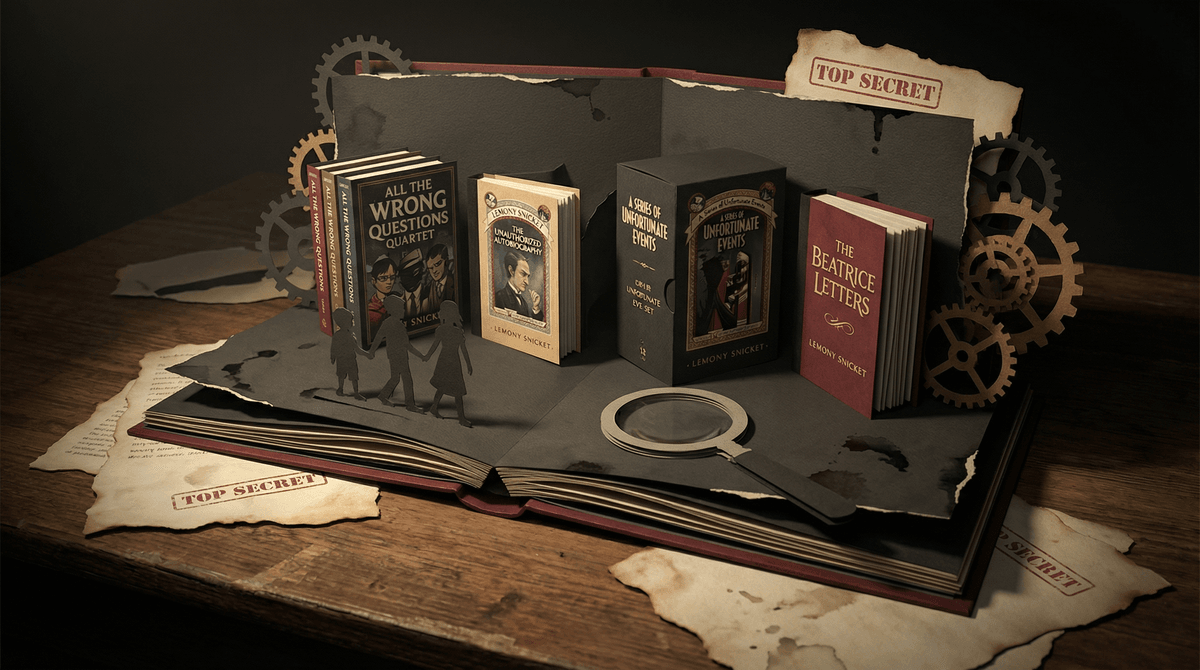
Lemony Snicket is the pen name of author Daniel Handler, and if your kid has discovered his work, congratulations — you're about to enter a delightfully dark, vocabulary-rich world that actually makes reading feel cool. The main series, A Series of Unfortunate Events, follows the three Baudelaire orphans (Violet, Klaus, and Sunny) as they're passed from one terrible guardian to another while being pursued by the villainous Count Olaf who's after their fortune.
But here's where it gets interesting: Snicket has written multiple interconnected series set in the same universe, and kids who fall in love with the Baudelaires often want to devour everything else. The question isn't whether they should read more Snicket (they absolutely should), but in what order.
Let's be real: these books treat young readers like intelligent humans who can handle complex vocabulary, moral ambiguity, and the fact that sometimes bad things happen to good people. Snicket never talks down to his audience. Instead, he uses a narrative voice that's simultaneously serious and absurd, defining difficult words in context, and acknowledging that life is often unfair.
The books are also genuinely funny in a dry, sophisticated way that makes kids feel like they're in on the joke. When Snicket warns readers to put the book down immediately because it will only bring them misery, kids obviously keep reading. It's reverse psychology that actually works because it respects their intelligence.
Plus, the Baudelaire children are competent. Violet invents things, Klaus researches everything, and even baby Sunny has skills (very sharp teeth, initially, then cooking). Kids love seeing young characters solve problems using their actual abilities rather than magic or luck.
Here's the thing: while you can read Snicket's books in any order, there's a reason to follow a specific path. The series build on each other, with characters, mysteries, and organizations connecting in ways that are way more satisfying when you catch the references.
Start Here: A Series of Unfortunate Events (Ages 8-12)
This is the main event — 13 books that should be read in order:
- The Bad Beginning
- The Reptile Room
- The Wide Window
- The Miserable Mill
- The Austere Academy
- The Ersatz Elevator
- The Vile Village
- The Hostile Hospital
- The Carnivorous Carnival
- The Slippery Slope
- The Grim Grotto
- The Penultimate Peril
- The End
Don't skip around. The mystery of V.F.D. (you'll know it when you see it) unfolds across all 13 books, and jumping ahead ruins the carefully constructed reveals. Each book is relatively short (200-300 pages), so even reluctant readers can build momentum.
Reading tip: Some kids race through these in weeks, others savor them over months. Both approaches work. The books were originally published over seven years, so there's no rush.
Then: All The Wrong Questions (Ages 9-13)
This four-book series is a prequel set in a dying town called Stain'd-by-the-Sea, featuring a young Lemony Snicket as an apprentice investigator. Read these after finishing A Series of Unfortunate Events, even though they're chronologically earlier. Why? Because the references and connections are way more meaningful when you already know the main series.
- Who Could That Be at This Hour?
- When Did You See Her Last?
- Shouldn't You Be in School?
- Why Is This Night Different from All Other Nights?
These have a different vibe — more noir detective story, slightly younger protagonist — but the same sophisticated vocabulary and moral complexity. If your kid loved ASOUE, they'll appreciate seeing how Snicket himself became who he is.
For Younger Readers: The Bad Mood and the Stick (Ages 4-8)
This picture book exists for younger siblings who want in on the Snicket action. It's got his signature style but is genuinely appropriate for little kids. Think of it as a gateway drug to the longer series.
The Supplemental Files (Ages 10+)
Snicket also published several companion books that fit into the ASOUE universe. These should be read after you've finished the main 13 books:
- The Beatrice Letters — Read this right after The End. It provides additional context and closure (or does it?) to the series.
- The Unauthorized Autobiography — A collection of documents, letters, and photographs that expand the V.F.D. mystery. Best read after book 9 or 10 when you understand what V.F.D. is.
- The Puzzling Puzzles — Exactly what it sounds like. Optional, but fun for kids who love codes and mysteries.
Vocabulary is intense — Snicket defines words in context, but these books will expand your kid's vocabulary significantly. That's a feature, not a bug. Don't be surprised when your 9-year-old starts using words like "ersatz" and "carnivorous" correctly.
The themes are genuinely dark — Parents die in a fire on page one. The books deal with grief, injustice, incompetent adults, and the reality that sometimes villains win. But they do so in a way that gives kids tools to process difficult emotions. Snicket never pretends the world is fair, but he also shows resilient, capable young people navigating hardship together.
They're not scary-dark, they're philosophical-dark — There's no gore or graphic violence. The "darkness" is more existential: adults who don't listen, systems that fail, the complexity of right and wrong. It's age-appropriate melancholy, not trauma.
The Netflix adaptation is excellent — If your kid wants to watch A Series of Unfortunate Events (the show) after reading, it's actually really well done. Neil Patrick Harris nails Count Olaf, and the show is faithful to the books while adding visual richness. That said, read first, watch second — the books are better at letting kids imagine the world themselves.
If your kid is a strong reader who's ready for something more sophisticated than typical middle-grade fare, Lemony Snicket is a gift. Start with The Bad Beginning, commit to reading all 13 books in order, then move to All The Wrong Questions if they want more.
These books respect young readers' intelligence, expand their vocabulary naturally, and tackle real themes about loss, resilience, and moral complexity without being preachy. They're also genuinely entertaining for adults reading aloud or alongside their kids.
Fair warning: your kid will start narrating their own life in Snicket's voice, defining words you already know, and warning you that their day will be filled with misery and woe. It's adorable and only slightly annoying.
- Grab The Bad Beginning from your library or bookstore
- Consider reading it together, especially for younger readers (ages 8-9)
- Let them set the pace — these books are meant to be enjoyed, not assigned
- When they finish book 13, have The Beatrice Letters ready to go
- If they love the series, check out our guide to books like A Series of Unfortunate Events for what to read next
And remember: if your child asks for the entire series at once, that's not a warning sign of obsession — it's a sign you've raised a reader who knows what they want. That's a fortunate event indeed.