

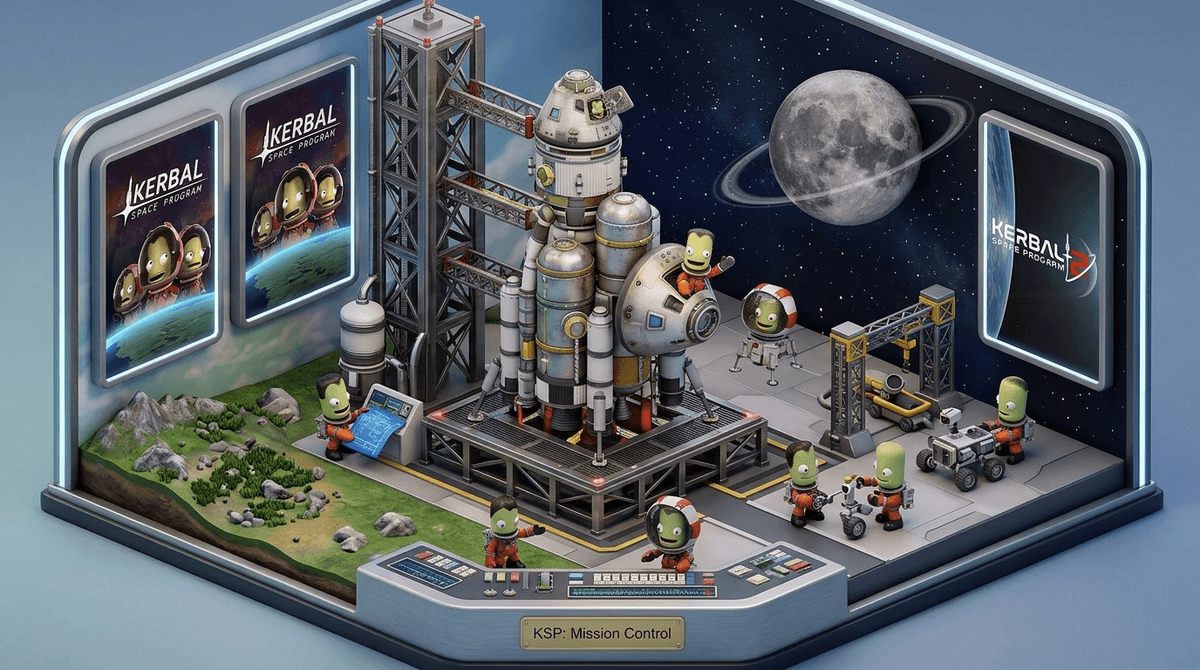
TL;DR: Kerbal Space Program (KSP) is the ultimate "smart" game. It’s a physics-based sandbox where kids build rockets to help little green aliens explore the stars. It’s notoriously difficult, incredibly rewarding, and possesses zero "brain rot" qualities. If your kid likes Minecraft but wants something more "real," this is the gold standard.
Quick Links:
- The Game: Kerbal Space Program
- The Sequel: Kerbal Space Program 2
- The Learning Curve: How to help your kid start KSP
- The Pro Guide: Scott Manley on YouTube
If you’ve walked past your kid's computer and seen a bunch of green, googly-eyed creatures strapped to a cylinder of liquid explosive that is currently cartwheeling through the upper atmosphere, you’ve found Kerbal Space Program.
In KSP, players run a space agency for a race of aliens called Kerbals. You design, build, and fly spacecraft, satellites, and space stations based on real-world aerodynamic and orbital physics. It’s not "pew pew" space lasers; it’s "did I remember to put parachutes on the command pod so Jebediah Kerman doesn’t become a permanent part of the landscape?"
It is one of the few games that NASA engineers and SpaceX employees actually play for fun. While most games "cheat" the physics to make things easy, KSP makes you respect the math.
Kids love KSP because it treats them like adults. It doesn’t hold their hand. When they finally reach orbit after twenty failed attempts, that "YES!" moment is earned in a way that very few modern games allow.
But let's be real: they also love the "Epic Fails."
In the world of YouTube and TikTok, "fail" culture is huge. KSP leans into this. When a rocket design is top-heavy and flips over at 10,000 feet, the result is a spectacular, non-violent explosion. The Kerbals themselves are hilariously resilient—they usually just look slightly panicked or weirdly excited as their ship disintegrates.
It turns the frustration of "losing" into a comedy of engineering errors. In KSP, a crash isn't a "Game Over"; it's a "Rapid Unscheduled Disassembly" that teaches you exactly what to fix for the next flight.

If your kid is showing interest in orbital mechanics (or just likes blowing things up in the name of science), here are the best ways to lean into that interest without falling into the Roblox money pit.
The Games
- The original and still the best. It has a massive library of "mods" (user-created additions) that can make the game look better or add new parts.
- If KSP is about building ships, this is about building solar systems. You can see what happens if you replace the Sun with a black hole or collide Earth with Mars. It’s a beautiful, terrifying physics toy.
- A slightly more streamlined, mobile-friendly alternative to KSP. Great for kids who want to design rockets on an iPad.
-
A newer, "cozy" physics game where you build weird rovers to deliver packages on Mars. It’s quirky, creative, and much less stressful than hitting orbit.
[Mars First Logistics](https://screenwiseapp.com/media/mars-first-logistics-app
The "How-To" Content
KSP is hard. Like, "I need a degree" hard. Most kids learn by watching others.
- The gold standard. He’s a real-life astronomer who explains the "why" behind the "how." If your kid is stuck, tell them to "Fly safe" with Scott.
- While not strictly a KSP creator, his engineering mindset is exactly what KSP fosters.
Books for the Coffee Table
- The ultimate "science-your-way-out-of-it" story. The junior edition keeps the math and loses the heavy swearing.
- A great way to show the real human history behind the orbital mechanics they’re playing with.
Ages 7-9: They will likely need you to sit with them. They'll enjoy the "Sandbox Mode" where everything is unlocked, and they can just strap 50 boosters to a chair. Don't expect them to reach the moon (the "Mun" in-game) without significant help.
Ages 10-13: The sweet spot. This is when they start to understand "Gravity Turns" and "Aero-braking." They might spend hours in the Vehicle Assembly Building (VAB) tweaking the center of mass on a space plane.
Ages 14+: At this point, they might be better at orbital mechanics than you are. This is a great time to introduce them to coding with Scratch or even Python, as KSP has mods that allow you to script your own launches.
KSP is a parent’s dream when it comes to digital wellness:
- Single Player: There is no built-in multiplayer in the original KSP. No chat rooms, no "grooming" risks, and no toxic 12-year-olds screaming in their ears.
- No Microtransactions: You buy the game, you own the game. There’s no "Kerbal-Coin" or limited-time skins to nag you about.
- Educational Value: It is legitimately educational. You cannot play this game without learning about the inverse-square law, aerodynamics, and resource management.
The only real "risk" is Time Sink. A single mission to Duna (Mars) can take hours of planning and execution. It’s the kind of game where you say "just one more launch" and suddenly it's 10:00 PM.
If you want to impress your kid (or just understand what they're shouting about), here is a quick cheat sheet of KSP terms:
- "Delta-V": This is basically "fuel range." If they say they "don't have enough Delta-V," it means their rocket is too heavy or doesn't have enough gas to get home.
- "The Mun": This is the game's version of the Moon. Landing on the Mun is the first "Big Deal" in every player's life.
- "Jebediah Kerman": He’s the "main" pilot. He is famously fearless and will smile even as the rocket is exploding. If Jeb is lost in space, it’s a tragedy.
- "Kraken": This is what players call physics bugs. If a ship starts vibrating uncontrollably and explodes, they’ll say "The Kraken got me."
Ask them: "How's the periapsis looking on that orbit?" or "Are you running a Career mode or Sandbox?" It shows you’re paying attention to the complexity of what they’re doing.
Kerbal Space Program is the antithesis of the "mindless scroll." It requires focus, patience, and a willingness to fail repeatedly in the pursuit of a goal.
In a world of Skibidi Toilet memes and Roblox "tycoon" games that are just clicking simulators, KSP is a breath of fresh, thin, upper-atmospheric air. It’s one of the few games where you’ll never feel guilty about the "screen time" because you can literally see their brain neurons firing as they calculate a docking maneuver.
- Check the Hardware: KSP runs on PC, Mac, and consoles (PlayStation/Xbox). The PC version is superior because of the modding community.
- Watch a Tutorial Together: Sit down for 10 minutes and watch a "First Orbit" tutorial. It will give you a shared language.
- Set a "Mission Timer": Since missions can be long, help them find natural stopping points (e.g., "Once you finish this burn, we're heading to dinner").