

Look, I get it. When you finally wrangle everyone onto the couch for family movie night, the path of least resistance is scrolling through the same Disney+ and Netflix suggestions you've seen a hundred times. But here's the thing: there's an entire world of incredible children's films being made outside Hollywood that your kids are missing out on.
International films for kids are exactly what they sound like—movies made in other countries, often in other languages, that tell stories from perspectives and cultures different from the American mainstream. We're talking Studio Ghibli from Japan, yes, but also French animation, Korean family dramas, Brazilian adventures, Indian musicals, and so much more.
Screenwise Parents
See allAnd before you think "my kid won't read subtitles," hold that thought. We'll get there.
It's easy to dismiss this as just feel-good multiculturalism, but the benefits are surprisingly concrete:
It builds actual empathy. Research shows that engaging with stories from different cultures helps kids develop perspective-taking skills. When your 8-year-old watches a film about a kid in Iran dealing with a lost goldfish, they start to understand that children everywhere have feelings, problems, and dreams—just in different contexts.
It normalizes difference. In a world where your kid's algorithm is constantly feeding them more of what they already like, international films are a gentle way to expand their reference points. Other countries aren't "exotic" or "weird"—they're just... different places where people live.
It's a stealth language lesson. Even with subtitles (or especially with subtitles), kids absorb pronunciation, cadence, and vocabulary. Plus, reading subtitles is genuinely good for literacy development. Studies have shown it improves reading speed and comprehension.
The storytelling is often just better. Hollywood has a formula. International cinema doesn't always follow it. Sometimes the pacing is slower, more contemplative. Sometimes the endings aren't wrapped up in a neat bow. This is actually good for kids—it teaches them that stories can be told in different ways.
Let's address the elephant in the room: "My kid won't watch anything with subtitles."
First, this is usually more about us than them. Kids are incredibly adaptable. If you present subtitles as normal (not as a chore or something "educational"), they'll roll with it. Start younger if you can—ages 6-7 is when many kids can handle simple subtitles, especially in visually engaging films.
Second, dubbed versions exist for many films. Yes, purists will say you lose something in translation, and they're not wrong. But you know what? A dubbed Ponyo is still better than the 47th rewatch of a mediocre Pixar sequel. Don't let perfect be the enemy of good.
Third, animation is your gateway drug here. The visual storytelling in animated films means kids can follow along even if they miss a subtitle here or there.
Ages 4-7: Start with animation
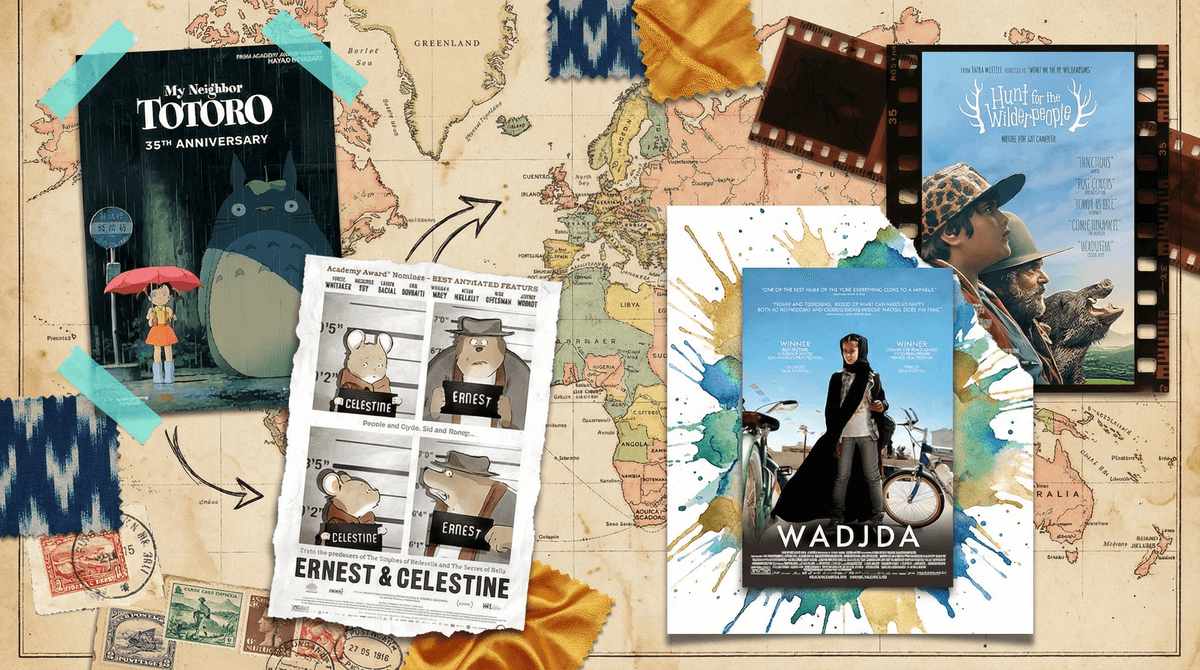
- My Neighbor Totoro (Japan) - The gentlest introduction to Studio Ghibli. Two sisters, a magical forest creature, zero conflict. It's vibes-based storytelling and it's perfect.
- Ernest & Celestine (France) - A mouse and a bear become unlikely friends. Gorgeous watercolor animation, sweet without being saccharine.
- The Gruffalo (UK) - Technically British, but it counts. Based on the beloved book, it's a perfect 27 minutes.
Ages 8-11: Branch out into live action
- Minari (USA/Korea) - Yes, it's American, but it's a Korean-American story told primarily in Korean. A family trying to make it on an Arkansas farm. It's beautiful and honest about struggle without being traumatizing.
- Wadjda (Saudi Arabia) - A girl who wants a bicycle in a place where girls don't ride bikes. It's about determination and challenging norms, and it's genuinely fun.
- Kiki's Delivery Service (Japan) - A young witch starting her own delivery service. It's about independence, failure, and finding your way. Also, the bread in this movie looks incredible.
Ages 12+: Get into the good stuff
- The Boy and the Heron (Japan) - Miyazaki's latest. Darker and more complex than his earlier work, but stunning. Grief, war, and magical realism.
- Persepolis (France/Iran) - An animated memoir about growing up during the Iranian Revolution. It's frank about politics and adolescence. Best for mature tweens and teens.
- Hunt for the Wilderpeople (New Zealand) - A foster kid and his grumpy foster uncle go on the run in the New Zealand bush. Hilarious and heartfelt.
This is the practical question, right? You're not going to special-order DVDs from France.
Streaming services you probably already have:
- Max has a solid Studio Ghibli collection
- Netflix has international kids' content, though you have to dig for it (search by country or browse the "International" category)
- Kanopy is free with many library cards and has an excellent international kids' section
- Hoopla (also free with library cards) has a surprising selection
Specialized platforms:
- MUBI ($12.99/month) curates international cinema, including family films
- Criterion Channel ($10.99/month) has a "Family Viewing" section with global selections
Pro tip: Change your Netflix profile to "Kids" mode and browse by country. You'll find things that never show up in the main algorithm.
Start with movie night momentum. Don't announce "Tonight we're watching a French film to broaden your horizons!" Just queue up Ernest & Celestine and press play. If they ask about it being in French, just say "Yeah, it's really good though."
Connect it to something they already like. If your kid is obsessed with Avatar: The Last Airbender, tell them Studio Ghibli films inspired it. If they love Minecraft, try Ponyo for its world-building.
Make it a thing, but not a lesson. Maybe Friday nights are "around the world" movie nights. Keep it fun. Make themed snacks if you're feeling ambitious (or just eat popcorn, no judgment).
Let them pick sometimes. Show them three options with cool cover art and let them choose. Buy-in matters.
International films aren't vegetables you're forcing your kids to eat. They're genuinely good stories that happen to come from different places. In a digital world where algorithms keep showing us more of the same, actively choosing to watch something from a different culture is one of the simplest ways to push back against that narrowing.
Your kids don't need to become world cinema experts. But watching a few films a year where the characters don't look like them, don't live like them, and don't speak like them? That's a pretty low-effort way to make the world feel a little bigger and a little more connected.
Plus, Studio Ghibli films are just objectively better than most of what's on Disney+ right now. I said what I said.
This week: Pick one film from the age-appropriate list above and queue it up for this weekend.
This month: Browse your library's Kanopy or Hoopla selection and save three international kids' films to your watchlist.
This year: Try to watch at least one film from a different country each month. By December, your kids will have experienced stories from twelve different places. Not bad for just watching movies you were going to watch anyway.
Want more specific recommendations based on what your kids already love? Find international films similar to your family's favorites .
.