

TL;DR
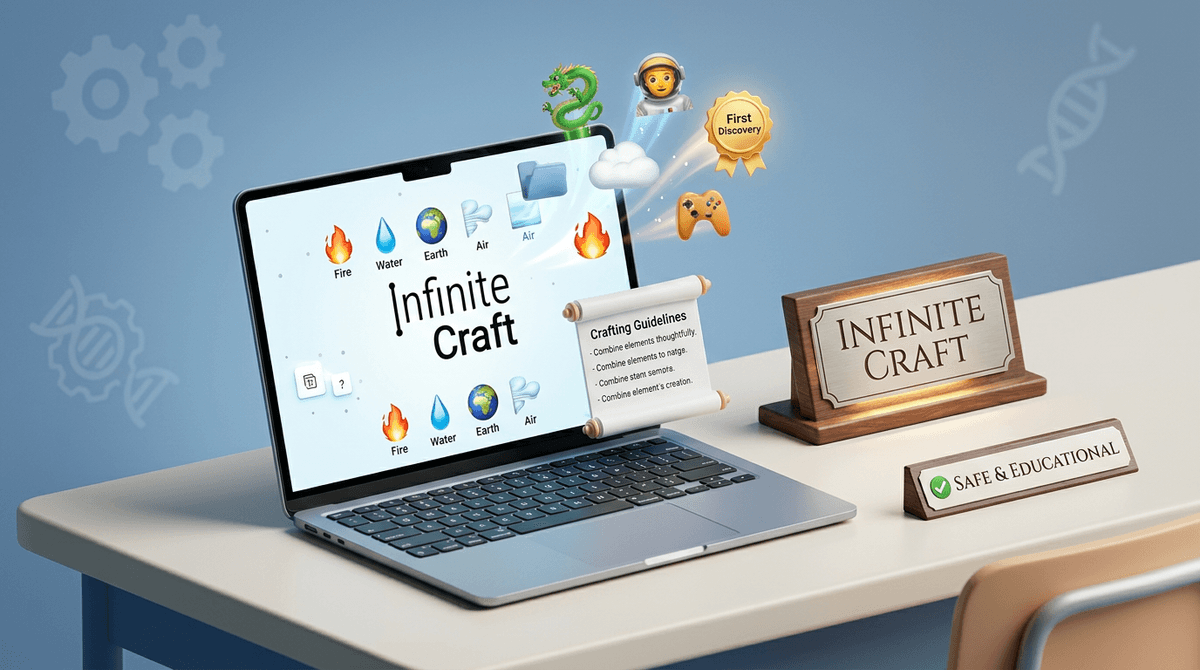
Infinite Craft is a viral, browser-based "alchemy" game where players combine basic elements (Water, Fire, Earth, Wind) to create... literally anything. From "Darth Vader" to "Global Warming" to "Skibidi Toilet," the game uses generative AI to determine what happens when two items merge. It’s free, has no chat features, and no microtransactions. The main "risk" isn't safety—it’s the fact that it is an absolute productivity killer in school computer labs.
Quick Links:
- The Game: Infinite Craft
- The Creator's Site: Neal.fun
- The Original Inspiration: Little Alchemy 2
- Similar Logic Fun: The Password Game
If you’ve walked past your kid’s Chromebook lately and seen a screen cluttered with little floating icons like "Unicorn," "Tsunami," and "Elon Musk," you’ve seen Infinite Craft.
Created by developer Neal Agarwal (who is basically the king of "weirdly addictive internet toys"), the game starts you with the four basics: Earth, Wind, Fire, and Water. You drag them on top of each other to make new things. Water + Fire = Steam. Earth + Steam = Mud. Simple enough, right?
But here’s the twist: unlike older games like Little Alchemy, which had a pre-set list of a few hundred combinations, Infinite Craft uses a Large Language Model (LLM)—specifically Llama 2—to generate results on the fly. This means the game doesn't just have a thousand items; it has infinite items. If you can think of a concept, celebrity, meme, or historical event, it probably exists in the game, or you can be the first person on Earth to "craft" it.
The game has become a massive hit in middle and high schools for a few specific reasons:
- The "First Discovery" High: When a player combines two obscure items and creates something that has never been made by anyone else in the history of the game, they get a "First Discovery" badge. In a world where kids are constantly chasing digital "clout," being the literal founder of "Zombie SpongeBob SquarePants" is a major flex.
- The Absurdity: Because it’s powered by AI, the logic is often hilarious or completely unhinged. Combining "God" and "Internet" might give you "Google." Combining "Batman" and "Ice" might give you "Mr. Freeze." It speaks the language of Gen Z and Gen Alpha humor—random, self-referential, and slightly chaotic.
- It’s Unblockable (Mostly): Since it’s a simple website rather than a downloadable app like Roblox or Fortnite, it often slips past school web filters. It looks "educational" enough from a distance—just icons and text—which makes it the ultimate "stealth" game to play while a teacher is lecturing about the Civil War.
- Zero Barrier to Entry: You don't need an account. You don't need to pay. You don't even need a fast computer. It runs on the crustiest school-issued Chromebook with ease.
Learn more about why browser games are making a comeback in schools
We hear the term "brain rot" a lot lately, usually associated with endless scrolling on TikTok or watching Skibidi Toilet videos.
Infinite Craft actually sits in a bit of a gray area. On one hand, it’s a logic puzzle. It requires lateral thinking and a decent grasp of vocabulary and cultural concepts. If a kid wants to make "President," they have to figure out the components (maybe "Human" + "White House"). It’s a giant game of word association.
On the other hand, it is designed to be a "dopamine loop." The urge to find just one more item can keep a kid clicking for hours. It’s not "educational" in the way that Khan Academy is, but it’s certainly more intellectually stimulating than watching a loop of someone unboxing toys.
It’s worth noting that Infinite Craft is just one part of the Neal.fun universe. Neal Agarwal has created several viral hits that your kids are likely playing:
- The Password Game: A hilariously frustrating game where you have to create a password that meets increasingly impossible rules (like including the current phase of the moon).
- Spend Bill Gates' Money: A simple simulator that lets kids see how hard it is to actually spend $100 billion.
- Wonders of Street View: A curated collection of the weirdest things found on Google Maps.
These sites are generally safe, creative, and reflect a "pure" version of the internet—one that isn't trying to sell you something or harvest your data.
Recommended Ages: 8+
While there is nothing inherently "adult" about the game's mechanics, the use of AI means there’s a tiny bit of unpredictability.
Safety Considerations:
- Content Filtering: The AI has "guardrails." If you try to combine things to make something explicitly pornographic or highly offensive, the game will usually just refuse to create the item or give you a "Boring" or "Nothing" result.
- No Social Interaction: There is no chat room. There are no "friends" to add. Your kid is playing against the AI, not a stranger in another country. This eliminates the #1 safety concern parents usually have with games like Roblox.
- Data Privacy: The game doesn't require a login. It saves your progress via "cookies" in your browser. This is great for privacy, but it means if your kid clears their browser history, they lose all their "First Discoveries." (Expect a meltdown if this happens).
The biggest "red flag" with Infinite Craft is time management.
Because the game is infinite, there is no "natural stopping point." In Minecraft, you might finish a house. In a round of Among Us, the game ends. In Infinite Craft, you can always find one more combination.
If your kid is struggling to get off the screen, it’s not because they’re talking to strangers or "leveling up" a character—it’s because they’re stuck in a creative rabbit hole.
How to Talk About It
Instead of "Put that game away," try asking:
- "What’s the weirdest thing you’ve crafted today?"
- "Have you gotten any First Discoveries lately?"
- "How do you think the computer knows that 'Fire' plus 'Ice' makes 'Water'?" (This is a great segue into talking about how AI works).
If your kid loves the logic and discovery of Infinite Craft, they might also enjoy these:
The "ancestor" of Infinite Craft. It’s more curated and polished. There’s a finite number of items (around 700), which makes it feel more like a puzzle you can actually "beat."
An AI experiment by Google where you draw an object and the AI tries to guess what it is. It’s fast, fun, and teaches kids about machine learning.
If they enjoy the "if I do this, then that happens" logic of crafting, they might be ready to start building their own games. Scratch is the gold standard for teaching kids the "crafting" logic of coding.
If you want to pivot that "browser game" energy into something actually productive for school, Zearn uses similar interactive elements to teach math.
Infinite Craft is a rare bird in the 2025 digital landscape: it’s a viral hit that isn't trying to steal your kid's lunch money or show them inappropriate ads. It’s a clever use of AI that rewards curiosity and creativity.
As long as it’s not getting in the way of their actual science homework (you know, the kind with real beakers and dirt), it’s one of the most harmless "obsessions" a kid can have. Just be prepared for them to tell you they "invented" the concept of "Taco Bell" on their computer today.
Next Steps:
- Sit down for 5 minutes and try to craft yourself. (Warning: You will get addicted).
- Check your kid's browser history if you're worried about how much time they're spending on Neal.fun.
- Ask our chatbot for more browser-based educational games