

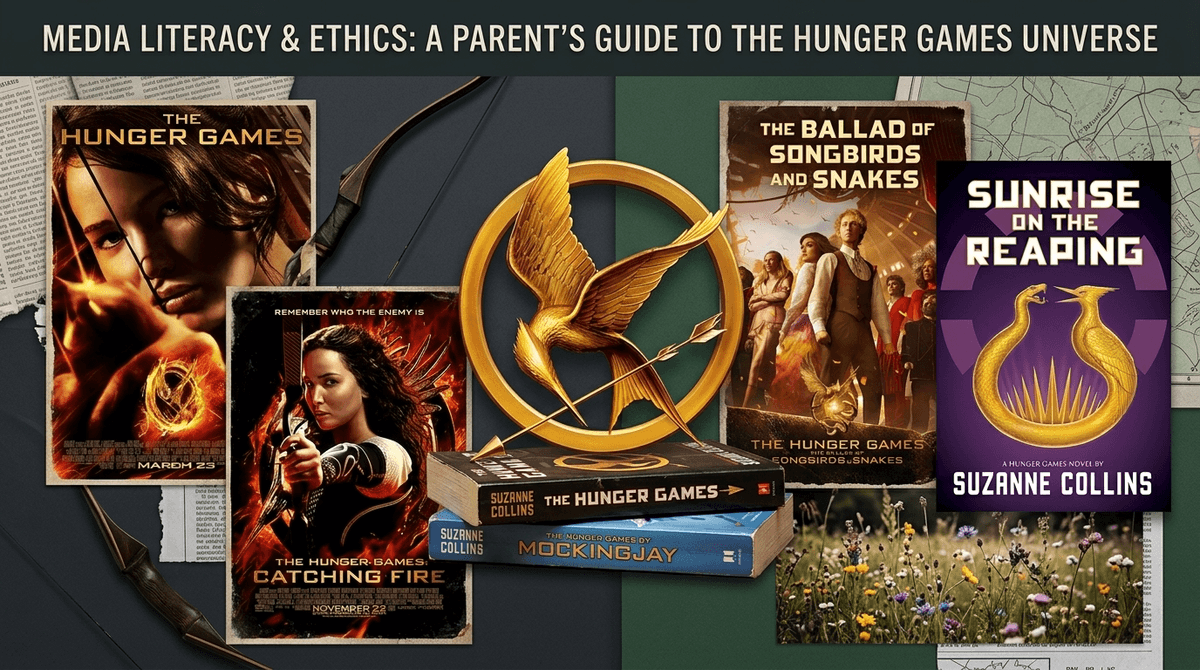
TL;DR: The Hunger Games franchise is the gold standard of "worth it" YA media. It’s violent, yes, but it’s the opposite of brain rot—it’s a masterclass in media literacy, political ethics, and standing up to systems. Most kids dive in around age 11 or 12. If your kid is ready for the heavy stuff, start with The Hunger Games (book) before the movies. With the new prequel Sunrise on the Reaping hitting shelves in 2026, the Panem obsession is about to peak again.
If you missed the 2012 cultural reset, here’s the gist: Panem is a North American dystopia divided into 12 poor districts and one glittering, gaudy Capitol. As punishment for a past rebellion, the Capitol forces two "tributes" from each district (aged 12-18) to fight to the death on live TV.
The story follows Katniss Everdeen, who volunteers to save her sister. It’s not just a "battle royale" story; it’s a scathing critique of reality TV culture, war propaganda, and class warfare. Unlike some of the "Ohio" memes your kids might be watching on YouTube, this franchise actually has something to say.
See a comparison between The Hunger Games and Divergent
It’s easy to look at the "kids killing kids" premise and wonder why this is a middle-school staple. About 45% of 7th graders have read at least one of the books, and by 9th grade, that number jumps closer to 70%.
The appeal isn't the gore; it's the agency. Katniss is a character who feels the weight of a world she didn't build, which is exactly how most 13-year-olds feel. There’s also the "shipping" element (Team Peeta vs. Team Gale), though the series eventually deconstructs that trope by showing how trauma makes "romance" a lot more complicated than a Twilight-style love triangle.
The first film is surprisingly gritty. The "shaky cam" style was a choice to hide some of the more visceral violence, but it also makes the experience more intense. It’s the most "game-focused" of the movies.
Widely considered the best of the franchise. It raises the stakes, introduces more complex characters, and transitions the story from survival to full-blown revolution. If your kid liked the first one, this is where they’ll get hooked.
Let’s be honest: splitting the last book into two movies was a cash grab by the studio. Part 1 is a lot of talking and propaganda filming (great for media literacy discussions, boring for action-seekers). Part 2 is very dark, heavy on PTSD, and features some genuinely terrifying "mutts" (monsters) in a sewer sequence that might give younger kids nightmares.
This is a prequel set 64 years before Katniss. It follows a young Coriolanus Snow (the villain of the original series). It’s a fascinating character study on how a "normal" person becomes a monster. It’s also more cynical and arguably more violent than the original trilogy.
Coming in March 2025, this book covers the 50th Hunger Games (the "Second Quarter Quell"). It’s the backstory of Haymitch Abernathy. Since this game featured twice as many tributes (48 kids), expect it to be particularly brutal.
Ages 10-11 (The "Maybe" Zone)
Some advanced readers dive in here. If they’re sensitive to violence or "bad endings," wait. The books are often more manageable than the movies because the reader's imagination self-censors the gore. If they do watch the movies, stay close.
Ages 12-14 (The Sweet Spot)
This is when most kids encounter the series. They’re old enough to understand the political subtext and the concept of "the greater good." This is a great age to talk about how the media can manipulate the truth.
Ages 15+ (Deep Dive)
High schoolers will appreciate the darker themes of The Ballad of Songbirds and Snakes. At this age, you can really get into the "Just War" theory and the ethics of rebellion.
While the physical violence is the obvious concern, there are a few other things to keep on your radar:
- Trauma and PTSD: The series doesn't "reset" after the violence. Characters deal with heavy depression, night terrors, and substance abuse (specifically Haymitch).
- Emotional Weight: The "good guys" don't always win, and many fan-favorite characters die suddenly and unceremoniously. It can be a heavy lift for a kid going through a tough time.
- Media Manipulation: The Capitol's use of "Propos" (propaganda videos) is a direct mirror to how social media algorithms and political ads work today. It’s a "safety" concern in the sense that it can be cynical, but it's also a great teaching tool.
Learn more about teaching media literacy to middle schoolers
If your kid is currently obsessed with Panem, use it as a bridge to some real-world conversations. You don't have to be a history professor; just ask a few "what would you do" questions.
- The Reality TV Parallel: "Why do the people in the Capitol treat the Hunger Games like a fashion show or a sporting event? Does that remind you of anything we see on social media today?"
- The Ethics of Snow: "In The Ballad of Songbirds and Snakes, Snow thinks people are naturally chaotic and need a tyrant to keep them in line. Do you think he’s right, or is he just making excuses for his own power?"
- The Cost of Victory: "Katniss 'wins,' but she’s clearly changed. Was it worth it?"
The Hunger Games is one of those rare franchises that actually respects its audience’s intelligence. It’s not "safe" in the way Bluey is safe, but it’s "safe" for development because it encourages critical thinking.
If your kid is asking to read the books or watch the movies, it’s a "Yes, but let’s talk about it" from us. It’s a far better use of their screen time than an endless scroll of Roblox "obby" videos or mindless YouTube shorts.
- Start with the books: The Hunger Games book is much more internal and philosophical than the movies.
- Watch together: If you have a middle schooler, make the first movie a family movie night. It's a great litmus test for their maturity level.
- Prep for the new release: If they're already fans, put Sunrise on the Reaping on their 2025 wishlist.