

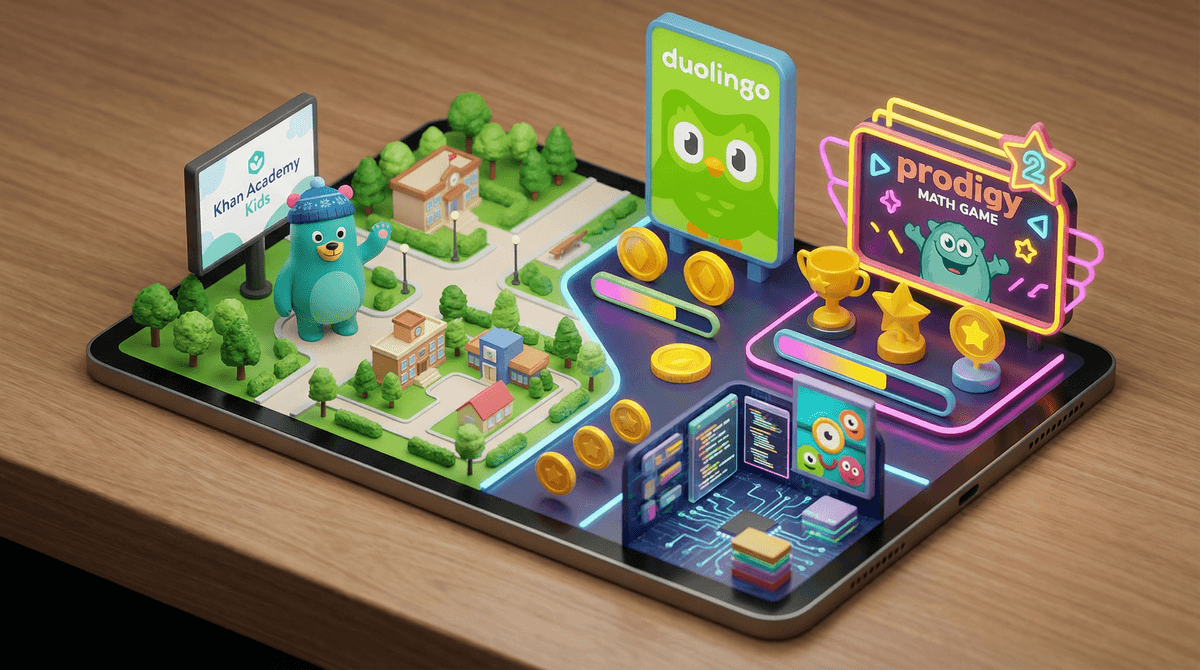
Let's be honest: slapping an "educational" label on an app is the easiest marketing trick in the book. Throw in some math problems between candy-crushing levels, add a cartoon owl that guilt-trips you about streak maintenance, or include a "parents dashboard" that shows meaningless progress bars, and boom — you've got yourself an "educational app."
But here's the thing: not all learning apps actually teach anything, and not all apps that teach are worth the time they take. Some are legitimately brilliant. Others are just glorified worksheets with sound effects. And some are basically slot machines that happen to flash vocabulary words while your kid clicks for dopamine hits.
So how do you tell the difference? How do you know if that app your kid swears is "helping with math" is actually teaching them anything, or just making them feel productive while they're really just... playing?
The stakes here aren't small. Time is finite. A kid spending 30 minutes on a genuinely good learning app is 30 minutes they're not spending on creative play, reading an actual book, being bored enough to invent something, or — revolutionary concept — learning something the hard way by trying and failing at it in the real world.
Plus, the "educational" label gives us permission to be less intentional. If it's learning, we don't have to feel as guilty about the screen time, right? We can let it run longer. We don't monitor it as closely. We tell ourselves it's fine.
Except when it's not fine. When the app is designed to maximize engagement (read: addiction) first and learning second. When it's teaching kids that learning should always be gamified, instantly rewarding, and entertaining. When it's replacing the harder, slower, deeper learning that actually sticks.
Here's your BS detector toolkit. Run any "educational" app through these questions:
1. Could they explain what they learned?
This is the simplest test. After 20 minutes on the app, pause it. Ask your kid: "What did you learn?" or "Can you teach me how to do that?"
If they can articulate something specific ("I learned that fractions are just parts of a whole, like if you cut a pizza into 8 slices, each slice is 1/8"), that's promising. If they say "I got to level 47" or "I earned 300 gems," that's a red flag. They learned how to play the game, not the concept the game was supposedly teaching.
2. Is the learning the point, or is it the price of admission?
Good educational apps make learning the actual mechanic of the game. The fun IS the learning. Duolingo (despite its chaos owl energy) does this reasonably well — you're actually practicing language to progress.
Bad educational apps make learning the obstacle between your kid and the fun part. Answer three math problems to unlock 2 minutes of racing. Spell five words to get a new outfit for your avatar. That's not learning. That's just adding friction to entertainment and calling it education.
3. Does it adapt, or just repeat?
Quality learning apps use adaptive technology. If your kid nails multiplication, it moves them forward. If they're struggling with fractions, it adjusts the difficulty, changes the approach, or provides scaffolding. Khan Academy Kids does this well.
Low-quality apps just... keep going. Same difficulty. Same approach. Your kid either gets it or doesn't, and the app doesn't care. It just keeps serving up problems like a worksheet machine.
4. Are they learning the skill or learning the pattern?
This one's sneaky. Kids are excellent at pattern recognition. They'll figure out that the answer is always the biggest number, or that clicking the third option usually works, or that if they just tap randomly they'll eventually get it right and move on.
Watch them use the app. Are they actually reading and thinking? Or are they just gaming the system? If it's the latter, they're learning "how to beat this app," not the actual content.
5. Could this be done better another way?
Real talk: some things just don't need an app.
Learning to read? Actual books are better. Yes, even for reluctant readers — there are SO many good graphic novels and high-interest books that meet kids where they are.
Learning math facts? Sometimes old-school flashcards or even just cooking together (measuring, doubling recipes, dividing portions) teaches it better.
Learning to code? Maybe. Some apps like Scratch are genuinely great. But also, your kid could just... try to make something and google their way through it. That's how most actual programmers learned.
The question isn't "is this educational?" It's "is this the best way for my kid to learn this thing right now?"
6. What's the business model?
Follow the money. How does this app make money?
- Subscription with no ads? Usually good. The product is the education.
- Free with ads? Questionable. Your kid's attention is the product.
- Free with in-app purchases? Red flag. The app is designed to create desire and frustration, then sell the solution.
- Freemium with aggressive upselling? Hard pass. They're teaching your kid to want things and nag you for them, not actual content.
ABCmouse has been criticized for making it nearly impossible to cancel subscriptions. That tells you something about their priorities.
7. Is it building skills or just testing them?
Some apps are actually teaching — breaking down concepts, showing multiple approaches, building understanding step by step. Others are just quizzing your kid on things they're supposed to already know.
Testing has value, but it's not the same as learning. If the app is just a digital worksheet, it's probably not teaching much.
Watch out for:
- Endless rewards and achievements that have nothing to do with mastery. If your kid is more excited about their avatar's new hat than what they learned, that's a problem.
- Time pressure on every activity. Real learning often requires time to think. Apps that rush kids through are prioritizing engagement over understanding.
- No wrong answers or consequences that are so minimal they're meaningless. Learning requires feedback. If everything gets a "great job!" the app isn't teaching discernment.
- Busy, chaotic interfaces with flashing lights, constant sounds, and notifications. That's designed to hook attention, not facilitate learning.
Good educational apps usually:
- Have clear learning objectives that you can see and understand
- Show real progress in specific skills, not just points and levels
- Encourage experimentation and let kids try different approaches
- Connect to real-world applications — "here's how this math concept works when you're building something"
- Require actual thought, not just fast clicking
- Were designed by educators, not just game designers trying to crack the "education market"
Toca Boca apps aren't marketed as educational, but they're often better for learning than apps that are — they encourage open-ended creative play, experimentation, and narrative building.
Ages 3-5: At this age, the best "educational" apps are really just interactive play. Sago Mini apps, Endless Alphabet, or PBS Kids games that are simple, clear, and don't have a million bells and whistles. But honestly? At this age, real play is almost always better than app play.
Ages 6-9: This is where apps can be genuinely helpful for building specific skills. Prodigy Math is popular (though watch out for the aggressive in-app purchases). Epic! for reading access. Kodable for coding basics. But keep the sessions short and always check in on what they're actually learning.
Ages 10+: At this point, the best "educational" apps are often just tools for learning, not gamified lessons. Khan Academy (the full version, not just Kids), Duolingo for languages, or even YouTube channels like Crash Course or Kurzgesagt. They're learning how to learn, and sometimes that means less "educational app" and more "here's a tool, figure it out."
Most "educational" apps are somewhere in the middle — not terrible, not amazing. They might teach something, but probably not as much as the marketing suggests, and probably not as efficiently as other methods.
The real question isn't whether an app is educational. It's whether it's the best use of your kid's time and attention right now.
Sometimes the answer is yes. Sometimes an app really does make a concept click, or provides practice in a way that's actually engaging, or gives your kid access to learning they wouldn't get otherwise.
But sometimes — often, actually — the answer is no. The app is fine, but a book would be better. Or a conversation. Or building something. Or being bored for 20 minutes until they invent their own game.
Trust your gut. If it feels more like a game than learning, it probably is. And if your kid can't tell you what they learned after using it, they probably didn't learn much.
Want to dig deeper into specific apps your kid is using? Check out our media reviews where we break down the actual learning value (or lack thereof) of popular apps.
Trying to find genuinely good educational alternatives? We've got guides for math apps that actually teach, reading apps worth your time, and coding apps that aren't just busy work.
And if you're wondering whether your kid's current app lineup is helping or just filling time, Evaluate your kid's educational apps — we can help you figure out what's actually worth keeping.