

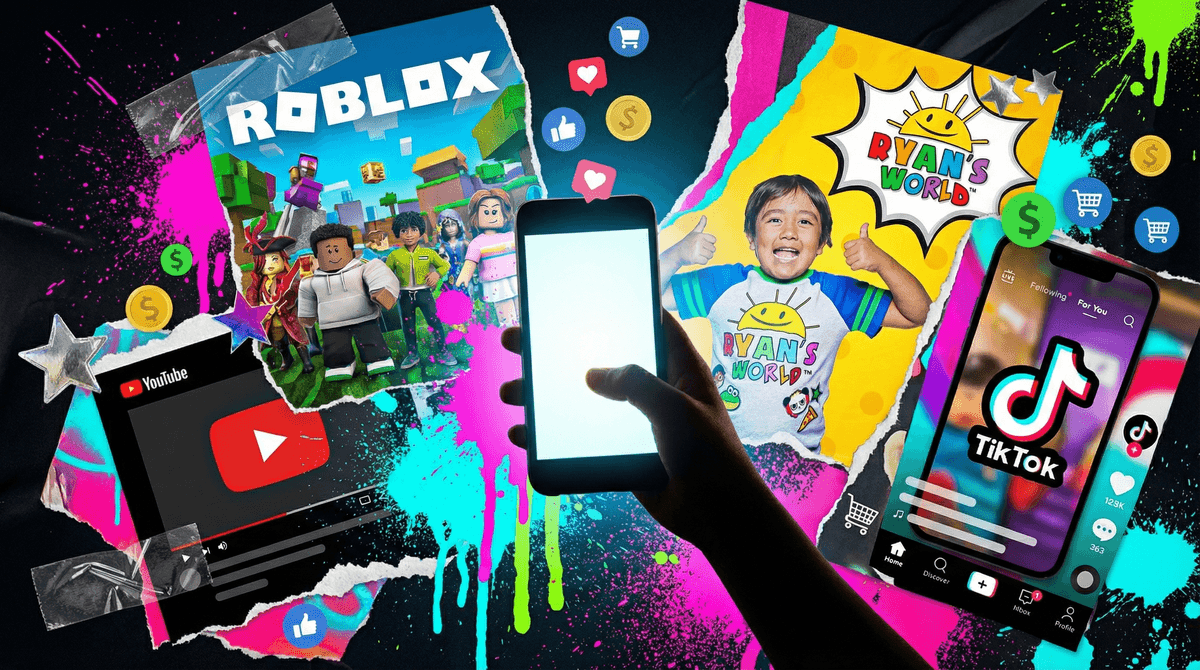
Here's the thing: your kid isn't watching commercials anymore. They're watching someone their age (or who feels like they could be their friend) unbox toys, play games, do challenges, or just talk about their day—and somewhere in there, they're being sold to. Hard.
Influencer marketing is when brands pay content creators to promote products to their audiences. And when it comes to kids, this happens on YouTube, TikTok, Roblox, Instagram, Snapchat, and basically anywhere kids spend time online.
Unlike traditional advertising (which has rules, disclosures, and literal commercial breaks), influencer marketing is designed to feel like not advertising. It's your kid's favorite creator "just showing" their new headphones, "just playing" a sponsored game, or "just mentioning" a snack they love (that they're being paid thousands of dollars to mention).
The psychology is brilliant and kind of terrifying: kids trust influencers more than they trust traditional celebrities or ads. They feel like they know them. So when that creator says something is cool, kids believe it—and want it.
Kids' brains aren't fully equipped to recognize persuasive intent until around age 11 or 12—and even then, it's shaky. Before that age, they genuinely can't tell the difference between a recommendation and an advertisement, especially when it's coming from someone they parasocially consider a friend.
Here's what makes influencer marketing especially effective:
It doesn't look like an ad. There's no "We'll be right back after these messages." It's woven into content kids already want to watch. A Minecraft YouTuber casually using a branded skin. A TikToker doing a dance with a product in frame. A Roblox game that's literally built by a brand.
It leverages FOMO and social proof. When a kid sees their favorite creator using something, and all the comments are talking about it, and their friends at school mention it—suddenly that thing feels essential. Not having it feels like being left out.
It's everywhere. Your kid might see the same product mentioned by three different creators in one afternoon, across multiple platforms, without realizing it's a coordinated campaign.
The disclosure is terrible. Even when influencers are legally required to say #ad or #sponsored, it's often in tiny text, buried in a caption, or said so quickly kids miss it entirely. And younger kids don't know what those terms mean anyway.
YouTube is the OG. Unboxing videos, toy reviews, "a day in my life" vlogs—so much of it is sponsored. Ryan's World (formerly Ryan ToysReview) built a literal empire this way. Even educational-ish content can have embedded sponsorships.
TikTok is the current epicenter. Branded hashtag challenges, product placements in viral trends, "get ready with me" videos featuring specific makeup or clothes. The algorithm amplifies what's popular, so sponsored content gets massive reach fast.
Roblox is where it gets wild. Brands are building entire games as ads. Gucci, Nike, and Chipotle have all created Roblox experiences. Kids don't think "I'm in an ad"—they think "I'm playing a cool new game." Learn more about how brands are using Roblox as an advertising platform .
.
Instagram and Snapchat skew older, but tweens are absolutely on there, seeing influencers promote everything from skincare to supplements to fast fashion.
Unboxing and hauls. "Look at all this stuff I got!" videos are often fully or partially sponsored. Even if the creator bought some items themselves, the expensive or trendy ones are usually provided by brands.
Affiliate links. Creators earn commission when viewers buy through their links. This isn't inherently bad, but it means they have financial incentive to push products—and kids don't understand that dynamic.
"Gifted" products. Brands send free stuff to influencers hoping they'll feature it. Technically not a paid sponsorship, but still a form of marketing. And creators know that if they feature gifted items positively, more free stuff will come.
Challenges and trends. That viral dance or challenge? Often started or amplified by a brand. Remember the "Chipotle Lid Flip Challenge"? Yeah.
Giveaways. "Follow me and tag three friends to win!" These drive engagement, grow audiences, and get kids hyper-focused on a product—all while feeling like a fun game.
First: this isn't your kid's fault, and it's not really about willpower. These are sophisticated, multi-million-dollar campaigns designed by people who study child psychology. Your 9-year-old is not equipped to resist this on their own.
Second: talking about it makes a huge difference. Kids who understand they're being marketed to are better able to think critically about what they're seeing. You don't need to ban everything—you need to build media literacy.
Third: it's not all evil. Some influencers genuinely love products they promote. Some sponsorships are for things that are actually useful or harmless. The issue is the lack of transparency and the volume of marketing kids are exposed to without realizing it.
Watch together sometimes. Sit with your kid while they're on YouTube or TikTok and ask questions: "Why do you think they're showing that product?" "Do you think they got paid to say that?" "How does it make you feel when they say everyone needs this?"
Teach them to spot the signs. Show them what #ad and #sponsored mean. Explain that even if someone doesn't say it's an ad, if they're talking about a product a lot, there's probably a business reason.
Talk about the economics. Older kids (10+) can understand: "This person makes money when people buy stuff they recommend. That doesn't mean they're lying, but it does mean they have a reason to make it sound really good."
Connect it to their real life. "Have you ever wanted something because you saw it in a video, and then when you got it, it wasn't as cool as you thought?" Use those moments to talk about how marketing creates expectations that don't always match reality.
Influencer marketing isn't going anywhere—it's only going to get more sophisticated. The good news? You don't need to eliminate screens or ban YouTube. You need to help your kid develop a healthy skepticism and the skills to ask "Wait, why am I seeing this right now?"
Kids can still enjoy content from creators they love. They can still want things. But they should understand why they want them, and recognize when they're being sold to—even when it doesn't look like selling.
Next step: Next time your kid mentions something they saw online and wants, instead of just saying yes or no, try: "That does look cool—where did you see it? Do you think that person was paid to show it?" You might be surprised by what they notice once you point it out.
And if you want to dig deeper into how specific platforms work, check out our guides on YouTube parental controls and understanding Roblox's economy—because understanding the ecosystem is half the battle.