

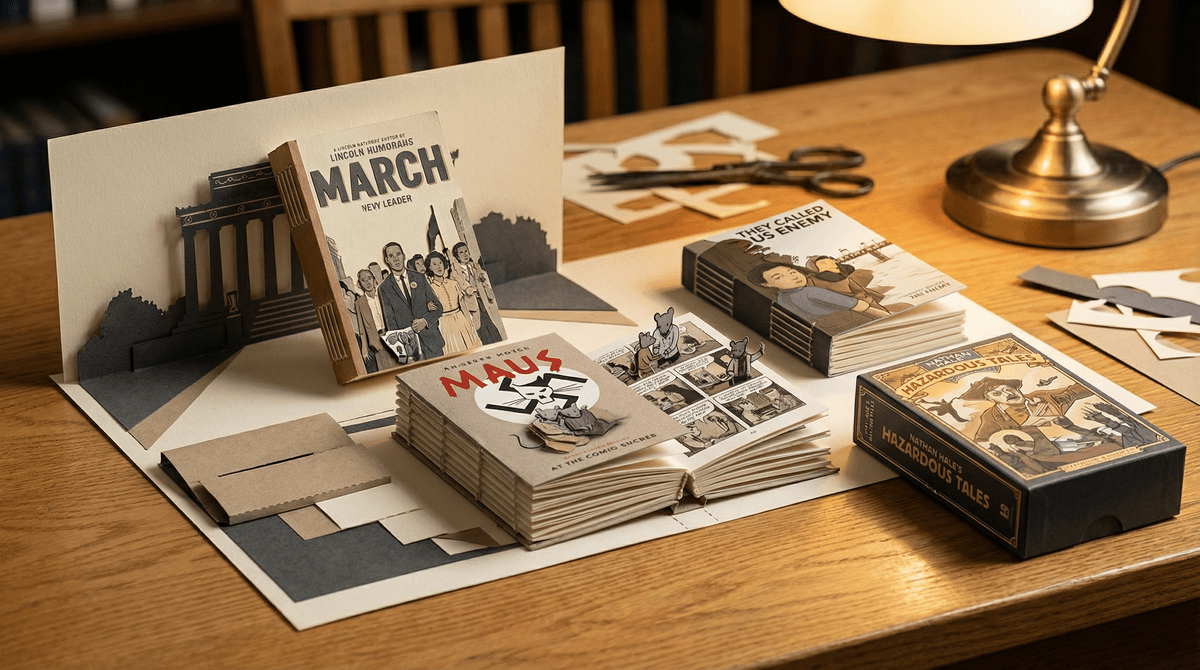
Historical graphic novels are exactly what they sound like — books that tell stories about real historical events, periods, or figures through a combination of illustrations and text. Think less "Captain America punches Hitler" and more "here's what life was actually like for a Jewish family hiding during the Holocaust" (Maus) or "this is how John Lewis experienced the Civil Rights Movement" (March trilogy).
These aren't your standard textbook summaries with some clip art thrown in. We're talking about sophisticated visual narratives that use the comics medium to make history accessible, emotional, and genuinely engaging. And before anyone gets weird about it — yes, graphic novels are "real reading." The visual literacy skills kids develop while reading them are actually pretty crucial for navigating our image-saturated world.
Here's the thing about history textbooks: they're often written like someone is trying to cram 500 years of events into 300 pages while also making sure no school board gets mad. The result? Dry, dense, and about as engaging as watching paint dry in a beige room.
Graphic novels about history do something different. They humanize the past in ways that straight text often can't. When a kid sees the facial expressions of people experiencing the Dust Bowl, or follows a visual sequence of someone escaping slavery via the Underground Railroad, it creates an emotional connection that "In 1863, the Emancipation Proclamation..." just doesn't.
The visual element also helps with comprehension and retention. Kids who struggle with dense text can follow the story through images. Kids who are strong readers get to practice synthesizing information from multiple sources simultaneously (words + pictures + layout + pacing). It's actually a more complex reading experience than straight prose.
Plus, let's be honest — history is often about things that are hard to talk about. Genocide, slavery, war, oppression. The graphic novel format can make these topics more approachable for young readers while still treating them with appropriate weight and seriousness.
Ages 8-12: Gateway Historical Graphic Novels
Start with books that tackle serious topics but with age-appropriate framing:
- Nathan Hale's Hazardous Tales series — Yes, there's humor mixed with the history. Yes, it works. Covers everything from the Alamo to World War I.
- I Survived graphic novel adaptations — If your kid already loved the novels, these visual versions hit different
- Yummy: The Last Days of a Southside Shorty — About an 11-year-old gang member in 1990s Chicago. Heavy but important.
Ages 12-15: Deeper Dives
This is when kids can handle more complexity and moral ambiguity:
- March trilogy by John Lewis — Absolutely essential reading about the Civil Rights Movement from someone who lived it
- Persepolis by Marjane Satrapi — Growing up during the Iranian Revolution. Funny, heartbreaking, eye-opening.
- Boxers & Saints by Gene Luen Yang — The Boxer Rebellion from two perspectives. Teaches that history isn't about good guys and bad guys.
Ages 15+: No Holds Barred
High schoolers can handle the full weight of historical trauma:
- Maus by Art Spiegelman — The Holocaust graphic novel. Won a Pulitzer. Will wreck you emotionally.
- They Called Us Enemy by George Takei — Japanese American internment camps through the eyes of a Star Trek legend
- The Best We Could Do by Thi Bui — Vietnamese refugee experience and generational trauma
These books don't sugarcoat history. That's actually the point. If your kid is reading about slavery, they're going to encounter violence and dehumanization. If they're reading about the Holocaust, they're going to see atrocities. The difference is these books present difficult history in a way that's emotionally processed and age-appropriate, not gratuitous.
Check the content first. Just because something is drawn doesn't mean it's for kids. Maus is taught in high schools for a reason. Read the book first or check reviews on Screenwise to understand what you're handing your kid.
Use them as conversation starters. The best thing about historical graphic novels is they make kids want to talk about what they're reading. "Did this really happen?" "Why would people do that?" These are the questions you want them asking.
They're not replacements for other history learning. Think of graphic novels as a complement to, not a substitute for, other ways of learning history. They're an entry point, a different perspective, a way to make the past feel real.
One massive advantage of the current boom in historical graphic novels: we're finally getting history told by people who actually lived it or whose communities experienced it. March is John Lewis's story. They Called Us Enemy is George Takei's story. Persepolis is Marjane Satrapi's story.
This matters. A lot. Kids aren't just learning about history — they're learning that different people experience and remember history differently. That there isn't one single "objective" historical narrative. That's a pretty sophisticated concept, and graphic novels make it accessible.
Historical graphic novels are one of those rare things that are both genuinely educational and actually engaging. They're not a trick to make kids read. They're a legitimate art form that happens to be really good at making history feel human and relevant.
If your kid is a reluctant reader, start here. If they're a voracious reader, add these to the mix. If they think history is boring, hand them Nathan Hale's Hazardous Tales and watch their mind change.
The goal isn't to make history "fun" in some superficial way. It's to make it real. And that's exactly what these books do.
Start with one book. Don't go buy a whole stack. Pick one that matches your kid's age and interests, read it together or let them read it solo, and see how it goes.
Visit your library. Graphic novels are expensive, and libraries have gotten way better about stocking them. Most library apps let you browse the graphic novel section and place holds.
Talk about what they're reading. Ask open-ended questions. "What surprised you?" "Does this change how you think about [historical event]?" "Why do you think the author chose to tell it this way?"
Want more specific recommendations based on what your kid is into? Check out our guide to finding the right graphic novels for your reader or explore alternatives to traditional history textbooks.