

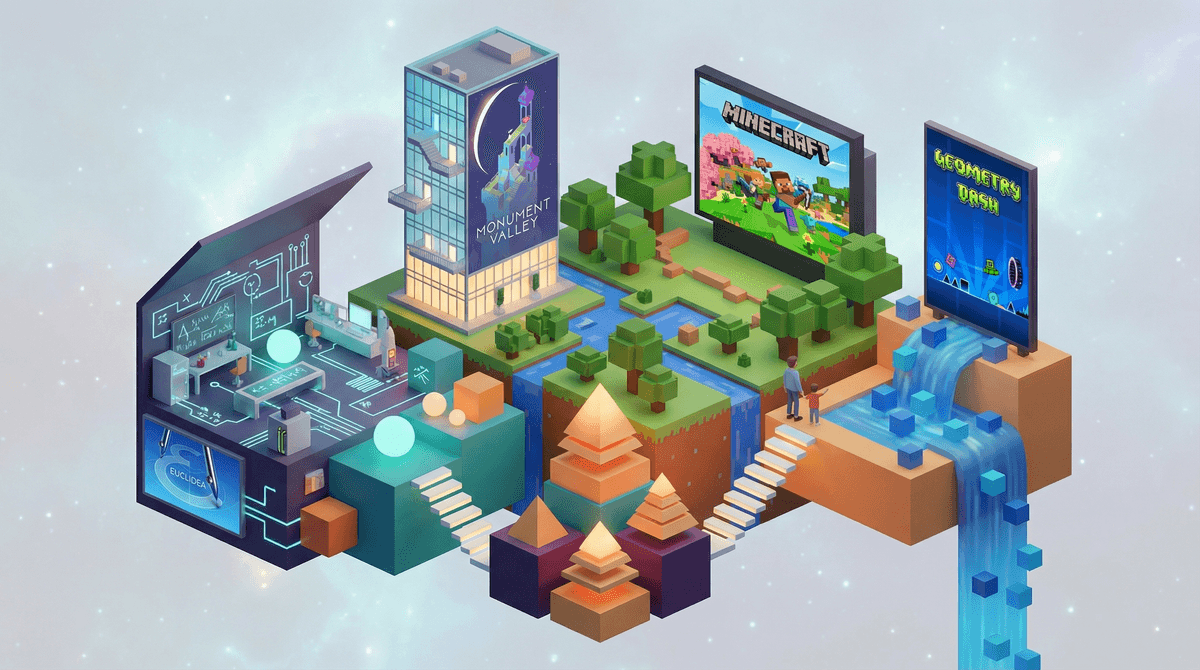
Geometry games are digital (and sometimes physical) games that teach spatial reasoning, shape recognition, pattern identification, and mathematical thinking through interactive play. We're talking everything from puzzle apps like Geometry Dash to building games like Minecraft that sneakily teach angles and spatial relationships while kids think they're just having fun.
The best geometry games don't feel like math homework. They're the ones where your kid is so absorbed in rotating shapes to fit through a portal or building a structurally sound bridge that they don't realize they're learning about vertices, symmetry, and spatial transformation.
These games range from simple shape-matching apps for preschoolers to complex spatial puzzles that honestly make most adults' brains hurt. And here's the thing: geometry games might be one of the most defensible types of screen time because spatial reasoning is genuinely predictive of STEM success later in life.
Geometry games hit that sweet spot of challenge and reward that makes brains light up. When your kid successfully rotates a shape to fit through a gap or figures out how to build a stable structure, they get an immediate dopamine hit that reinforces the learning.
The appeal breaks down like this:
- Immediate feedback: Unlike a worksheet where they have to wait for you to check it, digital geometry games show results instantly
- Low-stakes failure: Kids can try again immediately without the anxiety of a "wrong answer" being permanent
- Progressive difficulty: Good geometry games adapt, keeping kids in that "just challenging enough" zone
- Visual satisfaction: There's something deeply pleasing about shapes fitting together perfectly or patterns completing
And unlike some educational games that feel like vegetables disguised as dessert (looking at you, most "educational" apps from 2015), modern geometry games are actually engaging. Kids ages 6-10 especially seem to gravitate toward these because they're at that developmental stage where spatial reasoning is rapidly developing.
Ages 4-6: Shape Foundations
At this age, we're talking basic shape recognition and simple spatial relationships. Apps like Endless Shapes & Colors or Montessori Preschool work well because they're designed around touch and drag mechanics that little hands can manage.
Tangram puzzles (both digital and physical) are fantastic at this age. Kids learn that shapes can be combined to make other shapes, which is foundational geometric thinking.
Ages 7-10: Pattern Recognition and Problem-Solving
This is where it gets interesting. Games like Monument Valley are absolutely gorgeous and teach perspective, impossible geometry, and spatial reasoning without feeling like "learning." It's genuinely one of those games where parents will want to play too.
Geometry Dash is wildly popular with this age group (and older), though fair warning: it's rhythm-based and can be frustrating. But it teaches timing, pattern recognition, and persistence. The free version has ads, so consider the paid version if your kid gets hooked.
Building games deserve a mention here: Minecraft in creative mode is essentially a geometry playground. Kids learn about area, volume, symmetry, and structural stability while building elaborate structures. Learn more about Minecraft's educational benefits.
Ages 11+: Complex Spatial Reasoning
Older kids can handle games like Portal 2, which is essentially a physics and geometry puzzle game disguised as a sci-fi adventure. It teaches three-dimensional thinking, momentum, and spatial planning at a sophisticated level.
Euclidea is for the kid who actually likes geometry class and wants more. It's essentially geometric construction challenges using compass and straightedge rules. Niche, but brilliant for the right kid.
Screen time quality matters more than quantity here. Twenty minutes of focused puzzle-solving in a geometry game is cognitively very different from twenty minutes of passive YouTube watching. That said, even good games can become mindless if kids are just replaying easy levels on autopilot.
Watch for frustration tolerance. Some geometry games (looking at you, Geometry Dash) can be genuinely difficult. If your kid is getting angry rather than engaged, it might not be the right fit or the right time. Games should challenge, not enrage.
The "educational" label doesn't mean much. Some apps marketed as educational geometry games are basically digital flashcards with cartoon characters. The best learning happens when kids are problem-solving, not just tapping the right answer for a reward animation.
Consider mixing digital and physical. Pattern blocks, tangrams, and building toys like Magna-Tiles teach the same concepts with tactile feedback that screens can't provide. The combination is probably ideal.
Geometry games are one of those rare categories where educational value and genuine engagement actually overlap. Kids are building real mathematical thinking skills while having fun, and you don't have to feel guilty about the screen time.
The key is choosing games that require actual problem-solving rather than just memorization or button-mashing. Look for games where your kid has to think, plan, and experiment—not just follow instructions or tap in the right sequence.
Next Steps:
- Try one game from your kid's age range and play it together first
- Set a "geometry game" category in your screen time rules if you want to treat it differently than entertainment apps
- Explore more educational games that don't feel like homework
- Consider pairing digital geometry games with physical building toys for a fuller learning experience
And remember: if your kid is genuinely engaged and thinking hard, that's purposeful screen time. Not every minute needs to be "educational," but when it can be both fun and building real skills? That's a win.