

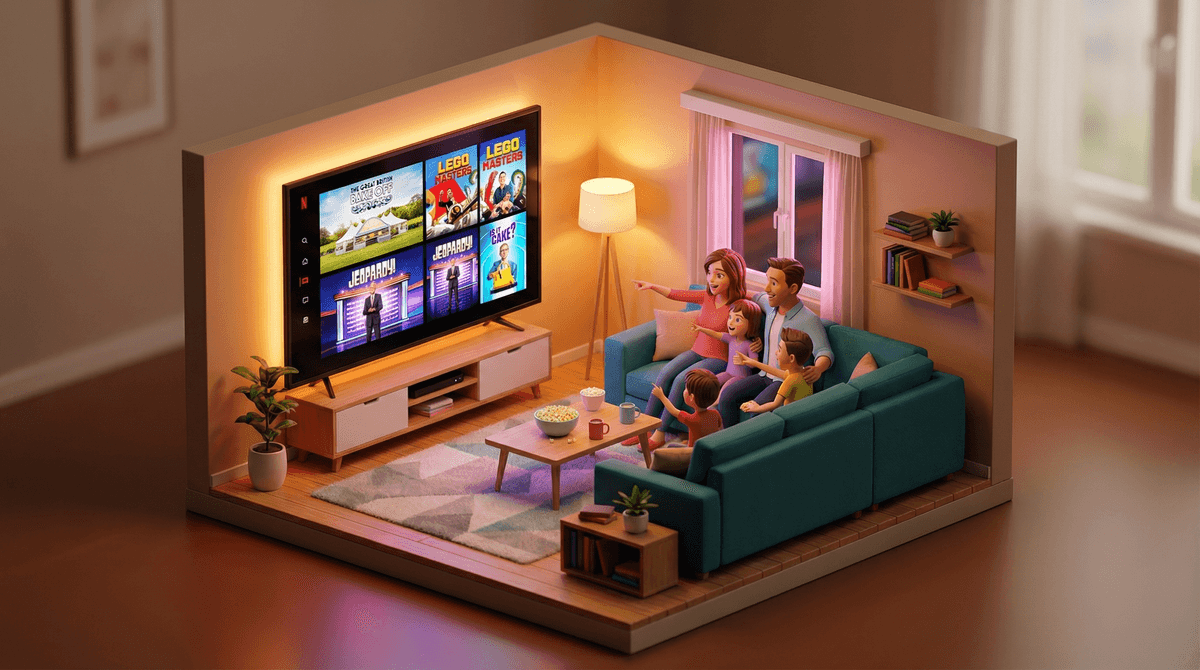
Look, we need to talk about something that might sound radical in 2026: not all screen time is created equal, and some of it might actually bring your family closer together instead of sending everyone to separate corners with separate devices.
Family game shows are competitive TV programs designed to be watched together—think Jeopardy!, The Great British Baking Show, Lego Masters, Floor is Lava, and a whole universe of cooking competitions, trivia challenges, and physical contests that have somehow become appointment viewing for families who can't agree on anything else.
Screenwise Parents
See allUnlike the passive scroll of TikTok or the isolated headphone world of gaming, game shows create a shared experience where everyone's watching the same thing, reacting in real-time, yelling at the TV together, and arguing about whether that answer should have counted. It's the digital equivalent of a board game night, except nobody has to clean up the pieces and your competitive uncle can't flip the table.
Here's what makes family game shows different from most screen time: they're inherently social. You're not consuming content alone—you're experiencing it together, which means conversation, connection, and yes, probably some heated debates about whether that contestant deserved to go home.
The research on co-viewing (watching together vs. parallel play on separate screens) consistently shows that shared media experiences can strengthen family bonds when done intentionally. You're modeling critical thinking ("How would you solve that puzzle?"), discussing strategy, celebrating wins, and processing losses together.
Plus, let's be honest: in a world where getting your teenager to look up from their phone feels like a Herculean task, finding something that everyone actually wants to watch is a genuine parenting win.
Built-in conversation starters: Game shows give you natural talking points that don't feel forced. "What would you do with that prize money?" "Could you eat that?" "Want to try making that recipe this weekend?"
Low-stakes competition: Your kids get to experience winning and losing vicariously, process disappointment when their favorite contestant gets eliminated, and practice rooting for underdogs—all without the pressure of being the one competing.
Skill exposure: Trivia shows build general knowledge. Cooking shows introduce new foods and techniques. Building competitions showcase problem-solving and creativity. Your kid might discover a genuine interest in baking, engineering, or geography just from watching people compete.
Genuine quality time: An hour of Nailed It! where everyone's laughing together beats an hour of everyone on separate devices in the same room. This is the screen time that actually creates shared family memories.
Ages 5-8: Start with visual, physical competitions
- Floor is Lava (Netflix) – Teams navigate obstacle courses, lots of splashing
- Lego Masters – Building challenges that'll inspire your own Lego sessions
- The Great Pottery Throw Down (HBO Max) – Surprisingly soothing, creative, and kid-friendly
Ages 9-12: Add strategy and knowledge-based shows
- The Great British Baking Show (Netflix) – Wholesome competition, actual baking inspiration
- Top Chef Junior – Kids competing means relatable contestants
- Jeopardy! – Classic trivia that rewards curiosity across subjects
Ages 13+: Everything's fair game
- The Amazing Race – Geography, culture, teamwork under pressure
- Survivor – Social strategy, alliances, moral dilemmas to discuss
- Is It Cake? (Netflix) – Weirdly compelling and genuinely impressive
- Physical: 100 (Netflix) – Athletic competition with inspiring backstories
Time commitment varies wildly: Some shows are 22-minute episodes (Nailed It!), others are hour-long sagas (The Great British Baking Show). Know what you're signing up for before you start one "quick" episode at 8pm on a school night.
Elimination shows can hit hard: If your kid gets attached to contestants, eliminations can genuinely upset them. This is actually a teaching opportunity about handling disappointment, but be prepared for some real feelings, especially with younger kids.
Some competition gets mean: Shows like Hell's Kitchen or The Apprentice feature aggressive conflict and harsh criticism. That's not inherently bad, but it's worth discussing whether that's the kind of competition your family wants to model. The Great British Baking Show proves you can have high stakes without cruelty.
Binge temptation is real: "Just one more episode" is the battle cry of game show viewers everywhere. Set boundaries before you start: "We're watching two tonight, then we're done."
Not all "family" shows are actually family-friendly: Squid Game: The Challenge might look like a game show, but it's based on a deeply violent series. Check ratings and read parent reviews before assuming something's appropriate just because it's a competition format.
The difference between game shows as quality family time vs. just another screen isn't the show itself—it's how you engage with it.
Play along: Keep score at home during Jeopardy!, guess eliminations before they happen, predict challenges before they're revealed.
Extend the experience: Try making a recipe from The Great British Baking Show together. Build something inspired by Lego Masters. Look up locations from The Amazing Race.
Talk about what you're seeing: "Why do you think she made that choice?" "Would you have helped your teammate there?" "What would be your strategy?"
Make it a ritual: "Friday night is game show night" creates anticipation and structure. It's something to look forward to that isn't just more random scrolling.
Family game shows aren't going to solve all your screen time struggles, but they offer something increasingly rare: screen time that's genuinely communal. In a digital landscape that's designed to fragment attention and isolate us into personalized content bubbles, watching people compete at making cakes or answering trivia questions together is almost rebelliously connective.
The key is intention. Don't just put on a show because you need the kids quiet—choose something everyone's excited about, commit to watching together without phones out, and actually engage with what you're watching. That's when screen time transforms from something you feel guilty about into something that genuinely brings your family together.
And honestly? If you can find anything that gets your teenager voluntarily sitting on the couch with the family, laughing at contestants trying to recreate elaborate cakes, you've found something worth protecting.
Start simple: Pick one show that matches your family's interests—cooking, building, trivia, physical challenges—and commit to one episode together this week. See how it goes.
Create the environment: Phones away (yes, yours too), snacks optional but encouraged, couch positions claimed. Make it feel special, not just background noise.
Reflect afterward: Did everyone enjoy it? What worked? What didn't? Would you watch another episode? Use that feedback to find your family's game show groove.
Want to explore more ways to make screen time actually work for your family instead of against it? Find family screen time ideas that bring you together about your specific situation—we can help you find the balance that makes sense for your crew.