

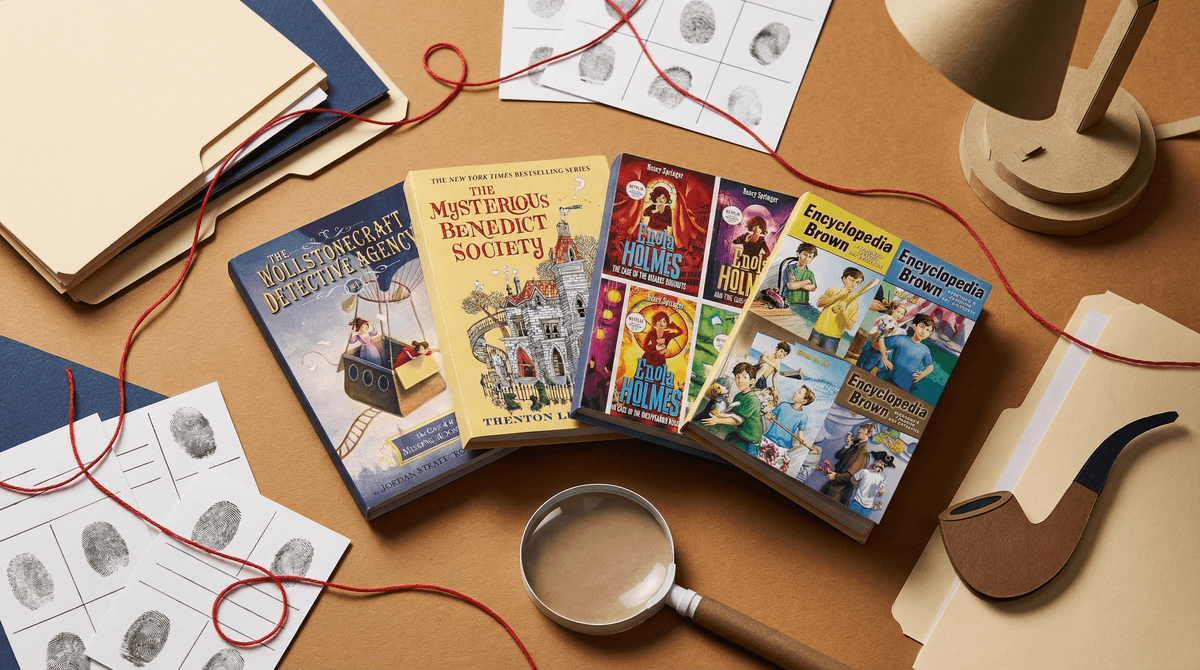
Look, I get it. Your 10-year-old has discovered they love a good mystery, but you're tired of either scary crime scenes or magic wands solving everything. You want detective stories that rely on actual deduction, not spells or graphic violence. The good news? There's a surprisingly rich world of age-appropriate detective fiction that treats young readers like the smart cookies they are.
These are books where kids solve mysteries using observation, logic, and teamwork—think more Encyclopedia Brown than True Crime podcast. They're perfect for that sweet spot age where kids are ready for chapter books with real plots, but you're not quite ready to hand them an Agatha Christie novel with a body count.
Mystery books hit different for 10-year-olds because they're finally at an age where they can follow complex plots, remember clues, and actually try to solve the mystery before the main character does. It's like a puzzle wrapped in a story, and kids this age are obsessed with proving they're smart enough to figure things out.
Plus, detective protagonists are usually kids or young teens who are taken seriously by adults (or at least prove the adults wrong). That's catnip for a 10-year-old who's navigating their own growing independence. They're not just reading—they're mentally playing detective alongside the characters, which is way more engaging than passive entertainment.
This series imagines Ada Lovelace and Mary Shelley as young detectives in Victorian London. It's clever, funny, and sneaks in real history and early computer science concepts. Ages 8-11 will love the friendship between two brilliant girls who solve mysteries using math and observation.
A classic for a reason. Cam has a photographic memory (she says "click" to take mental pictures) and uses it to solve neighborhood mysteries. These are shorter chapter books perfect for building confidence, and there are like 30+ books in the series. Ages 7-10 can start these and grow with them.
Two best friends solve mysteries in their town using a detective handbook and actual investigative techniques. The mysteries are genuinely clever without being scary, and the friendship dynamic is really well done. Ages 8-12 will appreciate that these feel like real kids, not mini-adults.
Sammy is a spunky seventh-grader who keeps stumbling into mysteries. While there's occasional mild peril, it's never graphic or traumatizing. The voice is fantastic—sarcastic, smart, and genuinely funny. Better for ages 10-13 who are ready for slightly longer books.
Okay, this one walks the line—there's a tiny bit of "special abilities," but it's more about gifted kids than actual fantasy. Four orphans with different talents work together to stop a villain using puzzles and critical thinking. It's like a detective story meets escape room. Ages 9-12 will devour this.
Sherlock Holmes' younger sister strikes out on her own as a detective in Victorian London. She uses disguises, codes, and observation—no magic, just smarts. The Netflix movies are great too if your kid likes to see the story come to life. Ages 10-14 will love the strong female protagonist and historical setting.
A 13-year-old detective in London solves mysteries using her network of contacts and sharp mind. These are proper mystery novels with red herrings and satisfying reveals. Ages 10-13 who are ready for something a bit more sophisticated will feel very grown-up reading these.
The key difference here is how problems get solved. In fantasy mysteries, someone might use a spell or magical object to reveal the truth. In more mature detective fiction, you might have violence, weapons, or genuinely scary situations. These books thread the needle—they're intellectually challenging without being emotionally overwhelming.
The mysteries involve things like stolen items, missing pets, neighborhood puzzles, or historical secrets. Nobody's getting murdered (or if they are, it happened 100 years ago and is treated academically). The stakes feel real to kids without triggering nightmares.
Here's something interesting: kids who get hooked on mystery books often become less interested in passive screen time. When you're in the middle of trying to figure out whodunit, putting down the book to scroll TikTok or watch random YouTube videos feels... boring?
Mystery books create the same dopamine hit as solving a level in a game, but they're building reading comprehension, critical thinking, and patience. Plus, unlike binge-watching a show, books have natural stopping points that make it easier for kids to self-regulate.
If you're trying to find a balance between screen time and other activities, detective fiction can be your secret weapon . It's engaging enough to compete with digital entertainment, but it's building different neural pathways.
Start with a series. Once kids find a character they love, they'll want to read every book. Cam Jansen or Milo and Jazz are great entry points because the books are short and there are tons of them.
Read together, at least at first. Even if your 10-year-old is a capable independent reader, reading a mystery aloud and pausing to guess together makes it more fun. You can make predictions, discuss clues, and model the kind of active reading that makes mysteries satisfying.
Connect to their interests. If they love Roblox detective games or shows like Gravity Falls, mention that these books have the same puzzle-solving energy. If they're into history, start with The Wollstonecraft Detective Agency. If they love funny books, go with Sammy Keyes.
Make it a treasure hunt. Take them to the library and give them a mission: find three mystery books that look interesting. Let them have agency in the choice. Kids are way more likely to read something they picked out themselves.
For younger 10-year-olds (or kids who are newer to chapter books): Start with Cam Jansen or Milo and Jazz. These have simpler vocabulary, shorter chapters, and straightforward mysteries.
For confident readers: Jump straight to Enola Holmes, The Mysterious Benedict Society, or Agatha Oddly. These have more complex plots and richer vocabulary.
For kids who say they hate reading: Try the Wollstonecraft Detective Agency or Sammy Keyes. The voice and humor in these can hook reluctant readers who think books are boring.
These books are genuinely safe for independent reading. You don't need to pre-read them looking for inappropriate content. The biggest "danger" is that your kid might stay up past bedtime with a flashlight trying to finish the book (which, honestly, is a parenting win in my book).
Some of these series have been around for decades (Cam Jansen started in 1980!), which means you might find them at library book sales, used bookstores, or in your own childhood collection. They hold up surprisingly well.
Also, mystery books are great for building executive function skills—keeping track of multiple characters, remembering clues, making predictions, and adjusting theories when new information appears. These are the same skills that help with everything from math word problems to navigating social dynamics.
If you're looking for books that engage your 10-year-old's brain without exposing them to graphic violence or relying on magic to solve problems, detective fiction is your answer. These books respect young readers' intelligence while keeping the content age-appropriate.
The best part? Once kids discover they love mysteries, they'll often seek out more books on their own. You're not just finding one book to get through—you're potentially unlocking a whole genre that can keep them reading for years.
Head to your library and check out 2-3 books from different series on this list. Let your kid browse the covers and first pages to see what grabs them. Most libraries also have apps where you can browse and place holds from home, which honestly makes this so much easier.
Ask the librarian for recommendations. Children's librarians are basically wizards at matching kids with books they'll love. Tell them "mystery books, no violence or fantasy, age 10" and they'll have opinions.
Consider audiobooks for car rides or quiet time. Many of these series are available on audiobook platforms, and hearing a great narrator can make a good book even more engaging. It's still "reading" in terms of building comprehension and vocabulary, just in a different format.
And if your kid tears through these and wants more? Come ask the Screenwise chatbot for personalized recommendations based on what they loved. We've got you covered.