

Fallout Season 2: What Parents Need to Know About Prime Video's Violent Wasteland
Fallout Season 2 isn't out yet (expected late 2025), but if it's anything like Season 1, this is firmly 17+ territory. We're talking graphic violence, disturbing imagery, sexual content, and a world where morality is as irradiated as the landscape. If your teen loved Season 1 and you're wondering whether to let them continue, or if they're begging to start the series, here's what you need to know about this post-apocalyptic Prime Video hit.
The short version: This is not The Last of Us with its occasionally redemptive moments. This is darkly comedic, ultra-violent, and morally complex in ways that require serious emotional maturity.
Screenwise Parents
See allQuick alternatives if you're looking for post-apocalyptic content with less gore: A Quiet Place (13+), WALL-E (all ages), or The Maze Runner series (14+).
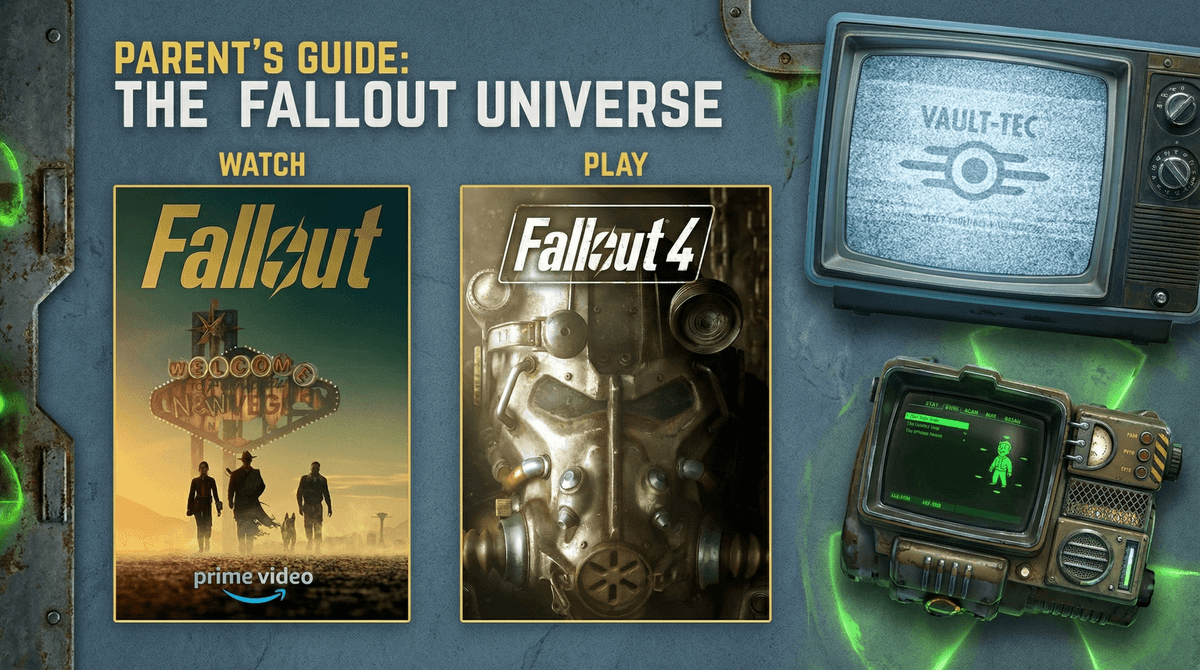
Fallout is Prime Video's adaptation of the massively popular Fallout video game series. Season 1 dropped in April 2024 and became an instant hit, following Lucy (Ella Purnell), a naive vault dweller who emerges into the nuclear wasteland 200+ years after the bombs fell. She teams up with Maximus, a Brotherhood of Steel soldier, and crosses paths with The Ghoul (Walton Goggins), a centuries-old bounty hunter who's basically a walking nightmare with a cowboy hat.
The show is set in a retro-futuristic 1950s aesthetic meets Mad Max brutality. Think: cheerful propaganda posters about nuclear safety while people are literally being dismembered on screen.
Season 2 was greenlit immediately and is currently filming, with an expected release in late 2025 or early 2026.
Violence & Gore
Season 1 opened with a graphic beheading. Not implied, not off-screen—full decapitation with blood spray. And it only escalated from there:
- Multiple dismemberments (limbs, heads, bodies cut in half)
- Torture scenes that linger
- A character getting their finger cut off on-screen
- Point-blank executions
- Body horror involving radiation mutations
- A scene where someone is basically melted alive
This isn't The Hunger Games where the camera cuts away. This is Tarantino-level violence with a darkly comedic edge that somehow makes it more disturbing.
Sexual Content
Season 1 included:
- Extended sex scene with nudity
- References to prostitution and sexual slavery
- Crude sexual dialogue throughout
- A scene involving incest (yes, really)
Language & Themes
F-bombs drop regularly. But honestly, the language is the least of your concerns here.
The thematic content is heavy:
- Moral ambiguity where "good guys" do terrible things
- Capitalism run amok (Vault-Tec literally caused the apocalypse for profit)
- Human experimentation on a mass scale
- The complete breakdown of society and what that does to people
- Questions about whether humanity deserves to survive
Drug Use
Characters use "chems" (the game's term for drugs) regularly, including addictive substances that have visible effects. The Ghoul is essentially a drug addict who needs radiation to survive.
TV-MA (Mature Audiences Only) - Prime Video's rating
17+ - Common Sense Media recommendation
18+ - Several international ratings boards
These aren't arbitrary. Season 1 earned every bit of that rating in the first 10 minutes.
Fair point. About 40% of teens 13-17 have played at least one Fallout game, and the games themselves are rated M (17+). But here's the thing: the show is significantly more graphic than the games.
In Fallout 4 or Fallout 76, violence happens in a third-person perspective with stylized graphics. You're controlling the action and can often avoid the worst of it. The show puts you in the front row for every brutal moment in live-action, 4K detail.
If your teen has played the games, they understand the world and lore, which is actually a point in favor of letting them watch—they're not going in blind to the moral complexity. But the visceral nature of the show's violence is a completely different experience.
Here's where I'm going to be honest: Fallout Season 1 is exceptional television. The production design is incredible, the acting is phenomenal (Walton Goggins is doing career-best work), and the storytelling is smart, layered, and faithful to the games while being accessible to newcomers.
It's also genuinely funny in the darkest possible way. The show has this satirical edge about American exceptionalism and corporate greed that's brilliant social commentary.
So yes, it's good. Really good. But "good" doesn't automatically mean "appropriate for your 15-year-old."
17-18+: Probably Fine If...
- They've demonstrated emotional maturity around violent content
- You've had conversations about media literacy and satire
- They can handle moral ambiguity (there are no clear heroes here)
- They're not particularly sensitive to gore or body horror
- You're willing to have follow-up conversations about themes
Consider watching together if you're on the fence. The shared experience gives you natural opportunities to discuss what you're seeing.
15-16: Case-by-Case
Some mature 16-year-olds can handle this. Many can't. Ask yourself:
- How do they react to violence in other media?
- Can they distinguish between entertainment and reality?
- Are they prone to nightmares or intrusive thoughts from media?
- Do they understand satire and dark comedy?
If you're unsure, watch Season 1 Episode 1 yourself first. If you think "absolutely not" in the first 15 minutes, trust that instinct.
Under 15: Hard Pass
I don't care how mature they are or how much they love the games. The sexual content alone makes this inappropriate for middle schoolers, and the violence is genuinely disturbing even for adults.
Based on where Season 1 ended and the game lore, expect:
More of the same violence level - The showrunners have said they're not toning anything down
New Vegas setting - Which means more factions, more moral complexity
Deeper lore - More vault experiments, which in the games include truly horrifying scenarios
The Ghoul's backstory - His pre-war life, which will likely include family trauma
Lucy's continued corruption arc - Watching her lose her innocence was brutal in Season 1; it's going to get worse
There's zero indication Season 2 will be more family-friendly. If anything, the showrunners earned the right to push boundaries further.
If your teen wants post-apocalyptic survival content but isn't ready for Fallout:
Shows:
- The 100 (14+) - Still violent but less graphic
- Sweet Tooth (12+) - Post-apocalyptic with heart
- The Last of Us (16+) - Still intense but with more emotional grounding
Movies:
- The Maze Runner series (14+)
- A Quiet Place (13+) - Tense but not gory
- I Am Legend (14+)
Games:
- The Last of Us Part II (17+) - Similar themes, player-controlled violence
- Metro Exodus (17+) - Post-nuclear but less satirical
- Horizon Zero Dawn (13+) - Post-apocalyptic with less violence
If you're letting your older teen watch, don't just hit play and disappear. Use this as an opportunity:
Before watching:
"This show is extremely violent and has some disturbing content. If anything feels like too much, we can pause or stop. No judgment."
During/after:
- "What do you think about how the show portrays violence? Does the dark humor change how it feels?"
- "The show suggests Vault-Tec caused the war for profit. What does that say about corporate power?"
- "Lucy starts out believing in right and wrong. How is that changing? Is that realistic?"
- "The Ghoul does terrible things but the show wants us to understand him. How do you feel about that?"
The big question:
"How does watching this in live-action feel different from playing the games?"
These conversations are honestly the most important part. Media literacy isn't about shielding kids from everything—it's about giving them tools to process what they see.
If you decide to let your 16-17-year-old watch, consider these approaches:
Option 1: Watch together
Pause for particularly intense scenes, gauge their reaction, discuss as you go. Yes, the sex scene will be awkward. That's parenting.
Option 2: You watch first, they watch after
Preview each episode, decide if it's okay, then let them watch knowing you can discuss specific scenes.
Option 3: Set check-in points
"Watch episodes 1-3, then let's talk before you continue." Gives them some autonomy while maintaining oversight.
Option 4: Use Prime Video's X-Ray feature
It shows you exactly what's coming in terms of content warnings. Not perfect, but helpful.
Fallout Season 2 is going to be must-watch TV for fans of the games and anyone who loved Season 1's blend of dark satire, incredible world-building, and yes, extreme violence. It's also going to be completely inappropriate for most teenagers.
The reality: Some 17-year-olds are ready for this level of content. Most 15-year-olds aren't. And if your kid is under 15, the answer should be a clear no, regardless of their protests about how "everyone at school is watching it."
Trust your gut. If you watch the trailer and think "this seems like too much," it probably is—for your kid, right now. That doesn't make you overprotective; it makes you a parent who knows their child.
And if you decide to say yes? Stay involved. Watch with them, or at minimum, watch it yourself so you can have real conversations about what they're seeing. The violence isn't going away in Season 2, but your presence and willingness to discuss difficult content can make all the difference in how they process it.
- Watch the Season 1 trailer yourself - Gets you 90% of the way to a decision
- If still unsure, watch Episode 1 - The opening 15 minutes will tell you everything you need to know
- Talk to your teen about why they want to watch - Is it FOMO? Genuine interest in the story? Understanding their motivation helps
- Set clear expectations - If you say yes, establish that this is a trial and you can revisit the decision
- Plan for Season 2's release - It's coming late 2025; decide now whether they'll watch it as it drops or wait
Want to dig deeper? Check out our guide to age-appropriate post-apocalyptic content or how to talk to teens about violent media.
And if you're trying to figure out whether your teen is ready for this level of content in general, our media maturity assessment can help you think through the decision.