

Okay, let's talk about fairy tales—those stories about talking animals, magical beans, evil stepmothers, and kids outsmarting witches. You know, the classics like Cinderella, Little Red Riding Hood, and Jack and the Beanstalk, but also modern retellings and brand-new tales that follow the fairy tale formula.
Here's the thing: in an age where your kid can ask ChatGPT to generate a personalized story in 3 seconds or binge 47 episodes of Bluey (no shade, Bluey is actually great), physical fairy tale books might seem quaint. Like, why read a 200-year-old story about a girl in a red cape when you could watch Encanto for the 18th time?
But fairy tales—whether you're reading the original Grimm versions or modern picture book adaptations—still have something uniquely valuable to offer. They're not just nostalgia bait for parents. They're actually doing important developmental work that screens can't quite replicate.
They teach pattern recognition and narrative structure. Fairy tales follow predictable formulas: a problem arises, a journey happens, obstacles appear, helpers emerge, and resolution comes. This repetition isn't boring—it's foundational. Kids learn how stories work, which helps them understand everything from playground drama to, later, how to structure their own writing.
They're emotionally honest in ways modern kids' content often isn't. Fairy tales don't shy away from scary stuff. Parents die. Kids get lost in the woods. Stepmothers are genuinely cruel. Yes, you can find sanitized Disney versions, but even those have real stakes. Compare that to a lot of modern kids' content that's so conflict-averse it's basically beige. Some shows are great, but many are just... there.
They create shared cultural literacy. When your kid reads fairy tales, they're joining a conversation that's been happening for centuries. They'll get references in other books, movies, and even memes. "Big Bad Wolf energy" means something. "Cinderella story" means something. This matters more than you might think.
They're a gateway to reading for pleasure. Fairy tales are short, plot-driven, and satisfying. They're perfect for kids transitioning from picture books to chapter books, or for reluctant readers who need a quick win. A 10-page fairy tale feels achievable in a way a 300-page novel doesn't.
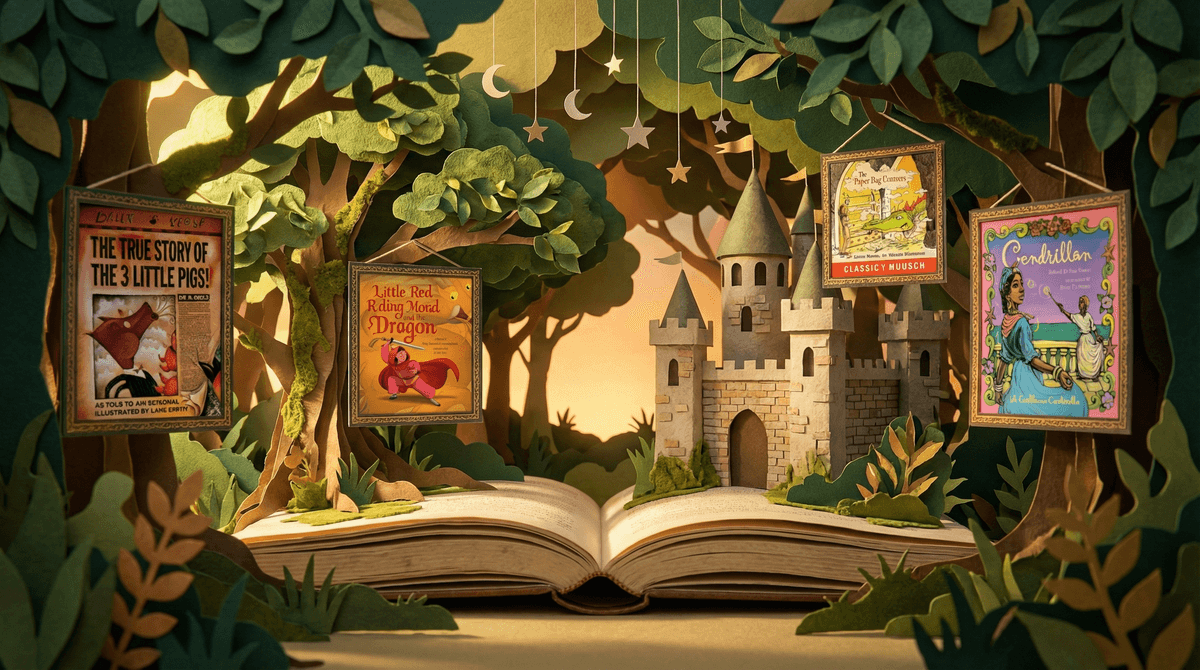
Ages 3-6: Picture Book Versions At this age, go for beautifully illustrated retellings that soften the scarier elements. Think The Paper Bag Princess by Robert Munsch (a feminist retelling where the princess saves herself) or classic collections with gorgeous art. Read aloud together, and don't be surprised if they want the same story 47 nights in a row.
Ages 6-9: Early Reader Collections This is prime fairy tale age. Try collections like My First Book of Fairy Tales or individual stories in early chapter book format. Kids this age can handle slightly spookier versions—the wolf eating grandma, the witch's oven—because they're starting to understand the difference between real and pretend. They're also old enough to start noticing patterns: "Wait, why is it always a stepmother who's mean?"
Ages 9-12: Original Tales and Fractured Fairy Tales Older elementary kids are ready for the real Grimm Brothers or Hans Christian Andersen (heads up: the original Little Mermaid is DARK). They're also perfect for "fractured fairy tales"—retellings that flip the script. Books like The True Story of the Three Little Pigs or Ella Enchanted by Gail Carson Levine are fantastic. This age group loves analyzing and questioning, so fairy tales become a great tool for critical thinking.
Ages 12+: Fairy Tale Retellings and Deconstructions By middle school, kids are ready for YA retellings that add complexity, diversity, and modern themes. Think Cinder by Marissa Meyer (Cinderella as a cyborg) or Spinning Silver by Naomi Novik (Rumpelstiltskin meets Jewish folklore). These books use fairy tale frameworks to explore identity, power, and choice.
Not all versions are created equal. The Disney version of Cinderella is wildly different from the Grimm version (where the stepsisters cut off parts of their feet to fit the slipper, no joke). Know what you're reading before you commit to bedtime story time. If you want to avoid nightmares, stick with modern retellings for younger kids.
Fairy tales are a great conversation starter. These stories are full of teachable moments. "Why do you think the stepmother was so mean?" "Was it fair that the prince only cared about how Cinderella looked?" "What would you do if you found a house made of candy in the woods?" Use them.
They're a screen-free bonding ritual. Reading fairy tales together—especially at bedtime—creates a tech-free zone that's increasingly rare. No notifications, no autoplay, just you and your kid and a story. It's the kind of memory that sticks.
Physical books have advantages here. Yes, you can read fairy tales on a tablet, but physical books don't have the temptation of "just one more video" lurking in the background. They also let kids flip back and look at illustrations, which is part of the experience. If you're trying to reduce screen time , fairy tale books are a solid alternative to offer.
Diverse retellings exist and are worth seeking out. Traditional Western fairy tales are... very white. But there are incredible collections from other cultures—African folktales, Asian fairy tales, Latin American stories—that offer the same narrative magic with different perspectives. Books like The Girl Who Married a Lion or Cendrillon: A Caribbean Cinderella expand the genre beautifully.
Fairy tales aren't a replacement for all the other stuff your kid is into—they're not going to stop asking for Roblox time or begging to watch YouTube. But they're a valuable addition to the mix. They offer something slower, richer, and more interactive than passive screen time.
You don't need to become a fairy tale purist or ban all screens in favor of leather-bound Grimm collections. But adding a few fairy tale books to your rotation—especially as bedtime reading or car trip entertainment—gives your kid access to stories that have survived because they're good. They work. They matter.
And honestly? In a world where your kid's entertainment is increasingly algorithmically generated and designed to maximize engagement metrics, there's something quietly radical about handing them a 200-year-old story about a girl, a wolf, and a grandmother. It's a reminder that good stories don't need Wi-Fi.
Start with one collection. Grab a well-reviewed fairy tale anthology from your library or bookstore. The Classic Treasury of Childhood Wonders or Fairy Tales Every Child Should Know are solid starting points.
Try a modern retelling. If your kid is resistant to "old" stories, start with a fractured fairy tale or a diverse retelling that feels fresh.
Make it a ritual. Pick one night a week for fairy tale reading. No screens, just story time. See what happens.
Ask your kid which tales they know. You might be surprised how many fairy tale references they've absorbed from movies, shows, and games without ever reading the original. Fill in those gaps.
Fairy tales aren't magic bullets for screen time struggles, but they're a pretty great tool in the toolkit. Give them a shot.