

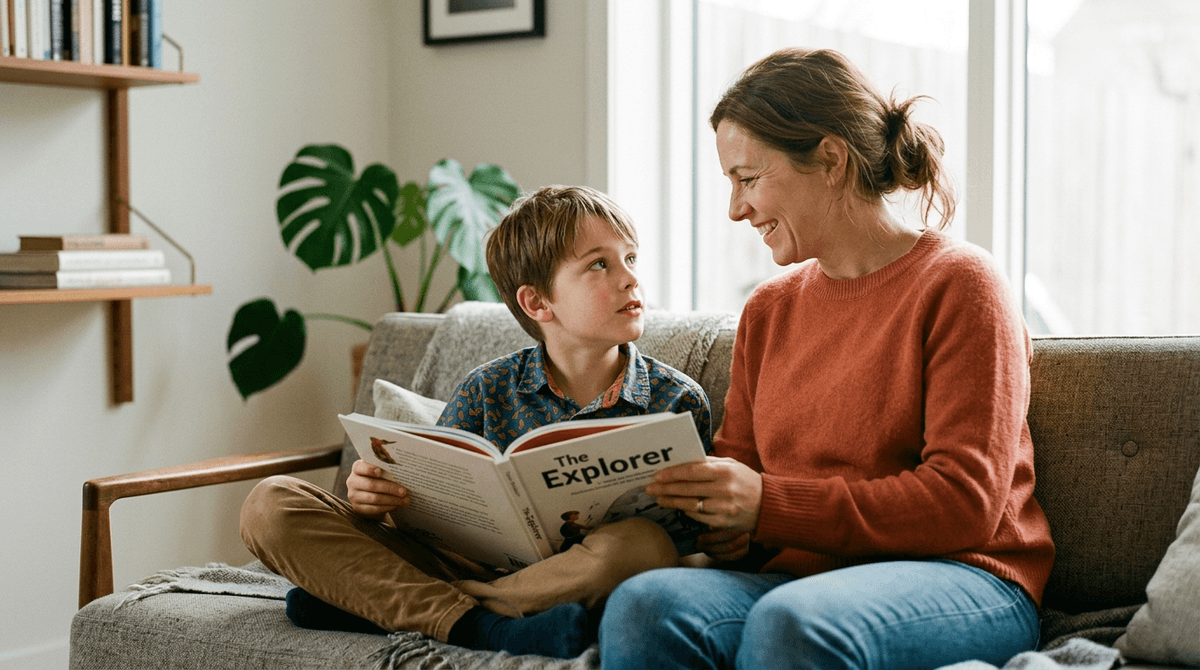
Asking "How does the dog feel?" is a more effective literacy strategy than asking "What color is the dog?"
Prioritize emotional connection over factual recall during storytime. Asking children how characters feel helps them process information faster and understand complex stories more deeply than standard "who, what, where" questions. This "empathetic questioning" approach creates a physical shift in how the brain tracks a story.
Parents often feel pressured to turn every book into a literacy lesson, turning bedtime into a pop quiz on plot points and vocabulary. This factual drilling can be counterproductive. When we quiz kids on "what happened," we treat reading like a data retrieval task. When we ask "how did it feel," we activate the parts of the brain responsible for deep focus and narrative synthesis.
This shift changes the evening routine from an academic chore into a cognitive performance booster. If your child is struggling to keep up with more complex chapter books or seems "checked out" during read-alouds, the fix isn't more phonics—it is more empathy. Emotional engagement acts as the glue that helps the plot stick in the mind.
Dialogic reading—the practice of having a conversation about a book while reading it—is the gold standard for early literacy. Historically, this has focused on factual prompts: pointing at objects, labeling colors, or repeating phrases. These work well for toddlers, but they don't necessarily help older children master deep comprehension.
Researchers suspected that "social-emotional" prompts—questions that require a child to infer a character's internal state—could improve the mechanical process of reading for elementary students. By using eye-tracking technology, they could see if a child's eyes physically moved differently across the page when their heart was involved in the story versus when they were simply hunting for facts.
Children who were asked empathetic questions showed significantly higher comprehension scores than those asked standard factual questions. The eye-tracking data provided a rare "under the hood" look at why this happens:
- Faster visual entry: Students asked about feelings locked onto key illustrations and text blocks much faster than those asked factual questions.
- Reduced visual wandering: The empathy group spent less time looking at irrelevant background details in the illustrations, keeping their attention on the narrative's "meat."
- Increased first-pass success: These students were more likely to understand a scene the first time they looked at it, rather than having to re-read sentences multiple times to make sense of the plot.
- Memory anchoring: Connecting a plot point to a feeling helped children recall those plot points more accurately during later testing.
Empathetic questioning increases the "cognitive load" in a productive way. It requires a child to take what they see on the page, compare it to their own life experiences, and make an inference. While that sounds more difficult than naming an object, it creates a much stronger mental map.
There is also a hidden efficiency here. When a child identifies with a character, they develop a "need to know" what happens next. This internal motivation is a more powerful focus tool than any external reward or parental "pay attention" reminder. Empathy is essentially a shortcut to high-level engagement.
The study was small, involving only 54 students. Most importantly, these were fifth-grade students in China reading English-language picture books. They were dealing with the added challenge of a foreign language, which may have made the "empathy boost" more visible because the reading task was already difficult.
We do not know for certain if native English speakers reading in their first language would see the same dramatic jump in comprehension, as the cognitive effort of the words themselves is lower. The study also measured immediate understanding, not whether these children became better readers six months down the line.
- If your child is "skimming" through books just to finish them... stop every few pages and ask "Why do you think the character made that choice?" to force their eyes to slow down and process the motive.
- If you are reading a book with complex illustrations... point to a character's facial expression and ask your child to describe what that character might be thinking to help them prioritize important visual cues over background "noise."
- If your child struggles to remember the plot of a story the next day... try ending the reading session by asking "What was the saddest or happiest part for you?" rather than just summarizing what happened.
- If you are buying books for a reluctant reader... prioritize "high-stakes" emotional stories—like books about overcoming fear or navigating a fight with a friend—as these are more likely to trigger the empathy-focus loop.
You don't need to be a literacy expert to help your child become a better reader; you just need to be a confidant. By focusing on the emotional heart of a story, you help your child build a faster, more attentive brain that naturally captures the facts along the way.
Yuehua Han, Songxiu Jiang, Xingyu Liu et al. (2025). Enhancing Elementary Education: The Impact of Empathetic Questioning in Dialogic Reading on Comprehension and Engagement. Reading Research Quarterly. — http://dx.doi.org/10.1002/rrq.70033