

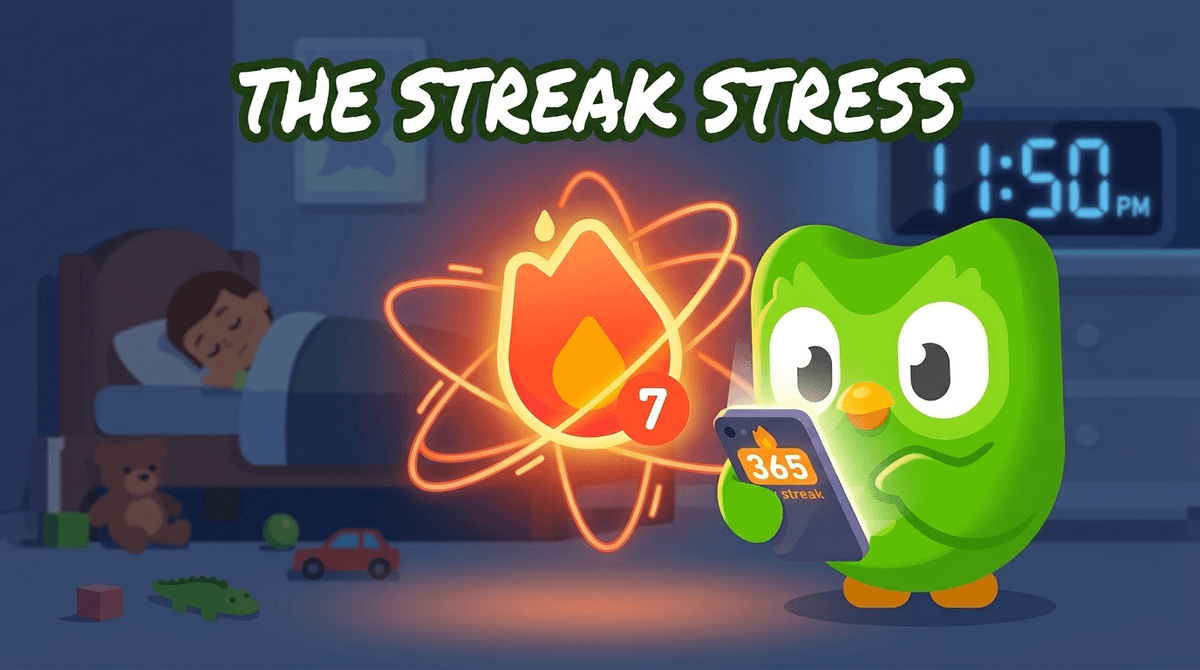
TL;DR: Duolingo uses a psychological trigger called "loss aversion" to keep kids coming back. While the "streak" feels like a win for consistency, it often morphs into a source of genuine anxiety and "performative learning" where kids care more about the number than the language. If your child is having a meltdown at 11:45 PM over a 200-day streak, it’s time to reframe the owl's role in your house.
Check out our guide on understanding gamification in kids' apps
Find out how to set healthy boundaries for educational apps
We’ve all been there. It’s late, the teeth are brushed, the lights are out, and suddenly a frantic voice chirps from the hallway: "I forgot my Spanish lesson! I’m going to lose my streak!"
On the surface, it’s a parent’s dream. Your kid is begging to do extra schoolwork. But if you look closer, they aren't actually excited to conjugate verbs. They are terrified of a digital counter hitting zero. This is the Duolingo "streak" in action, and while it's marketed as a tool for consistency, for many kids, it's become a high-stakes game of digital chicken that triggers more cortisol than conversation skills.
In behavioral economics, "loss aversion" is the idea that the pain of losing something is twice as powerful as the joy of gaining it. Duolingo didn’t invent this, but they perfected it for the K-12 set.
When a child sees that "100" next to the little fire icon, it represents 100 days of effort. Losing that isn't just a reset; to a ten-year-old, it feels like a literal erasure of their hard work. The app leans into this with increasingly passive-aggressive notifications from Duo the Owl. It’s a classic "dark pattern" of design—using psychological tricks to keep users engaged, even when that engagement is no longer healthy or productive.
Kids are wired for collection and completion. Whether it’s Roblox badges or Minecraft achievements, they love a visible metric of success.
The problem with Duolingo is that the streak becomes the primary goal, while the language becomes the obstacle. You’ll see kids doing the "easiest" possible lesson—reviewing "The boy eats the apple" for the 50th time—just to keep the streak alive. This is "performative learning." They aren't gaining fluency; they’re maintaining a status symbol.
When life happens—a camping trip, a busy sports weekend, or just a long day—the "streak" becomes a burden. The anxiety stems from the "all-or-nothing" nature of the mechanic. One missed day feels like a total failure.
We often give Duolingo a pass because it’s "educational." We’d never let our kids stay up until midnight playing Fortnite, but we might let them slide for "learning French."
But let’s be real: doing one five-minute lesson a day for a year won't make your child fluent. It’s great for vocabulary, but it’s not a substitute for actual immersion or structured classes. If the app is causing more stress than it is providing linguistic value, it’s effectively "educational brain rot." It’s a low-effort habit disguised as a high-value achievement.
Learn more about the difference between educational tech and digital busywork
If you're wondering if your kid's Duolingo habit is still healthy, look for these red flags:
- Panic attacks or tears when the streak is threatened.
- Prioritizing the app over sleep, meals, or family time.
- Gaming the system: Only doing the easiest, fastest lessons to "get it over with."
- Aggression toward the "reminders" (or toward you when you tell them to put the phone away).
- Zero interest in the actual language outside of the app.
You don’t have to delete the app, but you do need to break the spell. Here’s how to have that conversation:
1. The "Why" Audit
Ask your child: "If your streak disappeared tomorrow, would you still want to learn Spanish?" If the answer is a hard no, you’re dealing with a streak addiction, not a language interest.
2. Explain the "Streak Freeze"
Duolingo allows users to buy "Streak Freezes" with "gems" (earned in-app). Teach your child to treat these like insurance. It’s okay to take a day off. In fact, it’s healthy.
3. Focus on "Input" over "Output"
Shift the goal from "keeping the fire alive" to "actually using the language." If they like the language, try supplementing with other media:
- Watching Bluey in the target language.
- Listening to Wow in the World (some episodes are translated).
- Using Babbel or Rosetta Stone for a more structured, less "gamey" approach.
4. The "Controlled Burn"
Sometimes the best thing you can do is let the streak die. It’s a hard lesson in digital minimalism. Once the number hits zero, the pressure vanishes. Many kids feel a weird sense of relief once the "burden" of a 300-day streak is gone.
Elementary (Ages 7-11)
At this age, kids lack the emotional regulation to handle the "loss" of a streak. They take the owl’s "disappointment" personally. Strategy: Set a "Duolingo Time" that is nowhere near bedtime. If they miss it, they miss it. Do not let them bring the device to bed to "save the streak."
Middle School (Ages 12-14)
Social pressure kicks in here. They might be competing with friends on leaderboards. Strategy: Talk about the "Leaderboard Trap." Explain how apps use competition to keep you scrolling. Encourage them to set the profile to "Private" to opt-out of the leagues.
High School (Ages 15+)
Teens should be using Duolingo as a supplement to schoolwork, not a replacement. Strategy: If they are stressed about the streak, suggest they switch to a more utility-focused app like Quizlet or Khan Academy for their language needs.
Duolingo is a tool, not a master. If the green owl is causing your child to lose sleep or feel like a failure, the tool is broken. Gamification is a powerful way to build habits, but when the "game" part causes genuine anxiety, it’s no longer "wellness"—it’s just another digital chore.
Remind your child that a 500-day streak doesn't make them a linguist, and a 0-day streak doesn't make them a failure. The goal is to speak to humans, not to satisfy an algorithm.
- Check the settings: Go into the app and turn off the most aggressive notifications.
- Set a "Streak Max": Decide as a family that once a streak hits a certain number (like 100), you’ll intentionally let it reset to prove that the world doesn't end.
- Diversify: If they love languages, try a physical boardgame that involves communication.
Get non-gamified language learning resources
Read our guide on the best educational apps that don't use dark patterns