

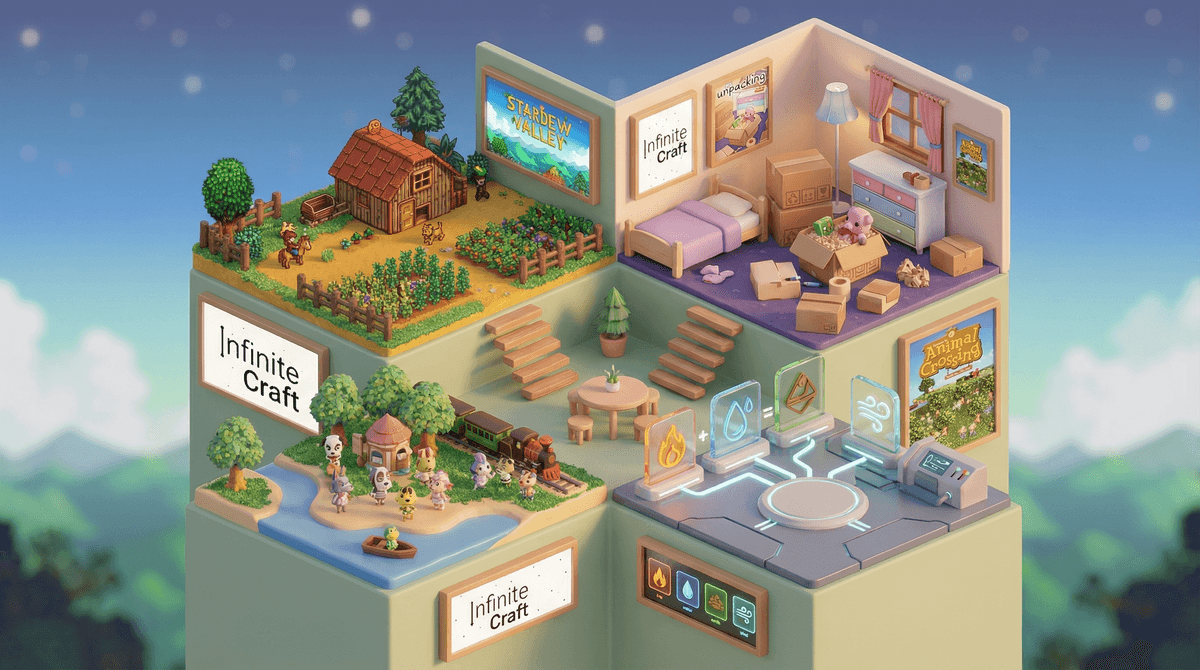
Infinite Craft is a free browser game that's been quietly taking over computer lab time and after-school moments. The premise is beautifully simple: you start with four basic elements (water, fire, wind, and earth), and you combine them to create new things. Water + fire = steam. Steam + earth = mud. And then it just keeps going—thousands of possible combinations that kids discover through experimentation.
What makes it different from a lot of what's competing for kids' attention is what it doesn't have. No battle passes. No loot boxes. No notifications. No chat feature. No accounts to create. Just a clean interface where you drag and drop elements to see what happens.
Screenwise Parents
See allIt's part of a broader trend toward what people are calling "cozy games"—digital experiences that prioritize creativity, discovery, and calm over competition and chaos. Think Stardew Valley, Animal Crossing, or the creative mode in Minecraft without the creepers.
The appeal is genuinely wholesome. Kids love the "aha!" moment of discovering a new combination. They'll spend 20 minutes trying to create "dragon" or "unicorn" or "pizza" (yes, you can make pizza). There's something deeply satisfying about the logic puzzle aspect—if I can make steam, and I can make metal, can I make a steam engine?
It's also become a social thing. Kids share their discoveries at lunch tables and in group chats. "Wait, you got WHAT from combining city and ocean?!" The game doesn't have built-in sharing features, but that hasn't stopped kids from creating their own community around it.
And honestly? It hits that sweet spot of being accessible on school Chromebooks while not being blocked by most school filters. It loads quickly, doesn't require installation, and looks innocuous enough that it flies under the radar.
Here's the real talk: with 55% of families in our community reporting that their kids engage with gaming, and average screen time sitting at about 4.2 hours per day, Infinite Craft is probably one of the better options in terms of how that time gets spent.
The genuinely good stuff:
- Zero monetization. No ads, no in-app purchases, no premium features
- No social features means no stranger danger, no cyberbullying, no chat moderation concerns
- Actually educational—kids are learning about logic, categorization, and creative problem-solving
- Self-limiting in a way that Roblox or Fortnite aren't—once you've discovered your combinations for the day, there's a natural stopping point
The considerations:
- It's still screen time, and it can be surprisingly absorbing. That "just one more combination" pull is real
- The AI that generates combinations can occasionally produce weird or inappropriate results (though this is rare and the game isn't designed to be provocative)
- Like any open-ended creation tool, it lacks structure—some kids thrive with this freedom, others feel lost without objectives
Ages 6-8: Totally appropriate with supervision. Younger kids might need help with spelling and reading the element names, but the drag-and-drop mechanic is intuitive. It's actually a nice way to practice reading in a low-pressure context.
Ages 9-12: The sweet spot. Kids this age can independently explore, and the logical thinking involved is right at their developmental level. You might even see them start keeping notebooks of their discoveries.
Ages 13+: Still engaging for teens who enjoy puzzle games or creative tools, though they might mix it with other activities. Some teens use it as a "brain break" between homework assignments.
Infinite Craft is part of something bigger worth understanding. The cozy games trend is a response to the intensity and competitiveness of mainstream gaming. These games prioritize:
- Low stakes over high pressure - No leaderboards, no rankings, no "git gud" culture
- Creativity over competition - Making things rather than beating things
- Calm over chaos - Gentle soundtracks, pleasant aesthetics, no jump scares
- Discovery over objectives - Exploration for its own sake
Other games in this category worth knowing about: Unpacking, A Short Hike, Spiritfarer, and Webfishing.
If your kid is into Infinite Craft, try asking:
"What's the coolest thing you've discovered today?" (This invites them to share their creative process)
"How did you figure out how to make that?" (Reinforces the problem-solving aspect)
"Can you teach me how it works?" (Positions them as the expert, which kids love)
You can also See the educational benefits of combination games if you're curious about the cognitive development angle.
In the landscape of things competing for your kid's attention, Infinite Craft is relatively benign. It's not teaching them questionable social dynamics like some multiplayer games, it's not trying to extract money from your credit card, and it's not engineered with the same addictive mechanics as social media.
That said, it's still screen time. If your family is already at or above that 4.2-hour average, this might be a good opportunity to think about balance. Could some of that Infinite Craft time become hands-on science experiment time? Could you print out chemistry flashcards and do real-world element combining?
The cozy games trend is, in many ways, a positive development in digital culture. But the coziest place of all is still the one where your kid looks up from the screen and engages with the actual world around them.
If you want to try it together: Pull it up on a laptop and spend 15 minutes combining elements side by side. It's actually kind of fun, and you'll understand the appeal immediately.
If you want to set boundaries: Time limits work better than outright bans with games like this. "You can play until you discover 10 new things, then we're done" gives them agency while maintaining structure.
If you want alternatives: Consider Little Alchemy (similar concept, slightly different execution) or actual hands-on activities like science experiment kits that scratch the same discovery itch.
And if you're trying to figure out where your family's gaming habits fit in the bigger picture, Screenwise can help you understand your digital patterns in context with what's actually happening in your community—not just what the internet says "should" be happening.