

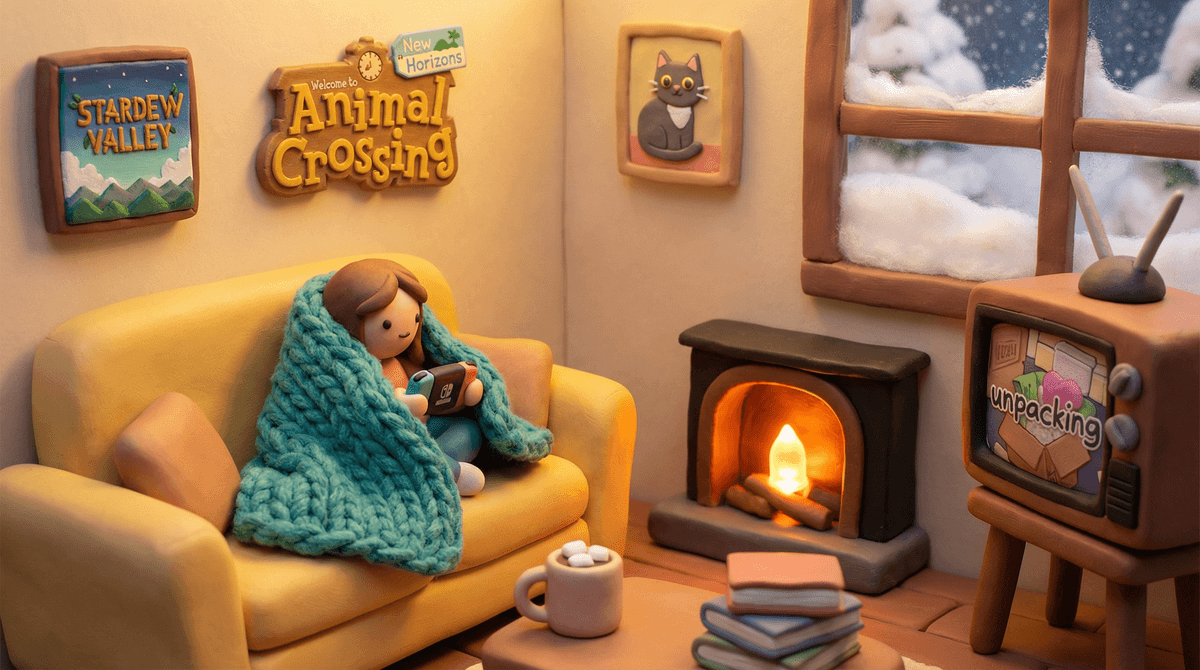
If your household gaming situation currently involves shouting, sweaty controllers, and someone rage-quitting because they got eliminated in the first 30 seconds, let me introduce you to the concept of cozy games.
Cozy games are exactly what they sound like—low-stakes, calming experiences that prioritize exploration, creativity, and gentle problem-solving over competition and combat. Think farming simulators, puzzle games, and life sims where the biggest "threat" is forgetting to water your virtual plants. No jump scares, no battle royales, no voice chat with random internet strangers calling your kid trash.
With about 55% of families in your community having kids who game, and average screen time hitting 4-5 hours on weekends, the holidays are prime time to be intentional about what fills those hours. Cozy games offer a refreshing alternative to the high-intensity experiences that dominate most kids' gaming diets.
The holidays are already a lot—travel, disrupted routines, family gatherings, sugar crashes. The last thing anyone needs is gaming that adds to the stress level.
Cozy games work beautifully during winter break because they:
Match the vibe. When it's dark at 4:30pm and everyone's in pajamas by noon, games about building cozy cottages or running a peaceful café just feel right.
Allow for flexible engagement. Unlike competitive games where you can't pause mid-match, most cozy games let you save anywhere and step away without penalty. Perfect for when grandma arrives or it's suddenly time for cookies.
Work for mixed ages. A 7-year-old and 12-year-old rarely want to play the same games, but cozy games often have that sweet spot of simple mechanics with deeper complexity available for those who want it.
Reduce household tension. There's something about watching someone build a garden in Stardew Valley that doesn't trigger the same parental stress as hearing "I'M GONNA DESTROY YOU" through the walls.
Ages 5-8: True Cozy Starters
Animal Crossing: New Horizons (Nintendo Switch) remains the gold standard. Kids this age love decorating their island, catching bugs, and talking to the adorable animal villagers. No reading required if you're willing to help navigate menus initially.
Unpacking (Switch, PC, Xbox) is a zen puzzle game where you literally just unpack boxes and arrange items in rooms. It's surprisingly meditative and tells a wordless story through objects. Great for kids who love organizing (and might inspire some real-life room cleaning, maybe?).
A Little to the Left (Switch, PC) appeals to the same organizing instinct—arrange household items in satisfying ways while a mischievous cat occasionally messes things up.
Ages 9-12: Building Complexity
Stardew Valley (everything—Switch, PC, mobile, consoles) is the cozy game that even non-gamers have heard about. Farm, fish, make friends, explore caves. Yes, there's light combat in the mines, but it's cartoonish and optional. Warning: this game is a time vortex. "Just one more day" is a real thing.
Spiritfarer (Switch, PC, consoles) is gorgeous and deals with themes of death and letting go in a gentle, meaningful way. You're a ferry master for spirits crossing over. It's emotional but beautiful—good for mature tweens and great conversation starter about loss.
Cozy Grove (Switch, PC, consoles, mobile) is designed to be played in 20-30 minute sessions each day. You're a spirit scout helping ghosts on a haunted island. The time-gated structure actually helps prevent the "just one more hour" spiral.
Ages 13+: Cozy with Depth
Unpacking works here too—teens often appreciate the storytelling more than younger kids.
Coffee Talk (multiple platforms) has you running a coffee shop and listening to customers' stories in an alternate fantasy Seattle. More narrative-heavy, deals with adult themes like discrimination and relationships, but in thoughtful ways.
Slay the Spire (okay, this one's debatable as "cozy" but hear me out)—it's a card-based strategy game that's turn-based and thoughtful rather than twitchy. Good for teens who want some challenge without the stress of real-time competition.
Cozy doesn't mean educational (usually). These games probably won't teach algebra, but they do encourage planning, resource management, creativity, and sometimes reading. Stardew Valley has turned more kids into spreadsheet enthusiasts than any math class.
They can still be addictive. Just because a game is calming doesn't mean it's not compelling. The "just one more day" pull is real. Set timers and expectations upfront.
Some have online features. Animal Crossing allows visiting other players' islands. Most cozy games are single-player, but check before assuming.
Price range varies wildly. Some cozy games are $5 indie titles, others are $60 Nintendo releases. The good news: many excellent cozy games are from indie developers and cost less than a movie ticket. Check out Steam's "cozy" tag for PC options.
They might surprise you. If you've only seen Fortnite or Roblox gameplay, sitting down to watch someone play Unpacking might completely shift your understanding of what games can be.
Some families love co-playing cozy games—taking turns in Animal Crossing, making farm decisions together in Stardew Valley, or just having one person play while others watch and offer suggestions.
Others find cozy games are perfect for parallel play—kid's on the Switch playing their island while you're on your phone, everyone in the same room but doing their own thing. Both are valid.
The beauty of cozy games is they're often genuinely pleasant to watch, unlike the sensory assault of watching someone play a battle royale.
The holidays are long, routines are disrupted, and yes, screen time is probably going to go up. With 55% of kids in your community gaming and weekend screen time averaging 5 hours, you're not alone in navigating this.
Cozy games offer a way to fill some of those hours with experiences that won't leave everyone overstimulated and cranky. They're not a replacement for outdoor time, reading, or family activities—but they're a solid option in the rotation that might actually leave your kid (and you) feeling more relaxed rather than more wired.
Try before you buy: Many cozy games have demos. Animal Crossing doesn't, but you can watch gameplay videos together to see if the vibe appeals.
Check your existing library: If your family already games, you might have cozy options you haven't explored. Minecraft on peaceful mode can be surprisingly cozy.
Set expectations: Just because a game is cozy doesn't mean unlimited play. Decide on reasonable limits before starting.
Consider it exposure: Even if your kid only plays for an hour before going back to Fortnite, you've expanded their understanding of what games can be.
Want to explore what gaming looks like in your specific community and get personalized recommendations? Take the Screenwise survey to see how your family's habits compare and get customized guidance.
Happy cozy gaming, and may your holidays be filled with virtual farms and zero rage-quits. 🎮✨