

Books with Disabled Characters: Building Empathy Through Stories
Look, I'm going to be real with you: representation in children's books matters. Not in a performative "check the box" way, but in a genuine "this is how kids learn that the world is bigger and more varied than their own experience" way.
And here's the thing about books featuring disabled characters—they're not just for disabled kids (though yes, those kids desperately need to see themselves in stories). They're for all kids, because understanding disability, difference, and the full spectrum of human experience? That's not optional life education. That's essential.
About 1 in 6 children has a developmental disability. That's roughly 17% of kids. Which means in a classroom of 24 kids, you're looking at about 4 students with some form of disability—visible or invisible, diagnosed or not.
Your kid is going to encounter peers, teachers, family members, and eventually colleagues with disabilities. Books are the lowest-stakes way to start building understanding, empathy, and—critically—the vocabulary to talk about disability without weirdness or pity.
Because here's what happens without that foundation: kids either stare awkwardly, ask inappropriate questions, or worse—they bully. Not because they're inherently cruel, but because difference without context breeds discomfort, and discomfort in kids often comes out sideways.
Not all representation is created equal. The disability community has a term for stories that exist solely to make able-bodied people feel good about disabled people "overcoming" their disabilities: inspiration porn.
You know the type—the story where the disabled character exists only to teach the able-bodied protagonist a lesson about gratitude or perseverance. Where the disability is either the character's entire personality or gets magically cured by the end.
Good disability representation looks different:
- The disabled character is a fully realized person with interests, flaws, and a personality beyond their disability
- The disability is acknowledged honestly—neither erased nor made into the only thing that matters
- The story doesn't treat disability as something to be "overcome" or "fixed"
- Disabled characters have agency and aren't just side characters teaching lessons
- Ideally, the book is written by someone with lived experience of disability
Ages 3-7: Picture Books
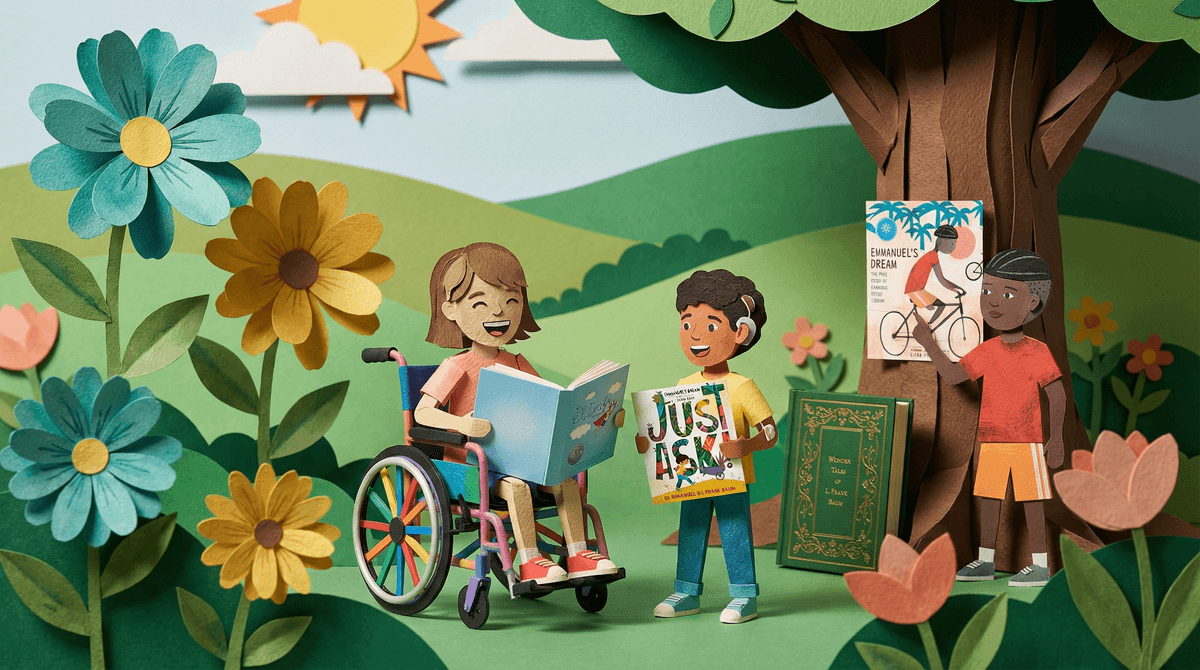
Just Ask! Be Different, Be Brave, Be You by Sonia Sotomayor – Yes, the Supreme Court Justice wrote a children's book. It features kids with different disabilities (including Sotomayor's own Type 1 diabetes) working together in a garden. Simple, joyful, normalizing.
El Deafo by Cece Bell – This graphic novel memoir about a girl with hearing loss who wears a Phonic Ear is brilliant. It's funny, it's real, and it doesn't sugarcoat the social challenges while also celebrating the protagonist's confidence.
Emmanuel's Dream by Laurie Ann Thompson – The true story of Emmanuel Ofosu Yeboah, who rode a bicycle 400 miles across Ghana with one leg to prove that disability doesn't mean inability. This one's genuinely inspiring without being inspiration porn because it's about changing societal barriers, not "overcoming" disability.
Ages 8-12: Middle Grade
Wonder by R.J. Palacio – You probably know this one. Auggie has a facial difference, and the book tackles bullying, friendship, and perspective-taking. Fair warning: some disability advocates critique it for being told partly from able-bodied perspectives. But it's a solid entry point for conversations about difference and kindness.
Out of My Mind by Sharon M. Draper – Melody has cerebral palsy and is brilliant but can't speak. This book will wreck you (in a good way) as it explores how people assume intellectual disability when someone can't communicate in typical ways. Essential reading for understanding ableism.
Insignificant Events in the Life of a Cactus by Dusti Bowling – Aven was born without arms, and this book is refreshingly matter-of-fact about it. She's funny, she solves mysteries, she makes friends. The disability is part of her life but not the whole story.
A Kind of Spark by Elle McNicoll – Written by an autistic author about an autistic girl advocating for a memorial to women accused of witchcraft (many of whom were likely autistic). This book centers autistic experience without making autism something to be fixed.
Ages 13+: Young Adult
The Silence Between Us by Alison Gervais – A Deaf teen navigates a new hearing school. Written by a Deaf author, it's both a romance and an honest look at Deaf culture and the exhaustion of constant advocacy.
Darius the Great Is Not Okay by Adib Khorram – Darius has clinical depression. This book beautifully portrays mental illness as a disability without making it his entire identity. Also deals with being Iranian-American and finding belonging.
Read these books together when possible, especially with younger kids. They'll have questions. That's good! Questions like "Why doesn't she have arms?" or "What's wrong with his face?" aren't inherently rude—they're kids trying to understand. Your job is to help them ask respectfully and understand the answers.
Use the correct language. Person-first language ("person with autism") vs. identity-first language ("autistic person") depends on individual preference. The disability community is split on this. When in doubt, follow the language the book uses or ask the person you're talking about.
Don't make it a one-time thing. One book about disability doesn't check a box. Make diverse books—including books with disabled characters—a regular part of your rotation. Representation shouldn't be an event; it should be normal.
Watch for your own discomfort. If you feel weird reading these books or talking about disability, your kid will pick up on that. Examine why. Often it's because we weren't given this vocabulary or framework as kids. That's okay—you're learning together.
Books with disabled characters aren't "special interest" reading. They're windows into experiences your kid needs to understand and mirrors for kids who rarely see themselves in stories.
The goal isn't to turn your kid into a disability studies scholar. It's simpler: help them see disabled people as people—complex, interesting, fully human people who deserve respect, inclusion, and the same shot at being the protagonist of their own story.
Start with one book. Have the conversation. See where it goes. And if your kid asks why someone in their class uses a wheelchair or stims or has a service dog, you'll have given them the foundation to approach that person with curiosity and kindness instead of fear or pity.
That's worth the $15 and the 30 minutes of reading time.
Not sure where to start? Get book recommendations based on your kid's age and interests . Or check out our guide to building a diverse home library for more ideas on representation that goes beyond disability.