

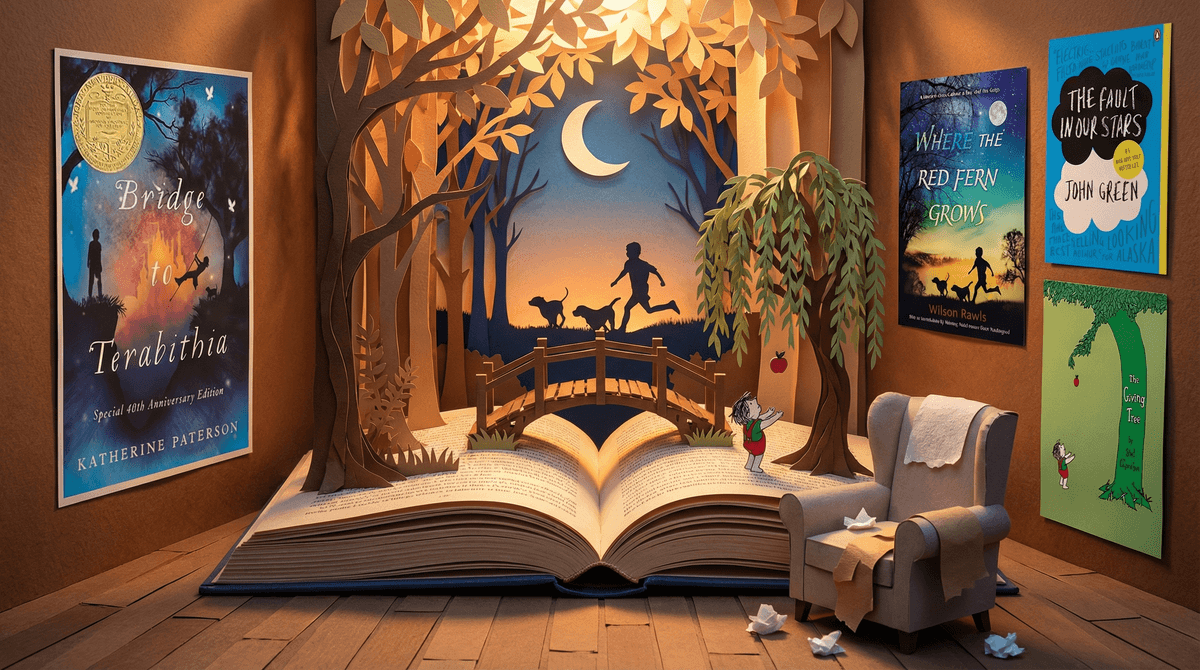
Books That Hit Different: When 'Light Reads' Leave You Emotionally Wrecked
TL;DR: Some books look like breezy reads but pack serious emotional punches. Whether it's Bridge to Terabithia, The Fault in Our Stars, or Where the Red Fern Grows, these "surprise trauma" books have been blindsiding readers for generations. Here's what you need to know before your kid picks one up—and how to help them process the feels.
You know that moment when your kid comes downstairs, red-eyed and clutching a book, and you're like "Wait, I thought you were reading something about a dog?"
Yeah. About that dog.
There's a whole category of books that look completely innocent on the surface—cute covers, wholesome premises, maybe even a Newbery Medal slapped on the front—but then BAM, emotional devastation. These aren't marketed as heavy reads. They're not shelved in the "prepare to ugly cry" section. They're just... there, waiting to wreck your kid on a random Tuesday night.
And honestly? Sometimes that's exactly what kids need. But it helps to know what's coming.
These books serve an important purpose. They're often a kid's first experience with processing grief, loss, injustice, or mortality through fiction. That's valuable! Stories give us a safe container to feel big feelings and practice emotional resilience.
But the "surprise factor" can be a lot. When a book shifts from "fun adventure about friendship" to "oh god everyone is crying and I don't know how to handle this," kids can feel genuinely blindsided. Some bounce back fine. Others need support processing what they just read.
The key is knowing which books pack these punches—and being ready to talk about them.
Ages 8-12
This one is LEGENDARY for traumatizing unsuspecting readers. It starts as this beautiful story about two kids creating an imaginary kingdom in the woods. Friendship! Creativity! Adventure! And then... well, if you know, you know. If you don't know, just understand that this book has been making kids cry since 1977.
What parents should know: The sudden tragedy happens about two-thirds through. There's no warning. It's realistic and handled thoughtfully, but it's a LOT for kids who aren't expecting it. Great for discussions about grief, but maybe not ideal for bedtime reading.
Ages 9-13
"It's about a boy and his hunting dogs!" Yes. And also about loss, loyalty, and the kind of crying where you can't breathe properly.
This book has broken entire generations of readers. The ending is devastating—not just sad, but devastating. Multiple deaths. Graphic descriptions. The works.
What parents should know: This is often assigned in schools (usually 5th-6th grade), so your kid might not have a choice about reading it. The themes are mature and the emotional impact is significant. Definitely worth checking in about.
Ages 13+
Okay, this one is marketed as a tearjerker, so it's not exactly a surprise. But teens often pick it up thinking "oh, a romance" and don't fully grasp that it's about terminal cancer until they're already emotionally invested.
The writing is beautiful. The characters are compelling. And yes, you will cry. Your teen will cry. Everyone cries.
What parents should know: This deals with death, illness, and mortality in very direct ways. There's also some sexual content (not explicit, but present). Best for older teens who can handle complex emotional themes.
Ages 11-15
This one sneaks up on you. It's about a boy visited by a monster who tells him stories. Sounds fantasy-ish, maybe a little spooky? Nope. It's about a kid processing his mother's terminal illness through metaphor and magical realism.
It's absolutely beautiful. It's also absolutely gutting.
What parents should know: The illustrations (by Jim Kay) are haunting. The themes are heavy—grief, anger, guilt, loss. But it's also one of the most honest depictions of what it feels like to lose a parent. If your family is dealing with serious illness, this might be either healing or too close to home. Use your judgment.
Ages 12+
Another school assignment classic. Kids go in expecting a story about teenage gangs and class conflict (which it is), but they're often not prepared for the violence, death, and trauma that comes with it.
What parents should know: Multiple character deaths, some violent. Themes of poverty, abuse, and systemic injustice. It's a great book for discussing social issues, but it's darker than the "classic coming-of-age story" label suggests.
Don't assume picture books are safe from emotional damage! These can hit even harder because kids (and adults) aren't expecting depth from "a book with pictures."
Ages 4-8
Is it a heartwarming story about unconditional love? Is it a deeply troubling tale of exploitation and codependency? Depends who you ask! Either way, adults tend to find this one WAY more upsetting than they remember from childhood.
Ages 3-7
This book about a mother's love across her son's lifetime seems sweet until you're sobbing at 8 PM on a Wednesday because TIME IS A RELENTLESS MARCH TOWARD DEATH and also your baby is growing up.
What parents should know: This one hits different when YOU'RE the parent. Your kid will probably be fine. You will not.
Ages 8-12
This seems like an uplifting story about a kid with facial differences learning to navigate school. And it IS that! But it's also about bullying, exclusion, and the cruelty kids can inflict on each other. The emotional moments hit hard.
What parents should know: This is generally a positive, hopeful book, but there are some genuinely painful scenes. Great for empathy-building and discussions about differences and kindness.
Ages 9-12
A Holocaust story told through the eyes of a Danish girl helping her Jewish friend escape. It's less graphic than some Holocaust literature, but the fear, danger, and loss are very real.
What parents should know: Age-appropriate introduction to Holocaust history, but still deals with death, persecution, and moral complexity.
Ages 9-14
This starts as a quirky story about a boy at a desert detention camp and evolves into something much darker—intergenerational trauma, racism, injustice, and violence.
What parents should know: The ending is satisfying and the overall tone is more "weird" than "depressing," but there are heavy themes throughout. Often assigned in 5th-6th grade.
Ages 13+
Narrated by Death. DEATH. During World War II. If that doesn't signal "emotional devastation ahead," I don't know what does. But somehow people still pick this up thinking it'll be a light historical fiction read.
What parents should know: Beautiful prose, important themes, multiple deaths (it's narrated by Death, remember?), and a gut-wrenching ending. For mature teens who can handle complex, heavy material.
Ages 14+
Teens often pick this up because it's about high school and friendship. But it deals with mental illness, trauma, abuse, suicide, and sexual assault—all revealed gradually throughout.
What parents should know: This is an important book for many teens, but it covers serious content. Worth reading yourself first if you want to know what your teen is processing.
1. Ask about the book beforehand "What's it about? What made you pick it?" can give you a sense of whether they know what they're getting into.
2. Check reviews Common Sense Media is your friend. A quick search can tell you if there are major content warnings.
3. Normalize checking in "How's the book going? Is it what you expected?" opens the door for them to share if something is hitting hard.
4. Don't over-warn There's a difference between "heads up, this book deals with some heavy themes" and "SPOILER ALERT: THE DOG DIES." Let them have their reading experience, just be available for processing afterward.
Validate their feelings "That sounds really sad" or "It makes sense you're upset" goes a long way. Don't minimize it with "it's just a book."
Ask what they're thinking about Sometimes kids need to process the themes more than the plot. "What do you think the author wanted you to feel?" can open good conversations.
Share your own experiences "I remember reading Where the Red Fern Grows and crying so hard" helps them feel less alone.
Offer a palate cleanser Sometimes they just need to read something light and fun afterward. Check out some cozy, comfort reads to have on hand.
Books that emotionally wreck us are often the ones we remember forever. They teach empathy, help us process difficult emotions, and show us we're not alone in our feelings.
But yeah, it would be nice to have a heads up sometimes.
The goal isn't to shield kids from emotional books—it's to be aware of what they're reading so you can support them through it. Some kids will breeze through Bridge to Terabithia without a tear. Others will be devastated for days. Both reactions are valid.
The best thing you can do? Be available. Check in. And maybe keep some tissues handy.
Want age-appropriate book recommendations that won't emotionally destroy your kid? Or looking for books that tackle tough topics gently? We've got you.