

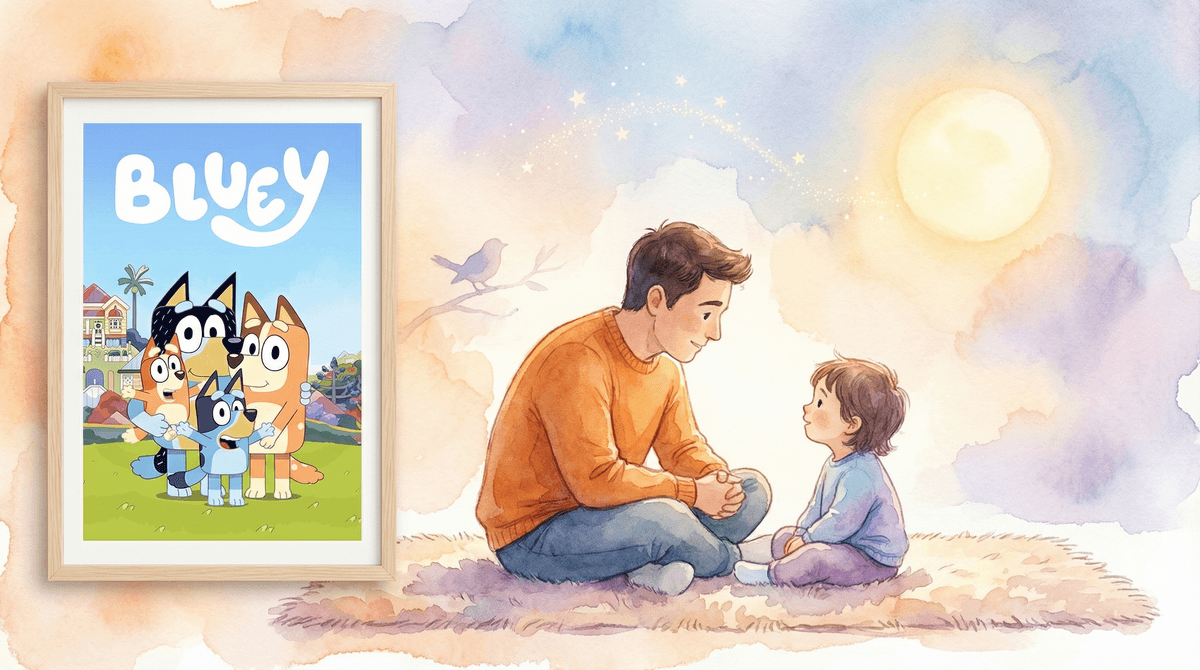
6 Bluey Episodes That Teach Emotional Intelligence (and What to Say After)
TL;DR: Bluey isn't just adorable—it's basically a masterclass in emotional development disguised as a kids' show. These six episodes tackle big feelings (disappointment, jealousy, anxiety, empathy) in ways that 4-6 year olds actually understand, and they give you perfect conversation starters for after the credits roll.
Jump to the episodes:
- Sleepytime - Separation anxiety & independence
- Copycat - Death, loss & processing hard things
- Flatpack - Frustration & perseverance
- Baby Race - Comparison & self-doubt (this one's for you, parents)
- Octopus - Empathy & perspective-taking
- Sticky Gecko - Disappointment & emotional regulation
Most kids' shows either talk down to children or throw in a ham-fisted "lesson" that makes everyone cringe. Bluey does something different: it shows real family dynamics where parents mess up, kids have big feelings, and nobody's perfect. The episodes are only 7 minutes long, which means you can watch one, pause, and actually have a conversation before your kid moves on to the next thing.
The show's created by Australian animator Joe Brumm, who based it on his own experiences raising two daughters. That authenticity shows. The emotional beats feel real because they are real—these are the actual moments that happen in homes with young kids every single day.
The setup: Bingo tries to sleep in her own bed all night, but keeps ending up back with Mum. The whole episode is a dreamscape set to Holst's "Jupiter" (yes, really), where Bingo literally journeys through space trying to reach her own planet.
Why it matters: This episode tackles separation anxiety and the push-pull of wanting independence while still needing comfort. It's visually stunning and emotionally devastating in the best way. Fair warning: you might cry.
What to say after:
- "Bingo wanted to sleep in her own bed, but she also wanted to be close to Mum. Have you ever felt like you wanted to do something by yourself AND have help at the same time?"
- "What did you think about Bingo's dream? What would your own planet look like?"
- For kids working on sleeping independently: "It's okay to need help sometimes. Growing up doesn't happen all at once."
Age sweet spot: 4-6 year olds dealing with bedtime separation, though honestly this one hits at any age.
The setup: Bluey finds a hurt budgie in the yard, tries to help it, but the bird doesn't make it. She processes this by playing "copycat" with Dad, literally copying everything he does as a way to work through her feelings.
Why it matters: This is one of the only kids' shows that directly addresses death with preschoolers, and it does it without being morbid or scary. The episode shows that play is how young kids process difficult experiences.
What to say after:
- "Bluey felt sad about the bird. What did she do when she felt sad?" (Validate that playing and being silly can be part of grieving)
- "Sometimes sad things happen and we can't fix them. That's really hard."
- "Did you notice how Dad let Bluey play the copycat game even though it was kind of annoying? Sometimes people need to do things that help them feel better."
Age sweet spot: 4-6 year olds who've experienced loss of a pet, or as preparation for that inevitable moment.
The setup: Dad's assembling flatpack furniture (hello, IKEA trauma) while Bluey and Bingo play "growing up" using the cardboard and bubble wrap. The whole episode parallels the frustration of assembly instructions with the challenges of life stages.
Why it matters: It's about perseverance when things are hard and frustrating. The metaphor is beautiful—life doesn't come with perfect instructions, and that's okay.
What to say after:
- "Dad got really frustrated with that furniture. What did he do? Did he give up?"
- "Bluey and Bingo's game showed growing up—learning to walk, going to school, all the hard stuff. What's something hard you've learned to do?"
- "Sometimes things don't work the first time. Or the second time. Or the third time. That's normal."
Age sweet spot: 4-6 year olds learning new skills (reading, riding a bike, tying shoes) and getting frustrated with the process.
The setup: Chilli (Mum) tells the story of when Bluey was a baby and all the other babies were walking first. Chilli felt like she was failing until another mum told her, "You're doing great."
Why it matters: Okay, this one's technically for parents, but your 4-6 year old is absorbing the message too: everyone develops differently, comparison is pointless, and sometimes we all just need to hear we're doing okay.
What to say after:
- "All the babies learned to walk at different times. Some were fast, some were slow. But they all learned!"
- "Bluey's mum felt worried because Bluey wasn't walking yet. Have you ever felt worried about something you couldn't do yet?"
- For parents: Maybe just hug your kid and remind yourself you're doing great. Seriously.
Age sweet spot: Any age, but especially helpful for kids who are late bloomers or comparing themselves to peers.
The setup: Chloe comes over to play, but she's anxious about her dad being late to pick her up. Bluey doesn't understand why Chloe's upset—her dad is always late, so what's the big deal? Through play, Bluey learns to see things from Chloe's perspective.
Why it matters: This is empathy training 101. Bluey learns that something that seems small to her can feel huge to someone else, and that's valid.
What to say after:
- "Bluey didn't understand why Chloe was upset at first. Why do you think Chloe felt worried?"
- "Have you ever felt worried about something that other people thought was no big deal?"
- "How did Bluey help Chloe feel better?" (She listened and played the game Chloe needed to play)
Age sweet spot: 5-6 year olds developing theory of mind and learning that other people have different feelings and experiences.
The setup: Bluey's at a kid's birthday party and desperately wants the prize from pass-the-parcel. When she doesn't get it, she has a complete meltdown—hiding under a table, refusing to participate, the full 4-year-old experience.
Why it matters: Disappointment is HARD for young kids, and this episode doesn't sugarcoat it. Bluey doesn't immediately bounce back with a lesson learned. She's genuinely upset, and Dad has to help her regulate and rejoin the group.
What to say after:
- "Bluey really wanted that prize. When she didn't get it, what happened to her body?" (Introduce the concept of physical reactions to emotions)
- "What did Dad do to help Bluey feel better?" (He didn't dismiss her feelings, but he also didn't let her stay stuck)
- "Have you ever wanted something really badly and didn't get it? What did that feel like?"
- "What are some things we can do when we feel disappointed?" (Brainstorm coping strategies together)
Age sweet spot: 4-5 year olds who are still learning emotional regulation and need to see that big feelings are normal.
Don't binge them. I know, I know—when you find a show that's actually good, the temptation is to let them watch 47 episodes in a row. But these work best when you watch one, talk about it, and let the concepts sink in before moving to the next.
Pause and predict. Before the resolution, hit pause and ask "What do you think will happen?" or "What would you do?" This gets kids thinking actively instead of just absorbing.
Revisit them. When your kid is dealing with disappointment in real life, you can reference Sticky Gecko: "Remember when Bluey didn't get the prize? This feels kind of like that, doesn't it?"
Let them play it out. After watching Copycat, don't be surprised if your kid wants to play copycat for three days straight. That's them processing. Let it happen (even though it's annoying).
The show respects both kids and parents. Unlike most children's programming, the parents in Bluey aren't idiots. They're tired, they make mistakes, they have their own emotional journeys—but they show up and do the work. It's refreshing.
It's not preachy. There's no "today we learned" moment at the end. The lessons are embedded in the story, which means kids absorb them naturally instead of feeling lectured.
Some episodes will wreck you. Sleepytime, Baby Race, and Grandad—have tissues ready. You'll be crying about a cartoon dog family, and that's fine. We've all been there.
It's Australian. Which means some vocabulary differences (capsicum instead of pepper, rubbish bin instead of trash can) and cultural references your kid might not get. This is actually a bonus—it's a gentle introduction to the fact that people in other places do things differently.
Bluey is what happens when someone who actually understands child development makes a TV show. These six episodes give you concrete opportunities to talk about emotional intelligence concepts that are typically hard to explain to 4-6 year olds: empathy, disappointment, perseverance, grief, anxiety, and self-compassion.
The show's available on Disney+ in the US (though some episodes are weirdly banned—you can look up why if you're curious). Each episode is 7 minutes, which is the perfect length for a young attention span and a meaningful post-show conversation.
Your kid will laugh at the silly parts, you'll appreciate the emotional depth, and everyone wins. Plus, the theme song is an absolute banger that will live in your head rent-free for the next three years. You're welcome.
- Start with Sleepytime or Sticky Gecko depending on what your kid is dealing with right now (separation anxiety vs. disappointment)
- Watch one episode, then talk about it using the conversation starters above
- Notice what your kid gravitates toward—they'll often replay episodes that resonate with what they're processing emotionally
- Check out other shows that teach emotional intelligence if you want to expand beyond Bluey
- Use the Find Bluey episodes for emotional development to find more specific episode recommendations based on what your kid is going through