

Look, I get it. You're trying to give your kindergartener a solid math foundation, but the last thing you want is to turn screen time into another battle or accidentally introduce them to some sketchy app that's basically a slot machine disguised as counting practice.
The good news? There are actually some genuinely excellent math games out there that make early number sense fun without the garbage. The trick is knowing which ones are worth your time (and money), and which are just dressed-up worksheets that'll make your kid hate math before first grade.
Let's break down the best options—both digital and hands-on—that actually work for building kindergarten math skills like counting, number recognition, simple addition and subtraction, shapes, and patterns.
Prodigy Math
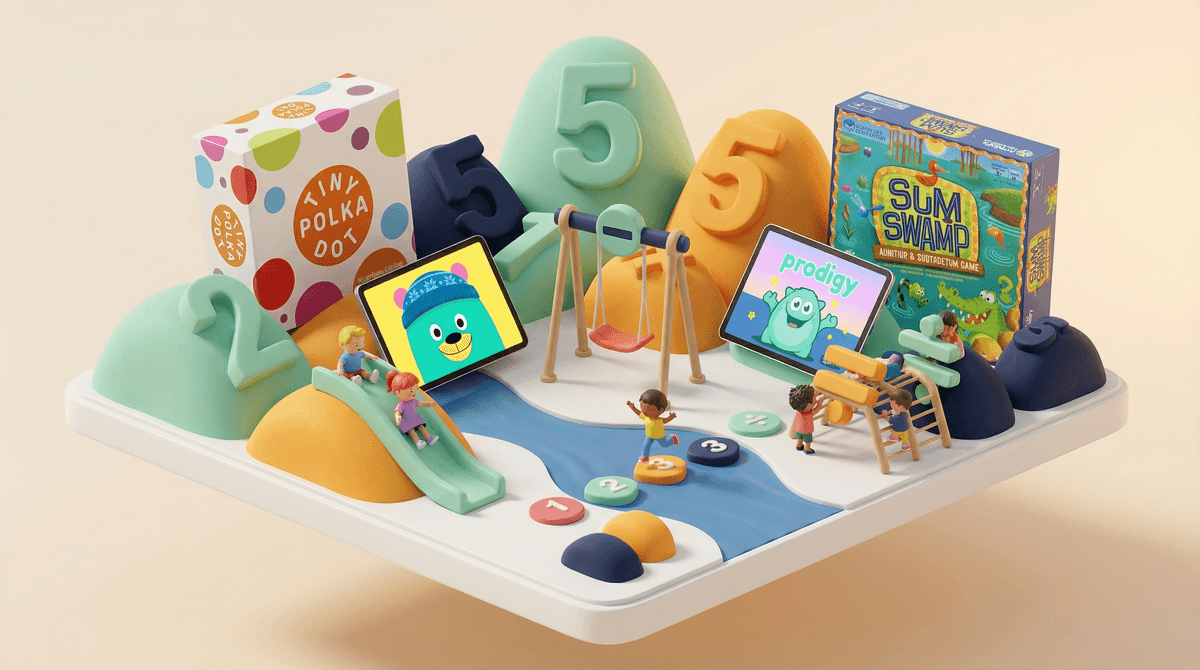
Prodigy Math is basically Pokémon meets math practice, and it's surprisingly effective. Kids battle monsters by solving math problems that adapt to their level. The free version is solid, though they'll definitely try to upsell you on the premium membership (which your kid will absolutely ask for because of course they will).
What works: The adaptive learning actually adjusts to where your kid is at. If they're crushing single-digit addition, it'll move them forward. If they're struggling with number recognition, it slows down.
The catch: The monetization can feel aggressive. Your kindergartener doesn't need the premium pet, but they'll want it. Set expectations early.
Best for: Ages 5-7, especially kids who are motivated by games and rewards.
Endless Numbers
This one's from the same folks who made Endless Alphabet, and it's genuinely delightful. Cute monsters teach number recognition, counting, and simple addition through interactive puzzles and animations.
What works: Zero ads, no subscriptions, just a one-time purchase. The animations are actually entertaining (for you too, honestly). It focuses on number sense rather than just rote memorization.
The catch: It's iOS only, and it's not free (though it's usually under $10).
Best for: Ages 4-6, especially kids who respond well to visual learning and silly characters.
Khan Academy Kids
Khan Academy Kids is the unicorn of educational apps: completely free, zero ads, no in-app purchases. It covers way more than just math (reading, social-emotional learning, etc.), but the math section is excellent for kindergarten.
What works: It's built by actual educators. The progression makes sense. Your kid can work independently while you make dinner without worrying they're going to accidentally purchase 10,000 gems.
The catch: The interface can feel a bit... earnest? Some kids find it less engaging than flashier games. But honestly, that's a feature, not a bug.
Best for: Ages 2-7, especially if you want something you can trust completely.
Todo Math
This one flies under the radar but it's genuinely excellent for early math concepts. It covers counting, addition, subtraction, and even early multiplication through mini-games that are actually well-designed.
What works: It's built specifically for early learners. The difficulty curve is gentle. The free version gives you enough to know if your kid likes it.
The catch: The full version requires a subscription, but it's reasonable (~$10/month or ~$60/year).
Best for: Ages 3-6, especially kids who need extra support with foundational concepts.
Here's the thing: the best math learning for kindergarteners often isn't digital at all. If you can get your kid engaged with physical games, you're building number sense in a way that screens just can't replicate.
Spot It! 123
Spot It! 123 is the numbers version of the classic matching game. Fast-paced, requires zero setup, and sneakily teaches number recognition and counting.
Best for: Ages 4+, especially kids who like fast games and friendly competition.
Sum Swamp
This board game from Learning Resources is basically Candy Land meets addition and subtraction. Kids roll dice, solve simple problems, and race through a swamp. It's goofy and effective.
Best for: Ages 5-7, especially kids who are ready for basic addition/subtraction practice.
Tiny Polka Dot
Tiny Polka Dot is a card game that teaches subitizing—the ability to instantly recognize quantities without counting. This is a foundational skill that makes all future math easier.
Best for: Ages 3-6, especially if you want to build real number sense.
Screen time isn't the enemy, but context matters. Twenty minutes of Khan Academy Kids is wildly different from twenty minutes of random YouTube videos about Skibidi Toilet (though honestly, if you don't know what that is yet, consider yourself lucky ).
).
The best math games feel like play, not work. If your kid is groaning through it, it's not worth it. There are enough good options that you can find something they actually enjoy.
Physical games > screens for this age. Kindergarteners are still building fine motor skills and spatial reasoning. Rolling dice, moving pieces, and handling cards all contribute to development in ways that tapping a screen doesn't.
Watch out for "educational" apps that are just dressed-up slot machines. If an app is constantly pushing you to watch ads for rewards or buy premium currency, it's not actually educational—it's training your kid to be a consumer. Prodigy Math toes this line, which is why setting expectations is crucial.
Ages 4-5: Focus on number recognition, counting to 20, and basic shapes. Endless Numbers and Khan Academy Kids are perfect here.
Ages 5-6: Start introducing simple addition and subtraction (within 10), patterns, and comparing quantities. [Todo Math](https://screenwiseapp.com/media/todo-math-game and physical games like Sum Swamp work great.
Ages 6-7: Work on addition and subtraction within 20, skip counting, and early problem-solving. Prodigy Math can be good here if you manage the monetization piece.
The best math game for your kindergartener is the one they'll actually play without you having to beg. Start with Khan Academy Kids because it's free and trustworthy. If your kid needs more engagement, try Endless Numbers or [Todo Math](https://screenwiseapp.com/media/todo-math-game.
But also? Buy a deck of cards and play Go Fish with numbers. Get some dice and race to see who can build a tower with that many blocks. Math is everywhere, and the more you can make it feel like regular life instead of "learning time," the better.
And if you're wondering whether your family's approach to educational screen time is working, Screenwise can help you figure that out with personalized guidance based on what other families in your community are doing.