

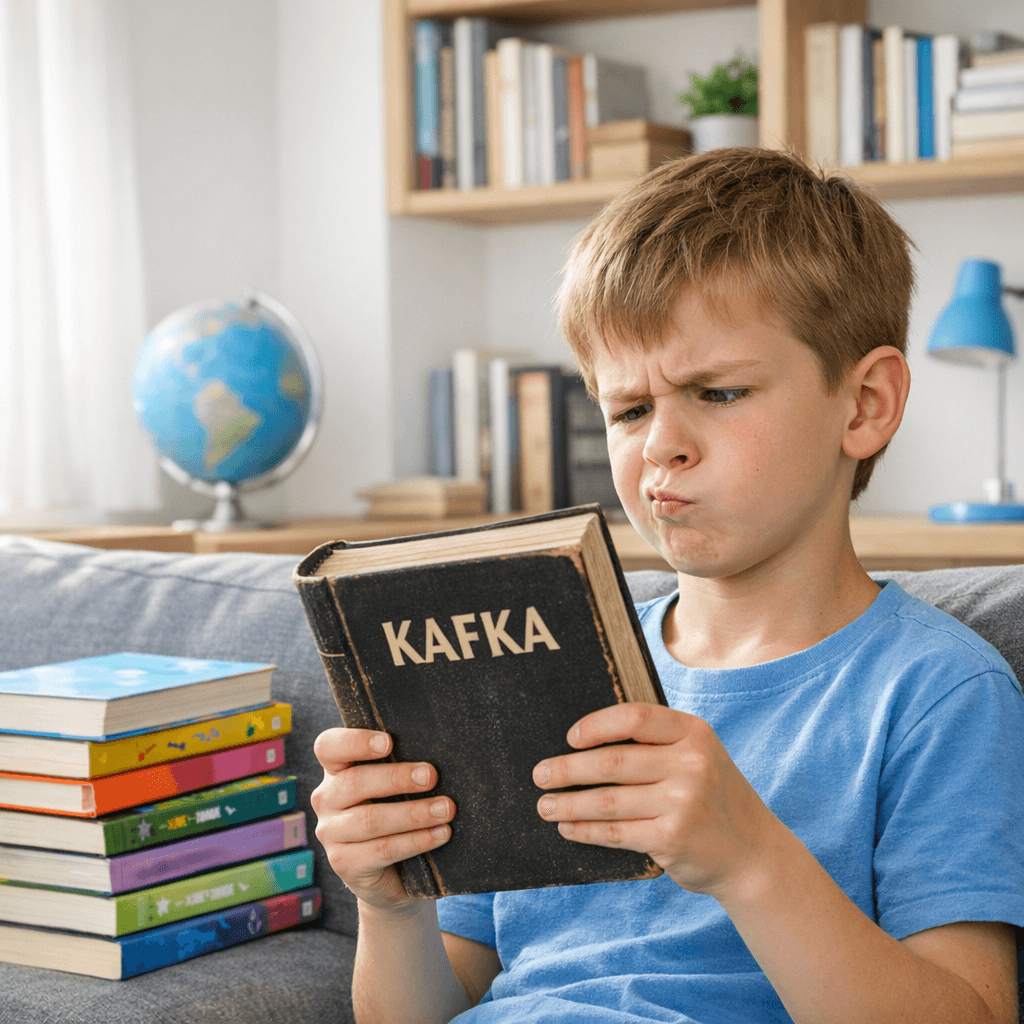
Kafka for Kids? Finding Age-Appropriate Existential Literature for 3rd Graders
Your 8-year-old asking about Kafka probably isn't ready for The Metamorphosis (waking up as a giant bug and dying alone is a lot). But if you've got a kid drawn to weird, philosophical, or slightly unsettling stories, there are absolutely books that capture that Kafkaesque vibe without the existential despair. Here's what to reach for instead:
- The Phantom Tollbooth by Norton Juster - Absurdist adventure with wordplay and bureaucracy
- The Wild Robot by Peter Brown - Robot questions existence and belonging
- Coraline by Neil Gaiman - Unsettling parallel world with bureaucratic horror
- The Arrival by Shaun Tan - Wordless graphic novel about alienation and bureaucracy
- A Wrinkle in Time by Madeleine L'Engle - Fighting conformity and sameness
First, let's be real: Franz Kafka wrote stories about people turning into insects, being tried for unknown crimes, and navigating absurd bureaucratic nightmares. His work explores alienation, powerlessness, and the absurdity of existence. Not exactly Dog Man territory.
But if your third grader is asking about Kafka—maybe they overheard you talking about work feeling "Kafkaesque," or they're the kind of kid who gravitates toward the weird and unsettling—they're probably drawn to:
- Absurdist humor (things that don't make logical sense but somehow work)
- Feeling like an outsider (not fitting in, being misunderstood)
- Questioning authority (why do adults make such weird rules?)
- Surreal or dreamlike settings (worlds that feel slightly off)
- Bureaucracy and pointless rules (okay, this one's a stretch for 8-year-olds, but stick with me)
The good news? There are tons of books that hit these themes without the crushing nihilism.
Ages: 8-12
This is the gold standard for absurdist children's literature. Milo, a bored kid, drives through a mysterious tollbooth into a world where letters and numbers are at war, where you literally jump to conclusions (on an island), and where you have to eat your words before you can speak.
The bureaucracy is real: there's a Which/Witch who imprisons Rhyme and Reason, and the Senses Taker who fills out endless forms. The wordplay is dense (some jokes will go over third-grade heads, but that's fine). The underlying message—that curiosity and learning make life meaningful—is pure Kafka-meets-optimism.
Why it works: Absurd rules, surreal landscapes, and a protagonist who feels disconnected from the world around him. But unlike Kafka, Milo actually finds meaning and connection.
Ages: 7-10
Roz is a robot who wakes up alone on an island with no memory of how she got there. She doesn't belong—animals are scared of her, she doesn't understand their language, and she has to figure out how to survive in a world that wasn't built for her.
This is Kafka's alienation without the despair. Roz learns to adapt, builds relationships, and ultimately finds belonging—but the questions she asks (What is my purpose? Why am I here? What does it mean to be alive?) are deeply philosophical.
Why it works: The outsider perspective, the struggle to understand an incomprehensible world, and the slow realization that identity is something you create, not something given to you.
Ages: 9-12 (some kids will handle it at 8, some won't—know your kid)
Coraline finds a door to a parallel world where everything is almost perfect—except her Other Mother has buttons for eyes and wants to trap her forever. The Other World is bureaucratic in its own way: everything runs on twisted rules, and Coraline has to navigate a system designed to keep her powerless.
This one's genuinely creepy (more Tim Burton than Kafka, but there's overlap). It's about feeling unseen by your real parents, questioning reality, and realizing that freedom is better than a comfortable cage.
Why it works: Surreal horror, a protagonist who feels misunderstood, and a world that operates on dream logic. Plus, Gaiman has openly cited Kafka as an influence.
Parent note: Some kids find this book terrifying. If your kid loved Scary Stories to Tell in the Dark, they'll probably be fine. If they're still scared of The Nightmare Before Christmas, maybe wait a year.
Ages: 7-12
This wordless graphic novel follows an immigrant arriving in a strange new city where nothing makes sense—the language is incomprehensible, the food is weird, the animals are surreal, and the bureaucracy is overwhelming (there's a whole sequence of him navigating immigration paperwork).
It's the most Kafkaesque book on this list in terms of pure alienation and absurdist bureaucracy. But it's also hopeful—the protagonist finds community, learns to navigate the system, and builds a new life.
Why it works: Visual storytelling that captures disorientation and powerlessness without words. Perfect for kids who are visual learners or who've experienced feeling like an outsider.
Ages: 9-12
Meg Murry fights a literal embodiment of conformity (IT, the disembodied brain that controls the planet Camazotz). Everyone on Camazotz does the same thing at the same time—bounce balls in sync, open doors in sync, think in sync. It's bureaucratic sameness taken to a horrifying extreme.
The book grapples with individuality, free will, and the cost of fitting in. Meg is an outsider who doesn't conform, and that's ultimately what saves her.
Why it works: The horror of enforced conformity, the surreal science fiction setting, and a protagonist who feels powerless but finds strength in her flaws.
The Giver by Lois Lowry - Often recommended for this vibe, but it's better for 5th-6th grade. The dystopian themes (euthanasia, emotional suppression, loss of color) are heavy for most 8-year-olds.
Kafka's actual short stories - "A Hunger Artist"? "In the Penal Colony"? Hard pass for elementary school. Maybe high school if they're into it.
The Metamorphosis adapted for kids - A few publishers have tried this. They're... fine? But they lose what makes Kafka Kafka (the dread, the absurdity, the lack of resolution), and you're left with "boy turns into bug, family is mean, the end." Just read The Wild Robot instead.
If your kid is drawn to weird, unsettling, or philosophical stories, that's actually a great sign. It means they're:
- Thinking abstractly - They're ready to engage with metaphor and symbolism
- Processing complex emotions - Stories about alienation can help kids make sense of feeling different
- Questioning the world - Absurdist fiction teaches critical thinking about rules and systems
That said, Kafkaesque themes can be heavy. Books about alienation, powerlessness, and absurdity should be balanced with stories about connection, agency, and hope. Make sure your kid's reading diet isn't all existential dread.
How to talk about it:
- Ask what they liked about the weird parts: "Why do you think the author made that choice?"
- Connect it to their life: "Have you ever felt like Roz, like you didn't belong?"
- Reassure them that feeling like an outsider is normal and temporary
If they're reading Coraline or The Arrival and seem anxious, check in. Some kids process dark themes just fine; others need more support.
Your third grader doesn't need to read Kafka to experience Kafkaesque themes. There are plenty of books that capture the absurdity, alienation, and surrealism of his work—without the crushing existential despair.
Start with The Phantom Tollbooth for absurdist humor, The Wild Robot for philosophical questions about identity, or The Arrival for pure visual alienation. If your kid loves those, move on to Coraline or A Wrinkle in Time.
And if they're still asking about Kafka in a few years? Revisit this conversation in high school. By then, they'll be ready for the real thing—and they'll have the emotional tools to handle it.
Explore more philosophical books for kids or Find weird, wonderful reads.