

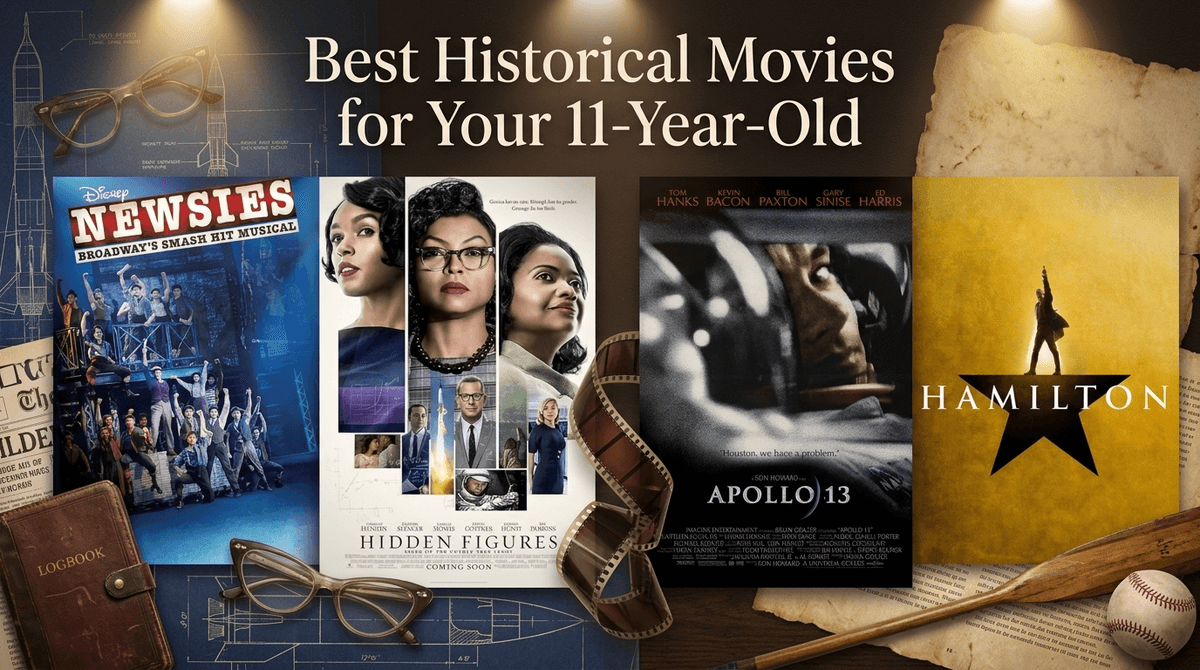
TL;DR: The Best Historical Movies for 11-Year-Olds
If you're looking for a quick win for movie night that isn't just another rewatch of a Marvel movie, these are the heavy hitters for the 11-year-old crowd:
Screenwise Parents
See all- The "Must-Watch": Hidden Figures — Space Race meets Civil Rights.
- The Modern Classic: The Boys in the Boat — 1930s underdog sports drama that actually keeps them focused.
- The High-Stakes Thriller: Apollo 13 — Science, survival, and zero "brain rot."
- The Cultural Phenomenon: Hamilton — Because they probably already know the soundtrack from TikTok.
- The "Gateway" Fiction: Enola Holmes — Victorian London with a modern, fast-paced energy.
Eleven is a weird, wonderful age. Your kid is officially a "tween," which means they’re starting to realize the world didn't actually begin the day they were born. They are moving past the "animated talking animals" phase and starting to crave stories with real stakes.
But let’s be honest: most historical movies are either too dry (hello, three-hour C-SPAN vibes) or too intense (we’re not quite ready for the opening scene of Saving Private Ryan).
The goal here is to find that "Goldilocks" zone—movies that are historically grounded but move fast enough to compete with a YouTube feed. Here is the Screenwise guide to historical films that will actually spark a conversation.
At 11, kids are often deep into STEM at school, and seeing those concepts applied to life-or-death situations makes history feel relevant.
This is arguably the best entry point for this age group. It handles the heavy reality of Jim Crow-era segregation and the sexism of the 1960s with a tone that is empowering rather than soul-crushing. It’s a movie about being the smartest person in the room and demanding the respect you’ve earned. Plus, the math is actually cool.
If your kid thinks history is boring, show them the scene where the engineers have to fit a square peg into a round hole using only spare parts to keep the astronauts from suffocating. It’s a masterclass in problem-solving and teamwork. It’s PG, but the tension is higher than most PG-13 action flicks.
Set in a 1950s mining town, this is the true story of Homer Hickam, a kid who decided he’d rather build rockets than dig for coal. It captures that specific "I want to do something big" feeling that 11-year-olds are just starting to tap into.

Sports movies are the ultimate "stealth" history lessons. They hook kids with the competition and leave them with a sense of the era’s social climate.
Released recently, this film follows the University of Washington rowing team as they head to the 1936 Berlin Olympics. It’s a great way to talk about the Great Depression without it feeling like a lecture. You see the poverty, the desperation, and then the looming shadow of Nazi Germany. It’s PG-13 for some language and smoking, but for a 5th or 6th grader, it’s very manageable.
This is the classic for a reason. It covers the World War II home front in a way that feels vibrant and funny. It touches on the changing roles of women and the racial segregation of the time (in a brief but poignant scene) while keeping the energy of a great baseball movie.
Want to explain the Cold War? Skip the maps and watch the 1980 U.S. Olympic hockey team take on the Soviets. It perfectly captures the "us vs. them" tension of the era through the lens of a hockey rink.
11-year-olds have a very high "fairness" meter. They are developmentally primed to get angry about injustice, which makes these films particularly impactful.
Whether you go with the 1992 Christian Bale movie or the filmed Broadway version, this is the best way to talk about labor rights and the Gilded Age. It’s literally about kids their age standing up to powerful billionaires. It’s high-energy, catchy, and surprisingly accurate about the 1899 newsboys' strike.
This one is PG-13 and definitely carries more weight. There is violence (the bridge scene is intense), but for an 11-year-old who is ready to understand the Civil Rights Movement beyond a one-page bio of MLK, it’s essential. It shows the strategy of the movement, not just the speeches.
A more modern piece of history set in 2001 Malawi. It deals with famine and the intersection of traditional life and modern science. It’s an incredible story of a kid saving his village using a library book and some scrap metal.
Check out our guide on how to talk to your kids about difficult historical topics
Sometimes you just need a "vibe" movie to get them interested in an era. These aren't documentaries, but they nail the setting.
- Enola Holmes: Great for Victorian-era aesthetics and the Suffragette movement.
- Hamilton: The best way to make the American Revolution feel like a high-stakes drama rather than a bunch of guys in powdered wigs.
- Dunkirk: If your kid is into Roblox war games, this PG-13 film is a visceral, almost dialogue-free look at WWII. It’s intense but lacks the gore of most war movies.
By 11, the "PG-13" rating becomes a constant negotiation. In the world of historical movies, PG-13 usually means one of three things:
- War Violence: (e.g., Dunkirk) Intense, but often focused on tension rather than "blood spray."
- Social Reality: (e.g., Selma) Racial slurs or depictions of historical violence that are necessary for the story but can be upsetting.
- "Era" Language: (e.g., The Boys in the Boat) A few more s-words or characters smoking because, well, it was 1936.
Our take: At 11, the context matters more than the rating. Watching a PG-13 historical drama together is a completely different experience than letting them scroll TikTok unsupervised. Use these movies as a bridge to more "grown-up" media.
You don't need to be a history professor to make movie night "educational." Honestly, just asking one or two questions after the credits roll is enough to keep their brains from turning to mush.
- "What part of that was actually real?" This is a great excuse to pull out a phone and spend five minutes on Wikipedia together. Kids love finding out which characters were real people.
- "Why do you think they didn't just [modern solution]?" This helps them understand that people in the past weren't "dumb," they just had different tools and social constraints.
- "How would that story be different if it happened today?" This is the ultimate "critical thinking" question.
Historical movies for 11-year-olds shouldn't feel like a chore. They should feel like a window into a world that was just as messy, exciting, and high-stakes as the one they’re living in now.
Start with Hidden Figures or Newsies. They’re safe bets that actually deliver on entertainment. If they’re into sports, go with The Boys in the Boat.
The goal isn't for them to memorize dates; it's for them to realize that history is just a collection of people who decided to do something interesting.