

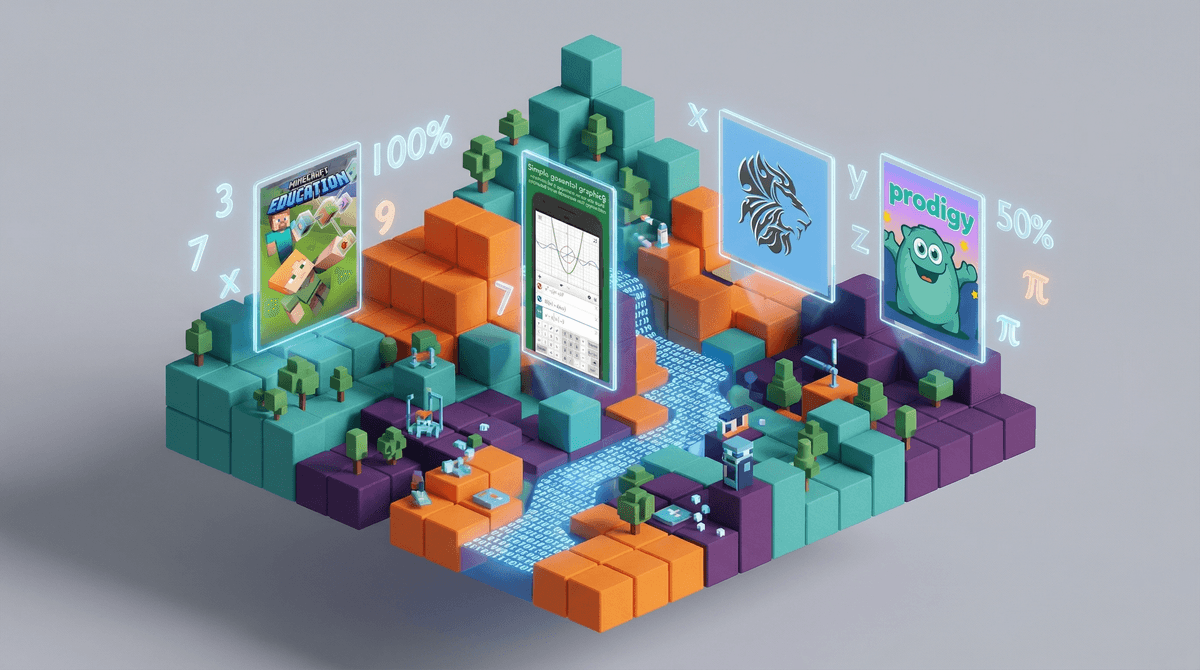
Sixth grade math is where things get real. We're talking pre-algebra concepts, negative numbers, ratios, percentages, and the kind of word problems that make everyone's brain hurt a little. It's also the year when many kids start to decide whether they're "math people" or not—which is honestly heartbreaking because that mindset can stick.
The good news? There are actually some legitimately engaging digital math games that don't feel like thinly-veiled worksheets. These aren't your "solve 50 problems to unlock a new hat for your avatar" situations (though some of those exist too). The best math learning games for this age group blend problem-solving, strategy, and genuine gameplay in ways that make kids forget they're doing math.
Sixth grade is a pivotal year. Kids are developing abstract thinking skills, which is exactly what pre-algebra demands. They're also at an age where peer perception matters intensely—nobody wants to be seen playing a "baby game" or something that screams "educational software from 2003."
The sweet spot is finding games that:
- Feel like actual games kids would choose to play
- Build conceptual understanding, not just procedural memorization
- Scale appropriately so they're not too easy or frustratingly hard
- Don't require constant parent supervision to navigate
Prodigy Math
Prodigy Math is essentially a Pokemon-style RPG where kids battle creatures by solving math problems. It's wildly popular with this age group—around 40% of 6th graders have used it at some point, often because their school has a subscription.
The good: It's genuinely engaging. Kids actually want to play it. The adaptive learning means problems adjust to their skill level. The curriculum alignment is solid for 6th grade standards (ratios, integers, expressions, equations).
The real talk: The free version is pretty aggressive with upsells for the premium membership. Your kid will definitely ask about it. Also, while the math is legit, some of the gameplay can become a bit grindy—solving problems to earn currency to buy pets to make battles easier. It's not quite as predatory as Roblox, but the freemium model is definitely there.
Best for: Kids who love RPGs and collecting things. If your kid is into Pokémon or similar games, this is a no-brainer.
DragonBox Algebra
DragonBox Algebra is brilliant for introducing algebraic thinking without the intimidation factor. It starts with visual puzzles that gradually transform into actual algebraic equations—kids are solving for x before they even realize what they're doing.
The good: No ads, no subscriptions after the initial purchase (around $8-15 depending on the version). The progression is beautifully designed. It builds genuine conceptual understanding of what algebra actually is rather than just teaching rules to memorize.
The real talk: It's not an endless game. Once they complete it, they're done. Some kids find it a bit slow-paced compared to more action-heavy games. It's also not comprehensive—it focuses specifically on algebraic thinking, so you'll want other resources for geometry, data analysis, etc.
Best for: Kids who are anxious about algebra or who need to build foundational understanding before tackling traditional pre-algebra.
Minecraft Education Edition
Yes, seriously. Minecraft Education Edition has math-specific worlds and lessons that use the game's building mechanics to teach concepts like area, perimeter, volume, and coordinate planes.
The good: If your kid already loves Minecraft, this leverages that existing engagement. The 3D spatial reasoning involved in Minecraft naturally supports geometric thinking. Many schools have licenses, so your kid might already have access.
The real talk: This requires more setup and parent/teacher guidance than plug-and-play games. You'll need to find or create the right worlds/lessons. It's also not as directly tied to curriculum standards as purpose-built math games. But for the right kid, building a scale model city while calculating ratios and areas? That's the dream.
Best for: Kids who are already Minecraft devotees and respond well to project-based learning.
Desmos Activities
Desmos is technically a graphing calculator, but their classroom activities are legitimately fun. Things like "Polygraph" (a guess-who style game with geometric shapes) or "Marbleslides" (creating equations to guide marbles through obstacles) are engaging and build real mathematical thinking.
The good: Completely free. No ads. Created by actual math educators who care about conceptual understanding. Works on any device with a browser.
The real talk: These are activities, not a comprehensive curriculum. You'll need to guide your kid to specific activities or have them assigned by a teacher. The interface is clean but not "gamified" in the way some kids expect.
Best for: Kids who like puzzles and don't need flashy graphics. Also great for parents who want to work through activities with their kid.
Beast Academy (from Art of Problem Solving)
Beast Academy is more of a full online curriculum than a game, but it's got comic-book style lessons and genuinely challenging problems that go beyond standard 6th grade fare.
The good: Excellent for kids who are ahead in math or who find regular math class boring. The problems require creative thinking, not just formula application. The comic format makes it more approachable than traditional textbooks.
The real talk: This is challenging. Like, actually hard. It's not the right fit for kids who are struggling with grade-level concepts. It's also a subscription ($15/month or $120/year). And while it's more engaging than a textbook, it's still fundamentally doing math homework, not playing a game.
Best for: Math-loving kids who need more challenge. The ones who finish their classwork early and are bored.
The worksheet trap: Some "math games" are literally just digital worksheets with a thin veneer of game mechanics. If the gameplay stops whenever there's a math problem, and the math feels completely disconnected from the game world, that's not a real math game—that's homework with extra steps.
Freemium fatigue: Many math games use free-to-play models with premium subscriptions. This isn't inherently bad, but be aware that your kid will encounter upsells. Decide upfront whether you're willing to pay for premium features or if you're committed to the free version.
Progress tracking rabbit hole: Many of these platforms offer detailed parent dashboards showing every problem your kid solved. This can be useful, but resist the urge to micromanage. If your kid is engaged and their understanding is improving, that matters more than whether they got 87% or 92% on last Tuesday's session.
Let them choose: Show your kid 2-3 options and let them pick. They're way more likely to stick with something they selected.
Set realistic expectations: 15-20 minutes a few times a week is plenty. This isn't meant to replace math class—it's supplemental practice that doesn't feel like punishment.
Play together sometimes: Especially with Desmos activities or Minecraft Education, doing some together can be genuinely fun and helps you understand what they're learning.
Don't make it a punishment: If math games become the consequence for poor grades, they'll start to hate them. Keep it positive.
Balance with other math experiences: Digital games are great, but also: cooking (fractions and ratios), building things (measurement and geometry), managing an allowance (percentages and budgeting). Real-world math matters too.
The best math game for your 6th grader is the one they'll actually use. Prodigy Math is the crowd favorite for good reason—it's engaging and comprehensive. DragonBox Algebra is perfect for building algebraic thinking without stress. Minecraft Education Edition is ideal if your kid already loves Minecraft. Desmos is the free, no-nonsense option. And Beast Academy is for the kids who need a challenge.
None of these will magically transform a math-phobic kid into a mathematician overnight. But they can make practice feel less like punishment and more like play—which at this age, when kids are forming their mathematical identities, matters a lot.
The goal isn't to add more screen time for the sake of it. It's to make the screen time that happens actually useful. Twenty minutes of genuinely engaged problem-solving in Prodigy beats an hour of frustrated worksheet grinding any day.
Not sure which one fits your kid's learning style? Find recommendations for your kid about your specific situation—we can help you figure out what'll actually work for your family.
Also, if your kid is struggling with math anxiety (not just needing practice), that's a different conversation. Let's talk about math anxiety and how to approach it, because no app can fix that alone.