

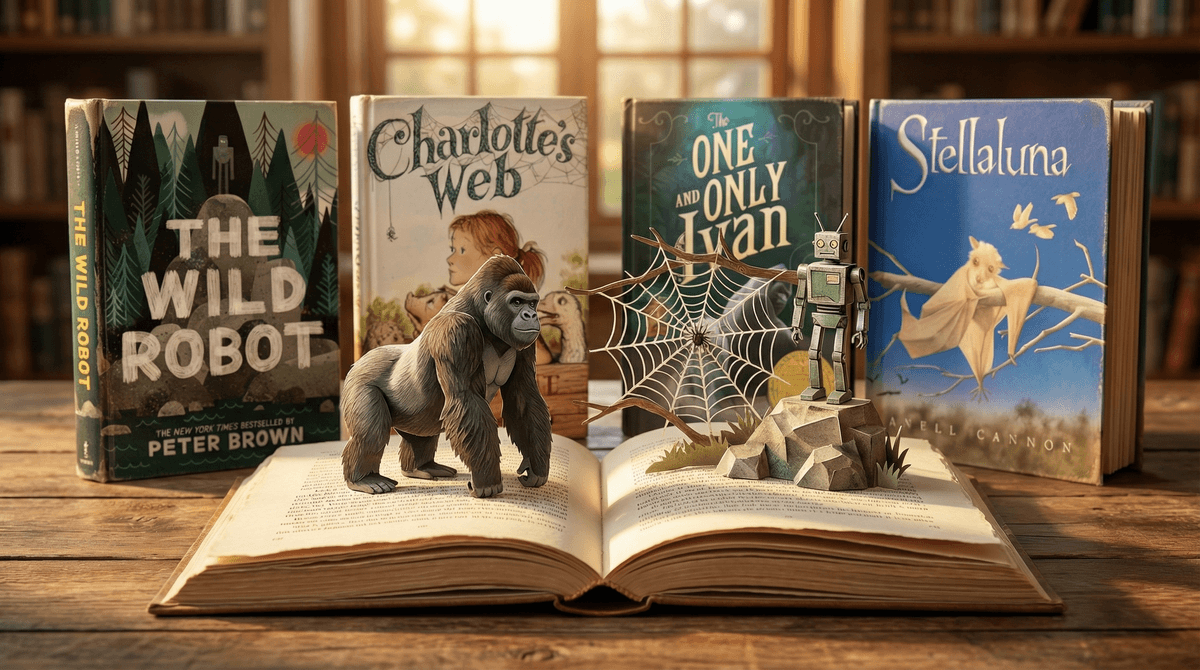
Look, we're not talking about dusty encyclopedias of the animal kingdom here (though those have their place). We're talking about the stories that make kids feel something—the ones where a pig saves a spider, where a mouse goes on an epic quest, where a dog's loyalty breaks your heart in the best way possible.
Animal books are having a moment, and honestly, they've always had a moment. From Charlotte's Web to Warriors to The One and Only Ivan, there's something about animal protagonists that lets kids explore big emotions and complex situations with just enough distance to feel safe.
And here's the thing: in an age where your kid's default entertainment is YouTube shorts or Roblox, a really good animal book can be the gateway drug to actual sustained reading. Not screen time. Not "educational" apps that are basically just dressed-up dopamine hits. Real, deep, imagination-building reading.
Kids gravitate toward animal stories for a few reasons that are actually pretty fascinating:
Animals don't judge. When a character is a dog or a bear or a talking mouse, kids can project their own feelings without the baggage of human social dynamics. A shy kid can see themselves in a timid rabbit without feeling called out.
The stakes feel real but safe. A story about a wolf surviving in the wilderness hits different than a story about a kid dealing with divorce—even though both can teach resilience. The animal lens creates emotional distance that paradoxically allows for deeper emotional processing.
They're learning empathy without a lecture. When your 8-year-old reads about how factory farming works in Charlotte's Web, they're not getting preached at—they're just really worried about Wilbur. That's how you build compassion that sticks.
Ages 3-6: Picture Books That Pack a Punch
-
The Gruffalo - A mouse outsmarts predators through pure creativity. Kids love it, parents don't mind reading it 47 times.
-
Stellaluna - A baby bat raised by birds learns about identity and belonging. Gets me every time.
-
Giraffes Can't Dance - About finding your own rhythm when you feel different. Not subtle, but effective.
Ages 6-9: Chapter Books That Hook Them
-
Charlotte's Web - The GOAT. Friendship, death, sacrifice, the meaning of life—all through a pig and a spider. If your kid hasn't read this, start here.
-
The Wild Robot - A robot learns to survive in nature by observing animals. Gorgeous illustrations, surprisingly deep themes about what it means to be alive.
-
Pax - A boy and his fox separated by war. This one's heavy but beautifully written. Have tissues ready.
-
Hatchet - Technically about a boy, but his survival depends entirely on understanding animal behavior. Classic for a reason.
Ages 9-13: Books That Respect Their Intelligence
-
Warriors series - Clans of feral cats with complex politics and battle scenes. Your kid will read all 87 books in this series and become insufferable about cat breeds. Let it happen.
-
Watership Down - Rabbits fleeing destruction, building a new society, dealing with authoritarianism. It's basically The Odyssey with bunnies. Ages 10+ because it gets dark.
-
The One and Only Ivan - A gorilla in a mall reflecting on captivity and freedom. Based on a true story. Will wreck you and your kid in the best way.
-
Redwall series - Medieval fantasy with mice, badgers, and epic feasts described in mouth-watering detail. Great for kids who love Lord of the Rings but aren't quite ready for the density.
These aren't "easy" books. Some parents dismiss animal books as less sophisticated than realistic fiction. That's nonsense. Watership Down tackles fascism. Charlotte's Web deals with mortality. These stories go DEEP.
Death is a common theme. Like, really common. Animal stories often involve predator/prey dynamics, natural selection, or the circle of life. This isn't a bug, it's a feature—these books help kids process the concept of death in a way that feels less scary than human death. But heads up if your kid is particularly sensitive.
Some get surprisingly violent. The Warriors series has battle scenes. Watership Down has graphic violence. Always good to skim reviews on Common Sense Media or our media pages before handing over a book to a younger or sensitive reader.
They're building real skills. When your kid reads about how a wolf pack operates or how birds migrate, they're learning actual biology and ecology. When they follow a character making hard choices, they're developing moral reasoning. This isn't just entertainment—it's education that doesn't feel like homework.
Read together, even with older kids. A 10-year-old might roll their eyes at "family reading time," but there's something magical about experiencing a great story together. Plus you can pause and talk about the themes as they come up.
Connect to real animals. Reading The Wild Robot? Watch some nature documentaries together. Reading Warriors? Visit a cat shelter. Making those connections from fiction to reality deepens the learning.
Let them draw, write, create. Kids who love animal books often want to create their own animal characters and stories. This is GOLD for developing creativity and writing skills. Encourage it. Even if it's fanfiction about warrior cats. Especially if it's fanfiction about warrior cats.
Use them as conversation starters. "Why do you think Charlotte helped Wilbur?" "What would you do if you were Brian in Hatchet?" These aren't teacher questions—they're genuine curiosity about how your kid thinks.
In a world where every tech company is fighting for your kid's attention with algorithms designed by PhDs in addiction, a really good animal book is a rebellion. It's slow. It requires imagination. It builds empathy in a way that no app ever will.
Will your kid still want to play Roblox? Yes. Should you let them? That's between you and your family's screen time philosophy. But adding rich, emotionally complex animal stories into the mix gives them something screens can't: the experience of getting completely lost in a world they have to build entirely in their own mind.
Start with one book. See what happens. My money's on Charlotte's Web if you're unsure—it's a classic for a reason, and it works for a huge age range (roughly 6-12, but honestly adults cry too).
And if your kid falls in love with reading because of a story about a pig and a spider? That's a win that'll pay dividends for life.
Want personalized book recommendations based on your kid's age, interests, and reading level? Get animal book recommendations for your kid to get specific suggestions.
Trying to balance books with screen time? Check out our guide to building sustainable reading habits that don't require you to completely ban devices (because let's be real, that's not happening).
Looking for more book recommendations across different genres? Browse our full library of book guides organized by age and interest.