

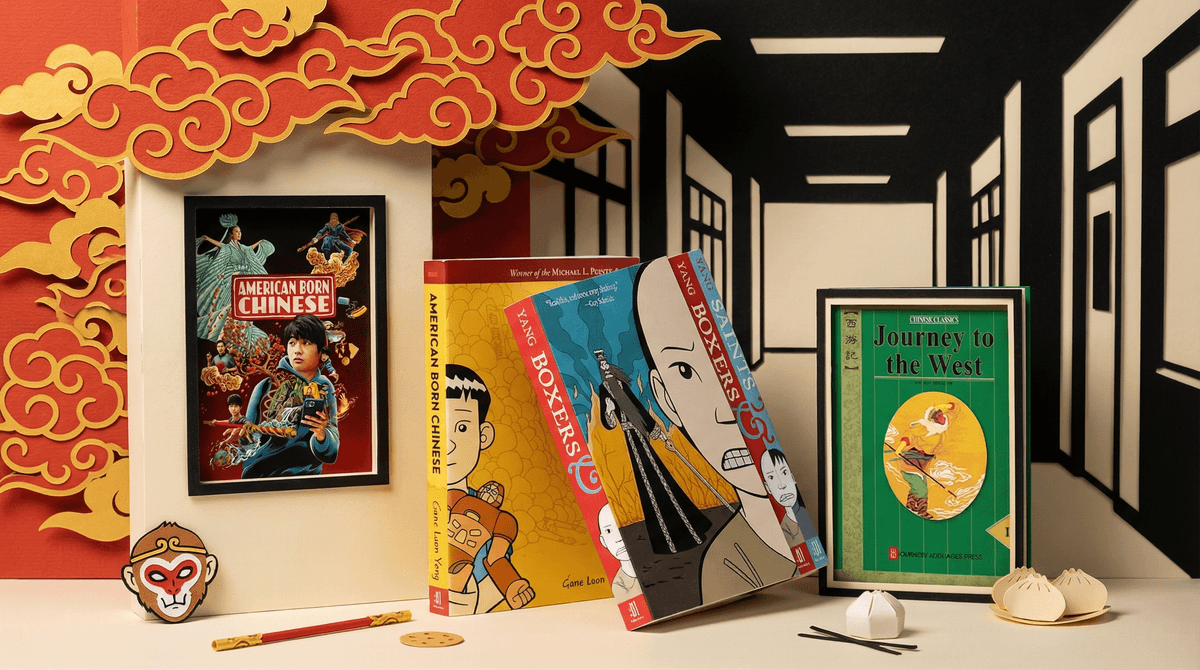
American Born Chinese by Gene Luen Yang is a groundbreaking graphic novel that won pretty much every award a book can win—the Printz Award, National Book Award finalist, and it was the first graphic novel nominated for a National Book Award. Published in 2006, it weaves together three seemingly separate stories: Jin Wang, a Chinese-American boy trying to fit in at his predominantly white school; the legendary Monkey King from Chinese folklore; and Danny, a popular high school student whose life gets disrupted by his embarrassing cousin Chin-Kee (yes, it's as uncomfortable as it sounds—that's the point).
The stories eventually converge in ways that explore identity, assimilation, and the damage stereotypes inflict on everyone involved. Yang uses the graphic novel format brilliantly—the visual storytelling does heavy lifting that pure text couldn't accomplish, especially when depicting transformation and the masks we wear.
Here's the thing: this book makes people uncomfortable on purpose. The Chin-Kee character is drawn as an offensive Asian stereotype—buck teeth, yellow skin, speaking in broken English with "ching chong" sound effects. It's genuinely hard to look at. Yang isn't endorsing these stereotypes; he's forcing readers to confront how Asian Americans are caricatured and othered in American culture.
For Asian American kids (about 6% of K-12 students nationally, though much higher in certain communities), this book can be deeply validating—finally seeing their experience of navigating two cultures reflected back. For non-Asian kids, it's an important window into experiences different from their own. For all kids, it's about the universal struggle of figuring out who you are versus who others expect you to be.
The book is commonly assigned in middle and high schools, so there's a good chance your kid will encounter it in class (typically grades 7-10). If they're reading it for school, you've got a built-in conversation starter.
Ages 11-13 (Middle School): This is the sweet spot. Kids this age are deep in their own identity formation—trying on different personas, figuring out friend groups, dealing with the awkwardness of not quite fitting anywhere. Jin's story of wanting to be someone else will resonate. The Chin-Kee sections require more context though. Pre-read this one if you can, because you'll want to have conversations about why Yang chose to depict stereotypes so offensively.
Ages 14-17 (High School): Teens can handle the more complex layers—the internalized racism, the way Jin transforms himself to escape his identity, the commentary on model minority myths. They're also more equipped to analyze Yang's artistic choices and understand satire versus endorsement.
Ages 10 and under: Probably hold off. The themes are sophisticated, and younger kids might not have the context to understand why the stereotypical depictions are being used critically rather than casually.
Let's talk about what's actually in here:
Stereotypes and Racial Slurs: The Chin-Kee character uses every offensive Asian stereotype. There are "ching chong" sound effects. A character uses a slur. This is intentional commentary, but it's still painful to read—especially for Asian American readers.
Identity Transformation: Jin literally transforms his physical appearance to become "Danny," a white teenager. This is magical realism, but it's depicting the very real desire some kids feel to escape their ethnic identity.
Bullying and Exclusion: Jin faces social rejection and microaggressions. Other kids won't sit near him, make comments about Chinese food smelling weird, assume all Asians know kung fu.
Romance and Rejection: There's a crush subplot where race plays a role in romantic rejection—a white character's mother forbids her from dating Jin because he's Chinese.
Violence (Mild): The Monkey King sections include stylized martial arts combat typical of the genre. Nothing graphic.
Before they read: "This book uses some really offensive stereotypes on purpose—to show how hurtful they are. Some parts might make you uncomfortable, and that's actually the author's intention. Let's talk about anything that bothers you."
Discussion starters:
- "Why do you think Gene Luen Yang chose to draw Chin-Kee that way? What point was he making?"
- "Have you ever felt like Jin—wanting to be someone different to fit in?"
- "What do you think about the ending? Did Jin make the right choice?"
- "The Monkey King wants to be accepted by the gods. How is his story similar to Jin's?"
For Asian American families specifically: This might bring up a lot. Kids might share experiences of racism or othering they haven't mentioned before. Create space for those conversations. Some families find the stereotypical depictions too painful and choose to skip this one—that's completely valid.
For non-Asian families: This is a window, not a mirror, for your kids. Help them understand they're learning about experiences different from their own. Resist the urge to say "I don't see color" or minimize the racism depicted—it's real and ongoing.
It's not just about race: Yes, race is central, but at its core, this is about the universal adolescent experience of self-rejection and the journey toward self-acceptance. Every kid trying to figure out who they are can find something here.
The format matters: If your kid says "I don't read books," try this one anyway. Graphic novels engage different parts of the brain—the visual storytelling can be more accessible than dense text, especially for reluctant readers or visual learners. (And yes, graphic novels are real reading —they build literacy skills and critical thinking.)
It pairs well with other media: If your kid likes this, they might enjoy Avatar: The Last Airbender (which also explores Asian-inspired cultures and identity), Ms. Marvel (another story about cultural identity), or Yang's other work like Boxers & Saints.
There's a TV adaptation: Disney+ released a series adaptation in 2023 that expands and updates the story. It's a different experience—more sitcom-style, less uncomfortable in some ways. If your kid struggles with reading, the show might be a good entry point, though the book's impact is stronger.
American Born Chinese is one of those rare books that's both important and genuinely engaging. Yes, it tackles heavy themes. Yes, some parts are deliberately uncomfortable. But it's also funny, creative, and ultimately hopeful about the possibility of accepting yourself.
For families navigating identity, belonging, and the pressure to assimilate—whether that's cultural, social, or just the normal middle school survival stuff—this book offers a framework for those conversations. It says: the masks we wear to fit in cost us something essential, and the journey back to authenticity is worth taking.
Read it with your kid if you can. Not hovering-over-their-shoulder reading, but "we're both reading this and can talk about it" reading. The conversations that come out of this book are often more valuable than the book itself.
- Check your school's reading list - If it's assigned, read it before or alongside your kid so you're ready for conversations
- Visit your library - Most libraries have multiple copies because it's so commonly taught
- Explore Gene Luen Yang's other work - Dragon Hoops, Boxers & Saints, and his Superman run all explore identity themes
- Look for companion resources - Many schools provide discussion guides; ask your kid's teacher for theirs
- Curious about other books that tackle identity and belonging? Screenwise can suggest age-appropriate titles based on your family's specific situation.