

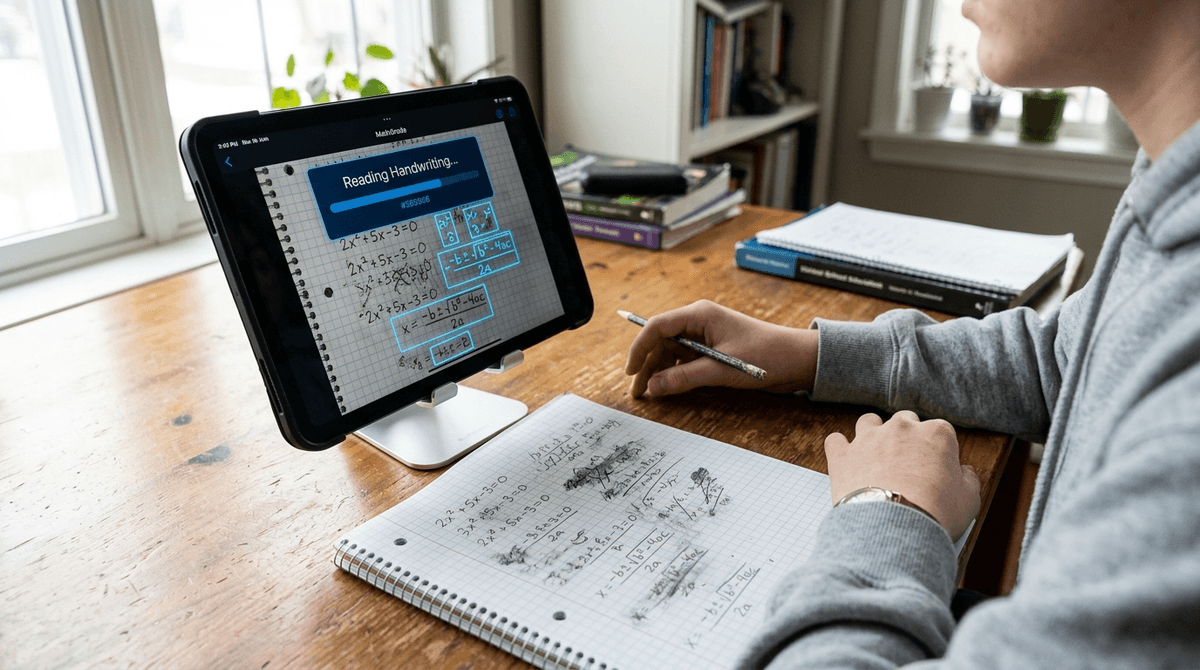
AI can now grade complex handwritten math homework with high accuracy, but it is much more likely to penalize a student for messy handwriting than for a wrong answer.
AI models are remarkably good at following complex grading rubrics for university-level math, but they fail frequently when they cannot decipher a student's handwriting. In the best-performing models, nearly 90% of grading errors were caused by the AI misreading numbers or symbols rather than a misunderstanding of the math itself.
Legibility is shifting from a "nice-to-have" soft skill to a high-stakes technical requirement. As schools increasingly adopt automated grading to handle heavy workloads, a student with perfect logic but messy penmanship risks receiving a failing grade simply because the software couldn't parse a "7" from a "1."
Parents need to recognize that the "interface" between the paper and the computer is now a primary point of failure. This changes the nature of homework help: it’s no longer just about checking the answer, but about auditing the clarity of the work and the quality of the photo being submitted to the portal.
Grading STEM assignments is a notorious bottleneck for educators, often taking days or weeks to return feedback to students. While previous AI attempts required separate steps to first digitize text and then analyze it, new "Vision-Capable" Large Language Models can do both simultaneously. Researchers wanted to see if these models could finally handle the "wild west" of handwritten student work, which includes idiosyncratic symbols, crossed-out lines, and varying image quality.
The top-performing AI model was highly accurate at evaluating STEM work, but its mistakes were predictable and narrow.
- Transcription is the bottleneck. About 87% of the errors made by the best model were "transcription failures," where the AI simply misread what was written on the page.
- Hallucinations are real. The AI occasionally "hallucinated" text or steps that weren't actually on the paper, leading it to penalize students for mistakes they didn't make or credit them for work they didn't do.
- Equivalency issues. The system sometimes struggled to recognize that two different-looking mathematical expressions were actually equal, marking a correct answer wrong because it didn't match the rubric's specific phrasing.
- One-step processing. Unlike older systems, these newer models can look at a photo and assign a grade in a single "thought" process, making the technology much easier for schools to deploy at scale.
The "hidden curriculum" of math is changing. Historically, if a human teacher saw a messy smudge, they could often use context to infer what the student meant. AI lacks that "benefit of the doubt" and defaults to what it thinks it sees. This creates a new form of inequality: students with dysgraphia or fine-motor challenges may be systematically disadvantaged by automated systems that aren't yet tuned to their specific writing styles.
Furthermore, because these models can "hallucinate" errors, a student's grade is no longer a static reflection of their work—it's a probabilistic guess by a machine. We are entering an era where students may need to "debug" their own handwriting to ensure it is machine-readable.
This study is a preprint and has not yet undergone formal peer review. The data was gathered from university-level STEM students, whose handwriting and organizational skills are generally more developed than those of elementary or middle schoolers. We don’t yet know how these models would perform against the more chaotic handwriting of a ten-year-old. Additionally, the study was limited to two specific courses at a single institution, so the results may not perfectly represent how AI would handle a broader range of subjects or grade levels.
- If your child is using an automated math portal, teach them to treat the "submit" button like a final publication step where they audit their own work for clarity and dark, bold lines.
- If your child receives an unexpectedly low grade on an AI-evaluated assignment, request a "transcription check" to see if the software misread a symbol or a decimal point before assuming they didn't understand the material.
- If a student has messy handwriting but strong math skills, encourage them to use a darker pen (like a felt-tip) rather than a light pencil to increase the contrast for the AI's vision sensors.
- If you are helping with homework submission, ensure the photo is taken in bright, even light without shadows; the researchers found that poor image quality was a leading cause of AI "hallucinations."
AI is becoming a competent math grader, but it remains a poor reader of messy ink. Until the technology improves, the clarity of a student's handwriting will be just as important as the accuracy of their equations.
Jacob Levine, Miguel Aenlle, Craig Zilles et al. (2026). Automated Grading of Handwritten Mathematics Using Vision-Capable LLMs. arXiv (preprint). — http://arxiv.org/abs/2605.19043v1