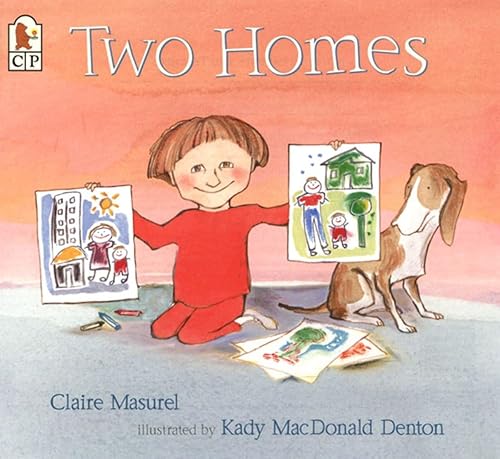
Most divorce books for the preschool set try to explain the why of a breakup, which usually goes over a four-year-old's head. Claire Masurel takes a different route. She focuses entirely on the logistics. To a kid, the existential dread of a family split often manifests as: "Wait, where is my Lego set going to be?" Two Homes answers that by inventorying the mundane.
It’s a masterclass in matching the right book to your child's developmental stage. At this age, the idea of "Mommy and Daddy aren't happy together" is abstract. "Mommy has a soft chair and Daddy has a rocking chair" is real. By focusing on the physical environment, the book helps kids build a mental map of their new life before they even have the vocabulary to talk about their feelings.
The "Two of Everything" Strategy
The book leans heavily into the idea of abundance rather than loss. Alex has two front doors, two bedrooms, and two sets of friends. It’s a strategic rebrand of a difficult situation. Critics and parents consistently point out that this is one of the few titles that doesn't feature a crying child or a scene of parents arguing. It starts after the dust has settled.
If you are looking for books about divorce for kids that address the heavy grief or the "it's not your fault" conversation, this isn't that book. This is the one you read to normalize the back-and-forth. It turns a potentially scary transition into a game of "spot the difference." It’s less about the divorce itself and more about the rhythm of a binuclear family.
Why the simplicity works
You might find the text repetitive, but for a three-year-old, that repetition is armor. The book repeats the phrase "At Mommy's house..." and "At Daddy's house..." until the cadence itself feels like a safety blanket. It’s not trying to be a literary masterpiece. It’s a piece of functional parenting equipment.
Amazon reviewers give it a 4.7 for a reason: it solves a very specific problem. It gives parents a script when they are likely too stressed to write one themselves.
When to skip it
If your family situation is high-conflict or involves a parent who isn't in the picture, this book might feel like fantasy. It assumes a best-case scenario where both parents are fully present, loving, and have stable, cozy housing. If that’s not your reality, the "double the love" message could feel confusing or even painful for a child who isn't seeing one of their parents.
But for the standard "we're living in different apartments now" transition, it’s a staple. It’s the kind of book that sits on the shelf until the week of the move, and then you’ll probably read it until the spine cracks. It’s not high drama, but as a tool for transition, it’s essential.