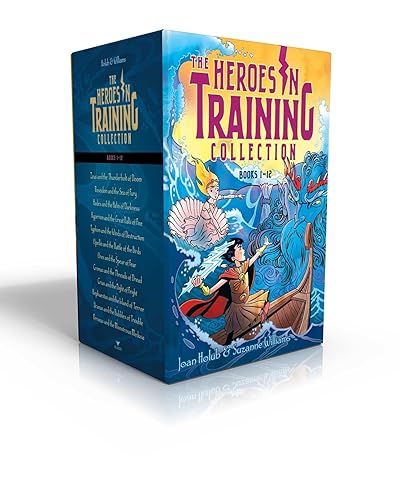
Heroes in Training series

Heroes in Training series

book

2016, Children's Books, Growing Up & Facts of Life

WISE
76%

WISE Score

4.8

Amazon

Greek gods as ten-year-olds fighting titans—mythology lite for the chapter book crowd, heavy on action, light on depth.

Amazon4.8
Common Sense Media

Where to Read

Our reviews and ratings are 100% unbiased, but as an Amazon Associate, Screenwise earns an affiliate fee if you buy a book or game by clicking one of our links. We don't get any credit if you just Google it instead :)

Screenwise Verdict

Heroes in Training does exactly what it sets out to do: give early readers a mythology-flavored adventure series they can actually handle. It's not groundbreaking—think of it as the mythology equivalent of Magic Tree House—but it's competently written, appropriately paced, and genuinely popular with its target audience.

The formula gets old fast if you're reading them aloud as a parent (16 books of "young god gets magical object, fights titan, wins" is... a lot), but for kids building reading independence, the predictability is actually a feature. They know what to expect, which builds confidence.

This won't replace Percy Jackson for older kids or become a beloved classic, but as a bridge between early readers and middle grade fantasy? It's solid. Just don't expect literary magic—expect functional, entertaining mythology-lite that'll keep a 7-year-old turning pages.

Age Fit

Best for ages 6-10, particularly 2nd-4th graders building chapter book stamina. The ten-year-old protagonists and AR 3.6-4.5 reading level hit the sweet spot for early independent readers. By 5th grade, most kids will have outgrown the simplicity.

WISE Breakdown
Wholesome
82

The series centers on young heroes working together to overcome challenges, with clear good-vs-evil dynamics and themes of friendship and cooperation. The protagonists are ten years old, making them relatable to the target audience. The books model teamwork and courage without being preachy, though the constant battle sequences can feel repetitive rather than emotionally nuanced.

Imaginative
75

Greek mythology provides rich imaginative material—gods, titans, magical objects like thunderbolts and helms of darkness. However, this is a well-trodden path in children's literature (Percy Jackson, etc.), and the series follows a fairly formulaic structure across 16 books. Each title follows a similar pattern: [Character] and the [Magical Object/Threat]. It invites kids into mythological worlds but doesn't break new ground or encourage much creative thinking beyond the reading experience itself.

Safe
92

This is straightforward adventure fiction with fantasy violence (battling titans and monsters) that's age-appropriate for early readers. No mature themes, no surprise trauma, no inappropriate content. The mythology-based conflicts are clearly fantastical rather than realistic violence. Amazon's 4.8/5 rating and consistent positive reception suggest no concerning content flags from parents. Reading levels (AR 3.6-4.5, ages 6-10) are well-calibrated.

Enriching
70

The series introduces Greek mythology in an accessible way for early chapter book readers, building cultural literacy and vocabulary. It can spark interest in ancient stories and history. However, these are quick-moving adventure books designed more for entertainment than deep learning—they're not diving into the actual complexity or lessons of Greek myths. The reading level is appropriate for building fluency in 2nd-4th graders, which has developmental value. But ultimately, these are popcorn reads rather than profound literature.

Parent Info
✓

Why It Might Be Great

  • Perfect entry point for kids curious about Greek mythology without the complexity of Percy Jackson
  • Short chapters and fast pacing make it accessible for reluctant readers transitioning from picture books
  • 16 books means if your kid latches on, you've got a long runway of familiar characters and stories
  • Co-authored by Joan Holub (Goddess Girls), so the mythology bones are solid even if simplified
  • Models teamwork and courage—the young Olympians work together rather than going solo hero
⚠

What to Watch For

  • Extremely formulaic—every book follows the same structure, which can feel repetitive by book 5
  • Fantasy violence throughout (battling monsters, titans) but age-appropriate and not graphic
  • The mythology is simplified and Disneyfied—don't expect the weird, dark stuff from actual Greek myths
  • If your kid devours these, they'll likely be ready for Percy Jackson or more complex mythology retellings soon after

Conversation Starters

  • "Which Greek god or goddess would you want to be? What would your special power be?"
  • "The Olympians had to work together to defeat the Titans—when have you had to team up with friends to solve a problem?"
  • "These books make the gods into kids. Do you think that makes them more relatable or less interesting?"
  • "Want to learn about the 'real' Greek myths? Some of them are way weirder than these books..."

Deep Dive

The Percy Jackson on-ramp

Every parent of a second grader eventually hits the Percy Jackson wall. Your kid is obsessed with the idea of lightning bolts and three-headed dogs, but they aren't quite ready to lug around a 400-page Rick Riordan novel. This is where Heroes in Training earns its keep. It functions as the ultimate training wheels for the middle-grade fantasy obsession that's inevitably coming for your bookshelf.

Joan Holub and Suzanne Williams have essentially reverse-engineered the epic quest. They take the heavy hitters of Olympus—Zeus, Poseidon, Hades—and de-age them to ten-year-olds. It’s a smart move because it removes the "ancient marble statue" vibe and replaces it with characters who deal with things your kid actually understands: feeling small, wanting to prove themselves, and figuring out how to work in a group. If your kid is currently vibrating with energy after watching a superhero movie but struggles to sit still for a long chapter, the 100-ish page length of these books is the sweet spot.

The power of the box set

There is a specific kind of magic in a 16-book series for a kid who is just starting to read independently. At this age, novelty is actually the enemy of stamina. When a kid picks up book four, Hyperion and the Great Balls of Fire, they already know the stakes, the tone, and the primary conflict with the Titans. That predictability isn't a bug; it's a feature. It allows them to focus on the actual act of reading rather than trying to figure out the "rules" of a new world every Tuesday.

If you’re looking for high literature or deep thematic resonance, keep moving. These books are the literary equivalent of a Saturday morning cartoon. They are fast, loud, and very focused on the next "boss battle" against a Titan. But for a reluctant reader, that momentum is everything. If you find they've burned through the first twelve books and are asking for more, you might want to broaden their horizons with The Best Mythology Reading List for Kids to see which culture’s legends they want to tackle next.

Mythology without the mess

Real Greek mythology is, frankly, a disaster zone of questionable parenting and even more questionable romance. Heroes in Training scrub-brushes all of that away. You get the cool powers and the monsters without having to explain why Zeus is turning into a swan or why everyone is related to everyone else in a weird way.

The conflict is simplified into a classic "underdog kids vs. giant meanies" dynamic. Cronus and the Titans are the ultimate schoolyard bullies, and the young Olympians are the kids finding their footing. It’s a safe, sanitized introduction. The friction here is mostly physical—battling "Winds of Destruction" or navigating the "Island of Terror"—rather than emotional or complex. It’s a great bridge, but once your kid starts asking why the Titans are so grumpy in the first place, they’ll likely be ready to graduate to more nuanced retellings. For now, let them enjoy the thunderbolts.

Ask Anything

Get a personalized guide on any topic