The most important thing to understand about Galaga is that it wasn't designed to be "fun" in the way modern games are. It was designed to be predatory. Like most hits from Namco Limited in the early '80s, this is a quarter-eater. It starts at a brisk pace and quickly ramps up to a frantic, blinking chaos that is specifically tuned to kill the player in under three minutes.
If you hand this to a kid raised on the gentle progression of Minecraft or the constant dopamine hits of Roblox, they are going to experience immediate friction. There are no save points, no upgrades that persist after a "Game Over," and no participation trophies. You either get the high score or you don't.
The Double-Ship Gamble
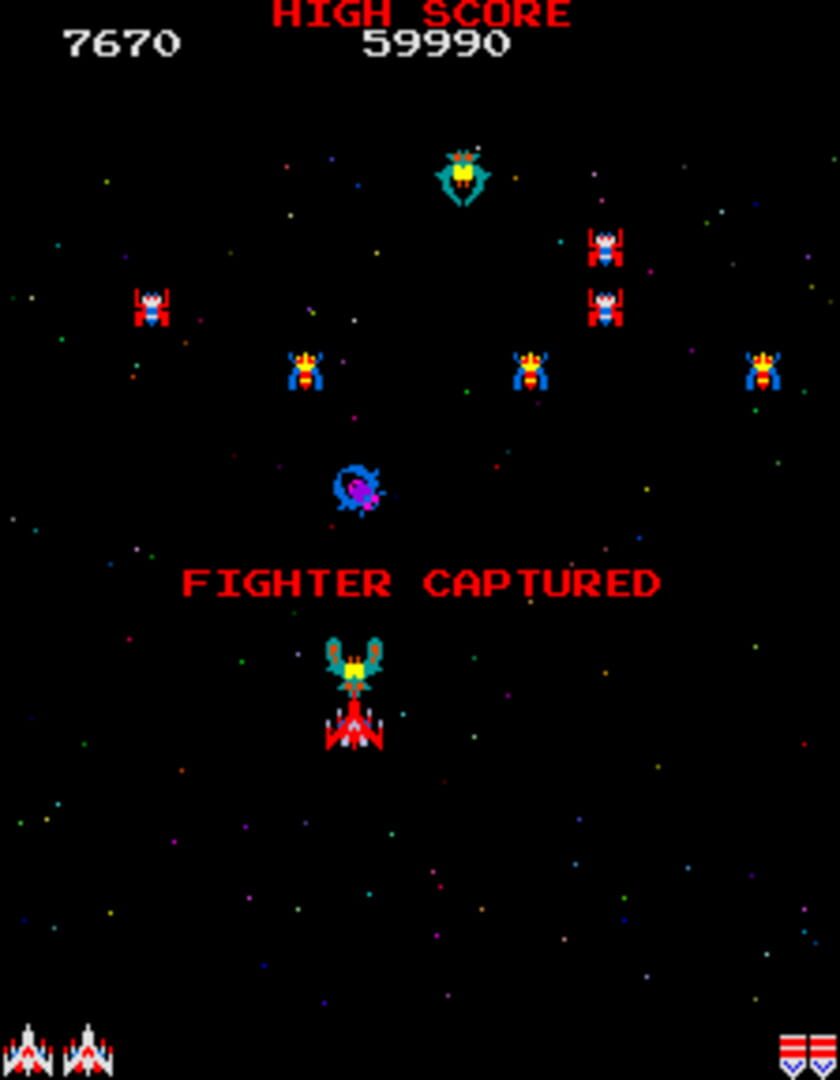
The one reason Galaga still gets discussed while other 1981 shooters have faded into obscurity is the tractor beam. When a "boss Galaga" flies down and tries to kidnap your ship, the instinct for a modern gamer is to dodge. But the pro move is to let it happen.
If you have a spare life, you let your ship get captured, wait for that boss to dive again, and then shoot the boss to release your old ship. Now you’re flying two ships side-by-side. You have double the firepower, but you’re also a double-wide target. It’s a perfect introduction to risk-reward mechanics. I’d suggest pointing this out to your kid early. Without that "dual fighter" strategy, the game is just a repetitive slog. With it, it becomes a high-stakes balancing act.
Why It Usually Fails the "10-Minute Test"
We have to be honest about the boredom factor. Modern games use "loops" that last for dozens of hours. Galaga has a loop that lasts about 45 seconds. You shoot the swarming bugs, you survive the dive-bombers, you do a "Challenging Stage" where nothing shoots back, and then you do it again, just faster.
If you’re looking to introduce your kid to the era of high scores and pixel art, our guide to classic arcade games covers why these relics still matter and how to frame them so they don't feel like a chore. For most kids, Galaga works best as a "palette cleanser" between more complex titles rather than the main event.
The Secret "Cheat" for Parents
If your kid gets frustrated because the game is too hard, you can mention the legendary "no-fire" bug. In certain versions of the game, if you leave a specific enemy alive on the left side and let it fire at you for about fifteen minutes without shooting back, the enemies eventually stop firing altogether. It’s a coding error that turns the game into a peaceful shooting gallery.
Is it cheating? Technically. But in a game this punishing, finding an exploit is a rite of passage. It’s also a great way to show a kid that games are just sets of rules written by humans—and humans make mistakes.
If they find the basic 1981 version too primitive, look for the modern remixes like Galaga Legions or Galaga Wars. They keep the bug-shooting DNA but add the visual flair and progression systems that today's players actually expect. Otherwise, keep this one in the "gaming history" bin for a rainy afternoon.