From board games to simulations
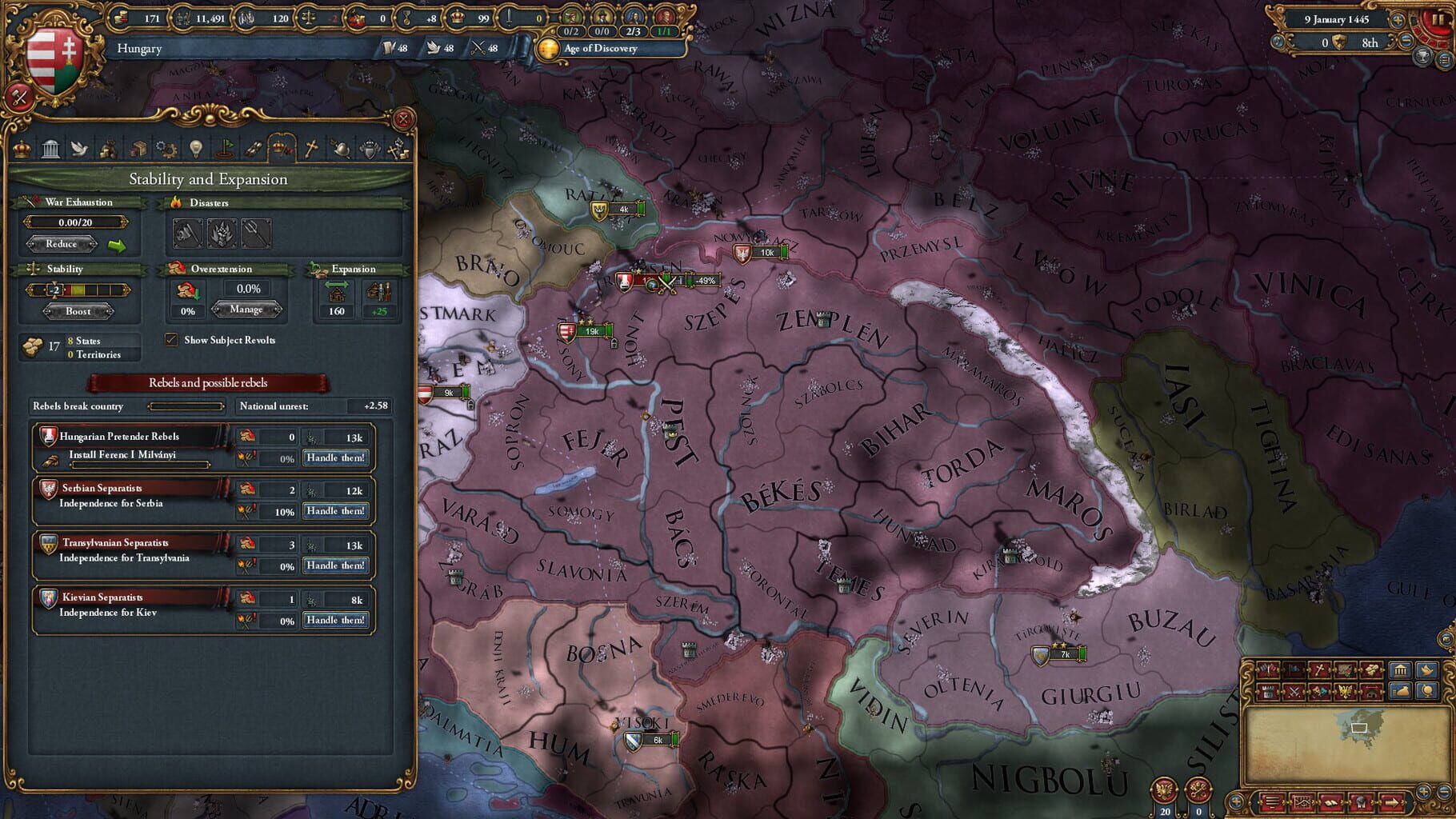
If your teen has already spent a few hundred hours on Civilization VI, they’ve effectively finished the tutorial for the grand strategy genre. Europa Universalis IV is the "hard stuff." While Civ feels like a high-stakes board game with clear turns and hexes, EU4 is a living, breathing, terrifyingly complex simulation of the world from 1444 to 1821.
The biggest shift for a player moving into this space is the lack of a "win" screen. You don't necessarily "win" at EU4; you survive, you expand, and you eventually realize that your 40-hour campaign as Prussia was just an elaborate way to learn about 18th-century administrative efficiency. If your kid is the type who gets frustrated when a game doesn't give them a gold medal every ten minutes, they will hate this. But if they are the type who enjoys the process of mastery more than the victory itself, this is their forever-game.
The "Second Screen" requirement
You will rarely see someone playing EU4 without a web browser open. This is a "wiki game." The internal tutorials are notoriously bad at explaining the "why" behind the "what." A player might see their economy collapsing and have no idea that it’s because they don’t understand how trade power flows from the Ivory Coast to the English Channel.
This creates a specific kind of friction. To get good, your teen has to be willing to research. They’ll be reading forum posts from 2018 and watching 45-minute YouTube breakdowns of how "Aggressive Expansion" works. It’s a massive academic lift disguised as a hobby. If you see them staring intensely at a map of the Holy Roman Empire for three hours, they aren't just playing; they’re basically doing a PhD in 17th-century geopolitics.
The moral vacuum of the sandbox
The most important thing to understand about the "map painting" phenomenon is that the game is a neutral observer. It provides the tools of history—colonization, forced religious conversion, slavery, and total war—and treats them as sliders and modifiers.
For a mature teen, this is an incredible tool for understanding how systems of power worked. They can see how the quest for trade dominance fueled the age of exploration and the subsequent horrors that followed. However, the game doesn't pause to tell the player that what they’re doing is "bad." It only tells them if it’s efficient.
This is why we suggest it for the 15+ crowd. A younger kid might just see "colonizing" as a way to make the map turn their favorite color. An older teen can use it as a springboard to talk about why the world looks the way it does today. For a deeper look at this specific dynamic, check out our guide on why your teen is 'map painting' through the night.
The DLC rabbit hole
While there are no loot boxes or "pay-to-win" mechanics in the modern sense, the studio has released dozens of expansions over the last decade. The base game is often cheap, but the "full" experience can feel like it costs a fortune.
You don't need all of it to have fun, but the community generally considers a few specific expansions essential for the game to actually function correctly. If your teen gets hooked, expect them to ask for "content packs" during every seasonal sale. It’s not predatory, but it is a commitment. Once they start rewriting history, they usually want the full toolkit to do it right.