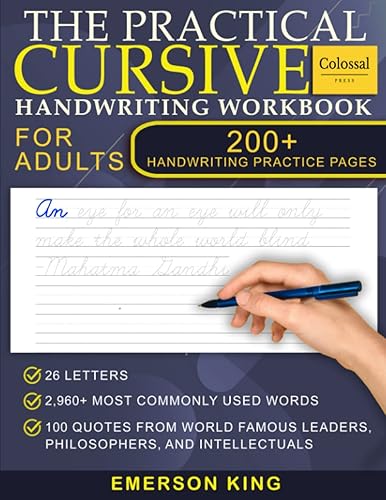
If you’ve ever watched a seventeen-year-old try to sign a legal document and realize they’re essentially drawing a jagged mountain range, you know why books like this exist. We’ve reached a point where cursive is basically a secret code for anyone born after 2005. This workbook is the brute-force solution to that problem. It isn't trying to be "educational entertainment" with mascots or gamified rewards. It is 200 pages of pure, analog repetition.
The "Not for Kids" Advantage
The biggest hurdle in getting a teenager or a young adult to fix their penmanship is the "pre-K" aesthetic of most workbooks. Nobody wants to practice their "G" by tracing a goofy giraffe. This book treats the reader like an adult. If you want your teen to have a legible signature without the cartoon elephants, you should skip the school-grade fluff and go straight to The 200-Page Handwriting Fix: Why Adult Cursive Workbooks Beat the Kids’ Versions.
The content here moves quickly from basic letters to over 1,600 common words. That’s the "Wirecutter" pick of the book: the volume of practice. Most workbooks give you ten pages and wish you luck. This one gives you enough reps to actually build the muscle memory required to write a thank-you note without your hand cramping into a claw.
Dignity in Recovery
While it’s great for students, the workbook specifically calls out its utility for stroke survivors and people dealing with brain injuries. This is where the "large font" and "easy on the eyes" descriptors actually matter. It’s designed for high visibility and low frustration.
There is a certain dignity in the way it presents its exercises. Instead of nursery rhymes, you’re tracing quotes from philosophers and scientists. If you’re supporting someone through rehab, having them write out a thought from an intellectual rather than "The Cat in the Hat" makes the process feel like a workout rather than a regression.
The Friction Factor
Let’s be real: this is a 200-page bound book. It’s thick. Because it’s a standard paperback binding, it doesn't naturally lay flat. If you’re a lefty or someone with limited grip strength, the "gutter" (the middle of the book) is going to be your enemy.
You’ll likely need to "crack" the spine or use a heavy clip to keep it open. It’s a minor annoyance for a casual user, but if you’re using this for genuine physical therapy, that resistance can be a dealbreaker. If the goal is a stress-free "unwind and relax" session, grab a clipboard or a heavy book weight before you sit down.
Why Bother?
In an era of AI and voice-to-text, cursive feels like a vestigial organ. But there’s a real cognitive win here. There is plenty of research suggesting that the physical act of writing things down helps with memory retention and focus.
This workbook is a low-stakes way to reclaim that focus. It’s not a "must-buy" for everyone, but if you’re tired of your kid’s chicken scratch or you want a screen-free way to keep your own brain sharp, it’s a functional, no-frills tool that does exactly what it says on the cover. Just don’t expect it to be "exciting." It’s a workbook, not a thriller. Its value is in the finish line, not the journey.