

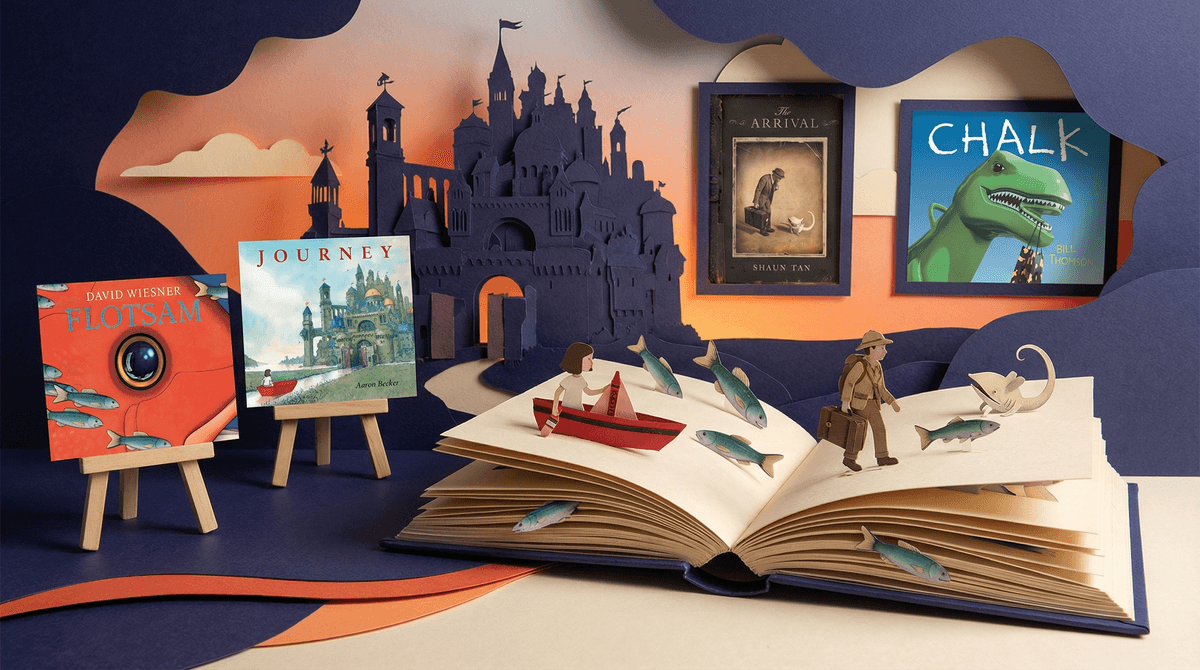
Wordless picture books are exactly what they sound like: books that tell entire stories through illustrations alone, without a single word of text. Think of them as the graphic novels of the preschool set, except instead of speech bubbles, you get pure visual storytelling.
Classic examples include Journey by Aaron Becker, where a lonely girl draws a door with a red crayon and escapes into a magical world, or The Arrival by Shaun Tan, a stunning immigrant story told entirely through sepia-toned illustrations. More recently, books like Chalk by Bill Thomson and Flotsam by David Wiesner have won major awards for their ability to captivate kids without using a single word.
These aren't just picture books with the words removed—they're carefully crafted visual narratives that require readers to actively interpret, predict, and construct meaning from images alone.
Here's the thing: our kids are growing up in a world where they're constantly interpreting visual information. Instagram stories, TikTok videos, YouTube thumbnails, Roblox environments, emoji-heavy texts—modern digital literacy is fundamentally visual.
But here's where it gets interesting: while screens are teaching kids to consume visual content passively, wordless picture books teach them to analyze it actively. When a 4-year-old "reads" a wordless book, they're doing serious cognitive work:
- Making inferences from facial expressions and body language
- Constructing narrative by connecting images across pages
- Developing vocabulary as they describe what they see
- Building attention span by slowing down to notice details
- Creating meaning rather than just receiving it
This is the exact opposite of what happens when they're watching Cocomelon for the 47th time (no judgment—we've all been there). With wordless books, there's no narrator telling them what to think, no dialogue spelling everything out. They have to figure it out themselves.
When kids get older and start navigating digital spaces independently, they need to interpret visual cues constantly: Is this person being sarcastic in their comment? What's the mood of this group chat? Is this YouTube thumbnail clickbait or legitimate content? What's actually happening in this Minecraft tutorial video?
Wordless picture books build the foundation for this kind of visual literacy starting at age 2 or 3. They teach kids to:
- Read emotional subtext (essential for understanding tone in digital communication)
- Notice what's not being shown (critical for spotting manipulation or misleading content)
- Create their own interpretations (rather than accepting whatever the algorithm serves up)
- Slow down and observe carefully (the antidote to infinite scroll)
Plus, wordless books are genuinely interactive in a way that most screen content isn't. Every "reading" can be different depending on what details your kid notices or how they interpret a character's expression. There's no single correct way to tell the story.
Ages 2-4: Start with simple wordless books like Good Dog, Carl by Alexandra Day or A Ball for Daisy by Chris Raschka. The narratives are straightforward, and you can narrate together: "What's the dog doing? Where did the ball go?"
Ages 5-7: Move to more complex stories like Tuesday by David Wiesner or The Lion and the Mouse by Jerry Pinkney. These books have subplots, visual jokes, and details that reward multiple readings.
Ages 8-12: Try sophisticated narratives like The Arrival or Journey. These work almost like graphic novels and can genuinely engage older kids who think they've outgrown picture books.
Ages 12+: Wordless graphic novels like The Silver Path by Benoit Springer bridge to teen reading while maintaining that visual storytelling power.
The beauty of wordless books is that there's no wrong way to approach them, but here are some strategies that work:
First time through: Just look at the pictures together without saying much. Let your kid absorb the story visually.
Second reading: Ask open-ended questions: "What do you think happened here? How is she feeling? What might happen next?"
Third reading: Look for details you missed. Wordless books are packed with visual Easter eggs and background stories.
Let them lead: Encourage your kid to tell YOU the story. There's no text to "get right," so they can't be wrong. This builds confidence and narrative skills.
Make it a conversation: "I noticed the cat in the background—did you see it? I wonder what it's thinking?"
This kind of interactive reading is basically the opposite of passive screen time. You're building connection, language skills, and critical thinking all at once.
These books aren't "easier" than regular books. In fact, they're often more cognitively demanding because kids have to construct the entire narrative themselves. Don't underestimate what your kid is doing when they're "just looking at pictures."
They're perfect for multilingual families. Since there's no text, wordless books work in any language. They're also great for kids with reading difficulties or language delays.
They complement (not replace) regular books. Your kid still needs exposure to written language, phonics, and traditional reading. Think of wordless books as a different tool in the literacy toolbox.
The "reading" gets richer over time. A book your 3-year-old loved will reveal new layers when they're 7. These are genuinely rereadable in a way most early readers aren't.
Look, I'm not going to tell you that wordless picture books are going to magically protect your kids from screen addiction or turn them into visual literacy geniuses. But they are a low-tech, high-engagement way to build skills that will serve them well in our increasingly visual digital world.
Plus, they're just really good books. Flotsam is genuinely mind-blowing. Journey is beautiful enough to frame. And watching your kid interpret a story in their own unique way? That's the good stuff.
In a world where so much of childhood is mediated through screens that tell kids exactly what to think and feel, wordless picture books offer something radical: space for interpretation, imagination, and genuine cognitive work.
They're not a replacement for managing screen time or setting digital boundaries—you still need to do that hard work —but they're a beautiful complement to it.
Start with one book. Hit your library or bookstore and grab Journey, Chalk, or any David Wiesner book. See what happens.
Make it a regular thing. Add wordless books to your bedtime rotation or quiet time routine.
Notice the transfer. Pay attention to whether your kid starts noticing more visual details in other contexts—in regular books, on walks, even on screens.
Let go of "reading it right." The point isn't to tell the "correct" story. The point is to engage, interpret, and create meaning together.
And if your kid would rather watch Bluey for the 800th time? That's okay too. Bluey is actually pretty great. But maybe try a wordless book tomorrow.