

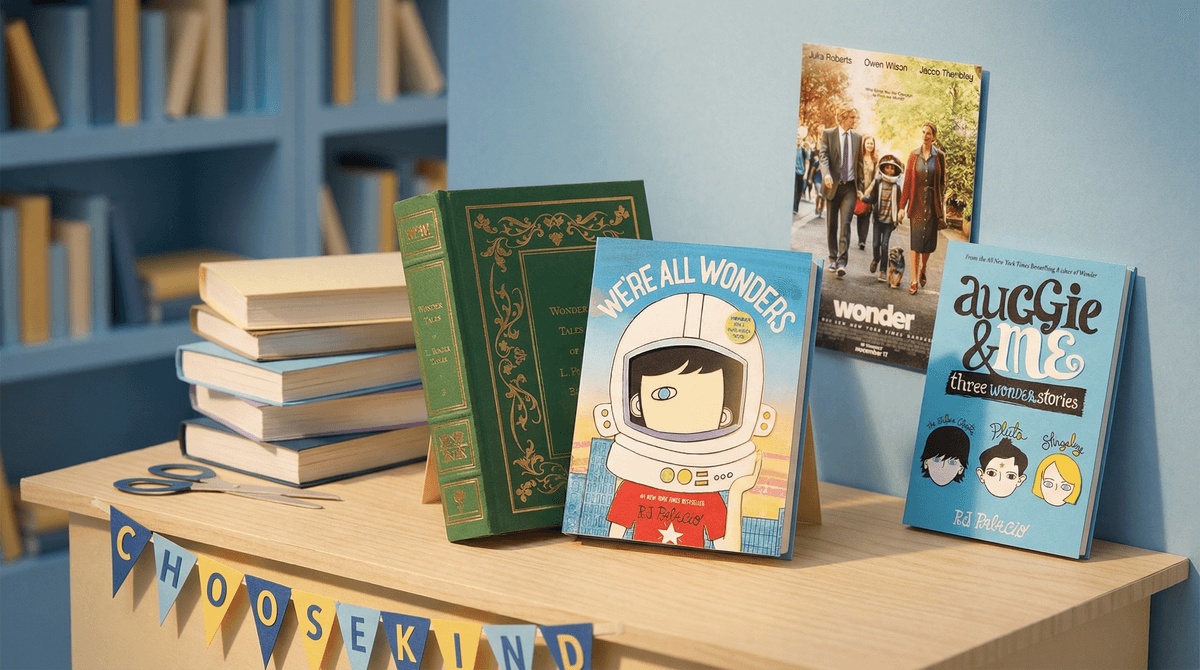
Wonder is a 2012 middle-grade novel by R.J. Palacio that became a cultural phenomenon, selling over 12 million copies and spawning a 2017 movie starring Julia Roberts and Owen Wilson. The story follows August "Auggie" Pullman, a fifth-grader with severe facial differences caused by a rare genetic condition, as he navigates his first year attending mainstream school after being homeschooled.
Here's why this matters for digital parenting: Wonder has become required reading in many schools, and the themes it explores—bullying, kindness, fitting in, and seeing beyond appearances—are exactly the conversations we need to be having about kids' online behavior too.
The book spawned several companion novels told from different characters' perspectives (Auggie & Me), a picture book (We're All Wonders), and has inspired the "Choose Kind" movement that many schools have adopted. If your kid's school is reading it, you're probably seeing #ChooseKind posters everywhere.
Wonder hit at exactly the right cultural moment, and it's stayed relevant because the issues it tackles have only intensified in our digital age.
The bullying depicted in Wonder mirrors online behavior. When Julian spreads rumors about Auggie, leaves mean notes, and gets other kids to exclude him—that's the offline version of what happens daily on group chats, Discord servers, and social media. The "Plague" game kids play (pretending they'll catch a disease if they touch Auggie) is basically the elementary school version of getting "ratioed" online.
It normalizes difficult conversations. The book doesn't shy away from staring, discomfort, or the reality that some people are cruel. For parents trying to teach empathy in an age where kids can hide behind screens, Wonder provides concrete examples of both harmful and helpful behavior.
It's genuinely well-written. This isn't a preachy after-school special. Palacio writes with humor and authenticity. Kids actually want to read it, which is half the battle when you're competing with YouTube and TikTok for attention.
Ages 8-12 (Primary audience): This is the sweet spot. The book is written at a 4th-5th grade reading level, and the protagonist is in 5th grade. Most schools assign it between 4th and 6th grade. Kids this age are developing their social awareness and starting to understand perspective-taking in more sophisticated ways.
Ages 6-7: The picture book version (We're All Wonders) is perfect for younger siblings who want to know what their older sibling is reading. It introduces the concepts without the more intense bullying scenes.
Ages 13+: Middle schoolers might roll their eyes at being assigned a "baby book," but many report that it hit differently when they read it in elementary school versus revisiting it later. The themes of identity, social media cruelty, and choosing kindness become more complex as kids get older.
The Movie (PG rating): Generally appropriate for ages 8+, though some parents find the bullying scenes harder to watch on screen than to read. The movie softens some of the book's edges and adds a bit more Hollywood sweetness, but it's a faithful adaptation.
The Good Stuff
It opens doors for conversations about digital behavior. After reading Wonder, you have a shared vocabulary. "Is that a Choose Kind move?" becomes shorthand for evaluating behavior—both online and off. When your kid is crafting a comment on a Roblox game or deciding whether to share that screenshot in the group chat, you can reference Auggie's experiences.
It teaches perspective-taking. The book is told from multiple viewpoints, which helps kids understand that everyone has their own story. This is a crucial skill for navigating digital spaces where it's easy to dehumanize people into avatars and usernames.
It addresses bystander behavior. Some of the most powerful moments in Wonder aren't about Auggie or his main bully—they're about the kids in the middle who have to decide whether to stand up, stay silent, or join in. This maps directly onto what kids face in group chats and online spaces every single day.
The Challenging Parts
The bullying is realistic and can be triggering. If your child has experienced bullying or has visible differences themselves, this book might hit hard. Some kids find it empowering; others find it painful. You know your kid best. Consider asking your child's teacher how they're handling it in class if you have concerns.
It might prompt questions about medical conditions and genetics. Be prepared to explain Treacher Collins syndrome or talk about genetic conditions in age-appropriate ways. The book handles this well, but curious kids will have follow-up questions.
The "Choose Kind" message can feel simplistic. While kindness is obviously good, some critics argue the book places too much burden on targets of bullying to be gracious and on bystanders to fix systemic problems. These are actually great conversations to have with older kids about how we create kind communities—both in person and online.
Here's where this gets practical for digital parenting:
Use it as a social media readiness test. If your kid can't articulate why Julian's behavior was harmful or why Summer's simple act of sitting with Auggie mattered, they're probably not ready to navigate the nuances of online social dynamics. The book provides a low-stakes way to gauge their empathy development.
Create family tech agreements using Wonder principles. What does "Choose Kind" look like in your family's group chat? How do you handle it when someone shares something mean about another kid? Many families find that having these conversations before problems arise makes addressing issues easier.
Discuss the permanence of digital actions. In the book, Julian's behavior follows him and has consequences. Online, things are permanent in a different way—screenshots, digital footprints, things that can resurface years later. The stakes are actually higher in digital spaces.
Wonder is one of those rare books that gives parents and kids a shared language for talking about empathy, inclusion, and social dynamics. In an era where much of kids' social lives happen on screens, the lessons from Auggie's story translate remarkably well to digital spaces.
Is it going to single-handedly prevent your kid from being mean online? No. But it's a tool in your parenting toolkit, and a pretty good one.
The book's core message—that how we treat people matters, that small acts of kindness compound, and that everyone is fighting battles we can't see—is exactly what we need kids to internalize before we hand them smartphones and social media accounts.
-
If your kid's school is reading it: Read it yourself (it's a quick read—you can finish it in an evening) so you can have informed conversations.
-
Watch the movie together: Use it as a jumping-off point to discuss how the story's themes show up in their digital life.
-
Create concrete connections: Next time there's a group chat drama or someone's being excluded online, reference Wonder. "What would Summer do in this situation?"
-
Check out the companion books: Auggie & Me tells stories from Julian, Christopher, and Charlotte's perspectives—great for kids who want more and for digging deeper into bystander behavior.
-
Explore other books and media
that reinforce these themes. Wonder works best as part of an ongoing conversation, not a one-time lesson.
The goal isn't to raise perfect kids who never make mistakes online. It's to raise kids who can recognize when they've been unkind, who understand the impact of their digital actions, and who have the tools to choose differently next time. Wonder is a pretty solid foundation for that work.