

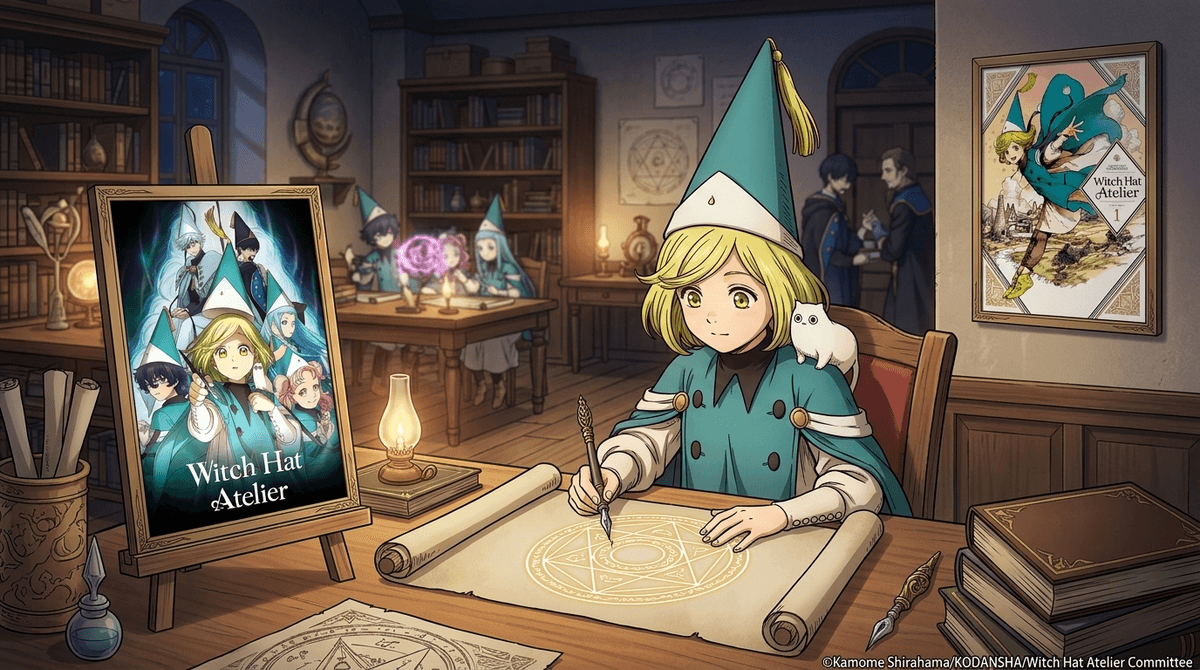
If you’re wondering if Witch Hat Atelier is the next "brain rot" show you need to worry about, you can breathe a sigh of relief—it’s actually a stunning, thoughtful masterpiece about art, ethics, and the hard work of learning a craft that your middle schooler (and probably you) will genuinely love.
TL;DR: Witch Hat Atelier is a breathtaking new anime that follows a girl named Coco who discovers that magic isn't a "born with it" gift, but a craft practiced through drawing with special ink. It’s a perfect pick for families who enjoyed The Owl House or Studio Ghibli movies, offering deep themes about who gets to hold power and the cost of "easy" shortcuts. Screenwise gives it a high WISE score for its focus on persistence, creativity, and the ethical responsibility that comes with knowledge.
Based on the award-winning manga by Kamome Shirahama, Witch Hat Atelier takes place in a world where magic is a closely guarded secret. The general public believes you have to be born a witch to perform magic, but our protagonist Coco—a "normal" girl obsessed with magic—accidentally discovers the truth: magic is drawn. It’s an art form.
After a tragic accident involving a forbidden spell, Coco becomes an apprentice to a traveling wizard named Qifrey. She joins three other girls in his atelier (a fancy word for a workshop) to learn the "laws" of magic. Unlike Harry Potter, where you just wave a stick and say a Latin-ish word, the magic here requires precise geometry, specific ink, and an understanding of how elements interact.
The "magic ink" system is a huge draw for kids who love to create. Since the anime premiered, we've seen a massive spike in "magic circle" art on social media. It turns magic from something "destined" into something "attainable" through practice.
For the 10-14 age group, the appeal lies in the "found family" dynamic of the four apprentices. Each girl has a distinct personality—from the perfectionist Agott to the cheerful Tetia—and their internal struggles with failure and identity feel very real, even in a world with flying boots.
There’s also a darker undercurrent. A group called the "Brimmed Caps" wants to bring back forbidden magic (spells that affect the human body), which adds a layer of mystery and high-stakes tension that keeps it from feeling like a "little kid" show.
At Screenwise, we look at media through the lens of what it’s actually teaching our kids’ brains. Witch Hat Atelier is a goldmine for developmental growth for a few reasons:
- The "Growth Mindset" on Steroids: Coco starts with zero talent. She fails constantly. The show emphasizes that being a "witch" isn't about a bloodline; it's about how many hours you’re willing to spend practicing your lines and circles. It’s a great counter-narrative to the "overnight influencer" or "natural genius" tropes kids see on TikTok.
- The Ethics of Gatekeeping: The show asks some big questions: Why is magic kept secret? Is it to protect people, or to keep power in the hands of a few? If your kid is starting to notice social inequities in the real world, this is a fantastic "safe" way to talk about privilege and the democratization of information.
- Artistic Inspiration: This isn't just "content" to be consumed; it's a catalyst for creation. We've seen parents reporting that their kids are picking up sketchbooks again after watching, trying to design their own spell circles.

While the art style is whimsical and reminiscent of classic European fairy tales, Witch Hat Atelier isn't "G-rated" in the way some might expect.
- Emotional Weight: The inciting incident involves Coco accidentally turning a loved one into stone. It’s heavy. The guilt she carries is a major part of her character arc.
- Peril and Body Horror: The "Brimmed Caps" use magic in ways that can be visually unsettling—think limbs turning into objects or creepy, distorted faces. It’s not Attack on Titan levels of gore, but it can be intense for sensitive 8 or 9-year-olds.
- Complex Villains: The "bad guys" often have points that make sense. They argue that magic should be for everyone. This lack of clear-cut "black and white" morality is great for older kids but might require some "pause and talk" moments with younger ones.
If your kid is deep into the series, use these questions to bridge the gap between "screen time" and "real life":
- "Coco discovered magic is a skill you can learn, not just something you're born with. Is there something you used to think was 'magic' or 'impossible' that you now realize just takes practice?"
- "The Knights Moralis (the magic police) say they keep magic secret to keep people safe. Do you think they're right, or should everyone have access to it?"
- "Which of the four apprentices do you relate to most? The one who wants to be perfect (Agott) or the one who just wants to make people smile (Tetia)?"
If your family has finished the first season and you're looking for something with a similar "vibe" (high quality, low "brain rot"), check these out:
- For the art lovers: Keep Your Hands Off Eizouken! – A brilliant show about three girls making an anime. It captures that same "creative spark" as Witch Hat.
- For the magic fix: Little Witch Academia – A bit more lighthearted and "Disney-esque," but shares the apprentice-learning-magic theme.
- For the deep thinkers: Frieren: Beyond Journey's End – A more melancholic, beautiful look at magic and the passage of time. Best for teens.
- For a non-anime alternative: The Dragon Prince on Netflix offers a similar blend of high-stakes magic and ethical dilemmas.
Q: What age is Witch Hat Atelier appropriate for?
Screenwise recommends Witch Hat Atelier for ages 10 and up. While younger kids might enjoy the magic, the themes of forbidden magic and the "body horror" elements of the villains make it a better fit for the middle-school crowd.
Q: Is there any "fan service" or inappropriate content?
One of the best things about this series is the complete lack of "fan service" (sexualized characters). The character designs are practical, beautiful, and age-appropriate. It’s a "clean" show in terms of romance and language, focusing almost entirely on the magic system and the plot.
Q: Is it better to read the manga or watch the anime?
The Witch Hat Atelier manga is famous for its incredible panel layouts that actually use the "magic circles" as part of the page design. If your kid is a reader, the manga is a 10/10 experience. The anime is a faithful adaptation that brings those drawings to life with a beautiful orchestral score. You can't go wrong with either.
Q: Does it have "Chosen One" tropes?
Refreshingly, no. Coco isn't a "Chosen One" with a secret prophecy. She’s just a kid who was in the right place at the right time to see something she wasn't supposed to see, and then worked her tail off to keep up with the "natural" witches.
Witch Hat Atelier is the kind of show we want more of in the digital landscape. It’s high-effort, high-art, and treats its young audience with respect by tackling complex themes. If your kid is asking to watch it, say yes—and maybe grab a sketchbook so you can try to draw some "spells" together after the episode ends.
Check out our full guide to the best anime for middle schoolers Learn how to set up parental controls on Crunchyroll