

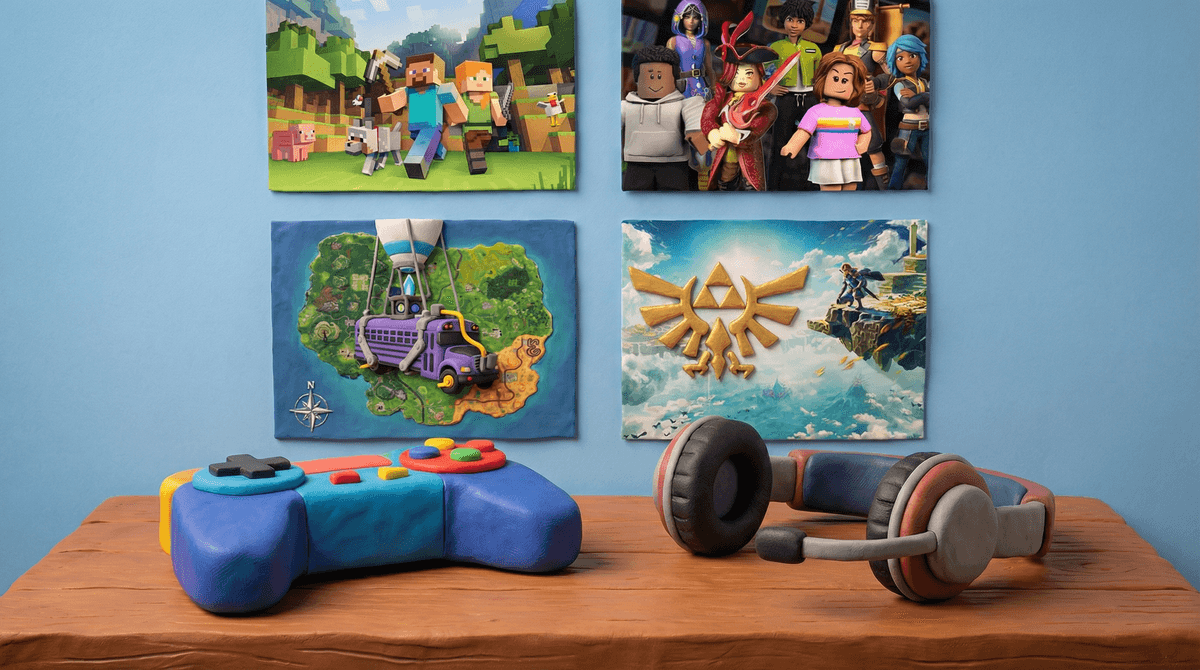
Your kid wants to play Minecraft every waking moment. They talk about Roblox at dinner. They watch YouTube videos about Fortnite when they're not playing Fortnite. They've requested a Zelda-themed birthday party for the third year in a row.
Sound familiar?
Single-game fixation is when a child becomes deeply absorbed in one particular game to the seeming exclusion of everything else. And it's one of the most common questions parents ask: Is this normal interest or should I be worried?
The short answer: It depends. But probably not in the way you think.
First, let's acknowledge that deep interest in one thing is actually pretty developmentally normal for kids. Remember when your six-year-old knew every dinosaur species? Or when your tween could recite every Taylor Swift lyric? Kids naturally cycle through intense interests as they build expertise, identity, and social connection.
Video games hit this sweet spot particularly well because they offer:
Mastery and progression - Games are literally designed to provide clear goals, feedback loops, and a sense of improvement. Your kid isn't just "playing," they're getting better at something measurable.
Social currency - Knowing the meta, the latest updates, the hidden Easter eggs—this is how kids connect with peers. Not knowing what's happening in the popular game can feel socially isolating.
Creative expression - Games like Minecraft and Roblox are essentially creative platforms. Your kid might be building elaborate worlds, learning game design, or even making actual money through Roblox development .
.
Predictability and control - In a world where kids have limited autonomy, games offer a space where they make the rules, control outcomes, and can reliably return to a familiar environment.
So when your kid wants to play the same game constantly, they're often pursuing legitimate developmental needs: competence, connection, creativity, and control.
That said, there's a difference between passionate interest and problematic obsession. Here's what to actually watch for:
Red Flags That Signal a Problem:
Functional impairment - Are they missing school, neglecting hygiene, losing sleep, or skipping meals? If the game is interfering with basic functioning, that's a problem.
Emotional dysregulation - Do they have explosive meltdowns when asked to stop? Are they irritable, anxious, or depressed when not playing? Healthy interests don't cause this level of distress.
Social withdrawal - Are they turning down real-life activities they used to enjoy? Avoiding friends who don't play the game? Missing birthday parties to play? That's concerning.
Lying or sneaking - Are they being deceptive about screen time, playing in secret, or finding workarounds to your boundaries? This suggests they've lost control.
Physical symptoms - Headaches, eye strain, wrist pain, weight changes, or disrupted sleep patterns that persist.
Green Flags That Suggest Healthy Interest:
They can stop when asked (even if they're disappointed)
They talk about the game but also other topics
They're learning transferable skills - problem-solving, collaboration, even coding
They maintain friendships (even if those friendships happen through gaming)
They're still doing their responsibilities - homework, chores, family time
They're engaged with the game's creative or strategic elements, not just mindlessly grinding
The key question isn't "how much time are they spending?" but rather "what is this replacing?"
Ages 6-9: Deep interests are totally normal and often shift every few months. A second-grader obsessed with Pokémon is probably just being a second-grader. Watch for whether they can transition away from the game when needed.
Ages 10-13: This is peak "everyone plays the same game" years. Roblox, Fortnite, and Minecraft dominate because they're social hubs. Single-game focus is often about peer connection more than the game itself. This is actually pretty healthy—they're building social skills in digital spaces.
Ages 14+: Teens might develop genuine expertise in competitive games like Valorant or creative platforms like Roblox Studio. This can be legitimate skill-building. The question becomes: are they pursuing mastery or escaping something?
If the obsession seems healthy:
Support the interest - Ask questions about the game. Watch them play. Learn why they love it. This builds connection and gives you insight into their world.
Help them go deeper - Can they join a club? Watch tutorials? Read strategy guides? Create fan art? Learn about game design? Healthy obsessions become richer when supported.
Set reasonable boundaries - Even healthy interests need limits. "You can play after homework and chores, and we'll do family dinner screen-free" is reasonable. Arbitrary "one hour per day" limits often backfire.
Create offline extensions - Get them books about the game, Lego sets of characters, or board game versions. This keeps the interest alive while diversifying activities.
If you're seeing red flags:
Get curious, not punitive - "I've noticed you seem really upset when you have to stop playing. What's going on?" opens conversation. "You're addicted to that game!" shuts it down.
Look for underlying issues - Is the game filling a void? Are they anxious about school? Struggling socially? Bored? Depressed? The game might be a symptom, not the problem.
Set clear, consistent boundaries - Not as punishment, but as structure. "Gaming happens after responsibilities, and we stop one hour before bed." Then enforce it calmly and consistently.
Offer appealing alternatives - "Stop playing" doesn't work. "Want to shoot hoops?" or "Should we try that new pizza place?" gives them something to transition toward.
Consider professional help - If you're seeing serious functional impairment, emotional dysregulation, or signs of depression/anxiety, talk to a therapist who understands gaming. Learn more about when gaming becomes addiction.
Most kids who obsess over one game are just being kids with a passionate interest. The same parents who worried about too much Minecraft would have worried about too much basketball in another era.
The real question isn't whether your kid plays one game a lot—it's whether that game is adding to their life or replacing it.
A kid who plays Minecraft for hours, maintains friendships, does their homework, and lights up talking about their latest build? That's probably fine.
A kid who plays the same game for hours, is failing classes, has stopped seeing friends, and melts down when asked to stop? That needs intervention.
Trust your gut. You know your kid. If something feels off, it probably is—but the game is rarely the actual problem. It's usually what the game is helping them cope with or avoid.
And hey, if your kid does turn their Roblox obsession into actual game development skills, you might be funding their college education with their entrepreneurial earnings. Stranger things have happened.
- Track it for a week - Note when they play, how easily they transition away, and what else they're doing. Data helps you see patterns.
- Have a conversation - Ask what they love about the game, who they play with, and what they're working toward. Listen without judgment.
- Evaluate your boundaries - Are your current rules working? Do they need adjustment? Are you enforcing them consistently?
- Check out alternatives to their current game if you want to encourage variety
- Read up on how to set healthy gaming limits that actually stick
You've got this. And remember—your parents probably worried about how much you loved something too.