

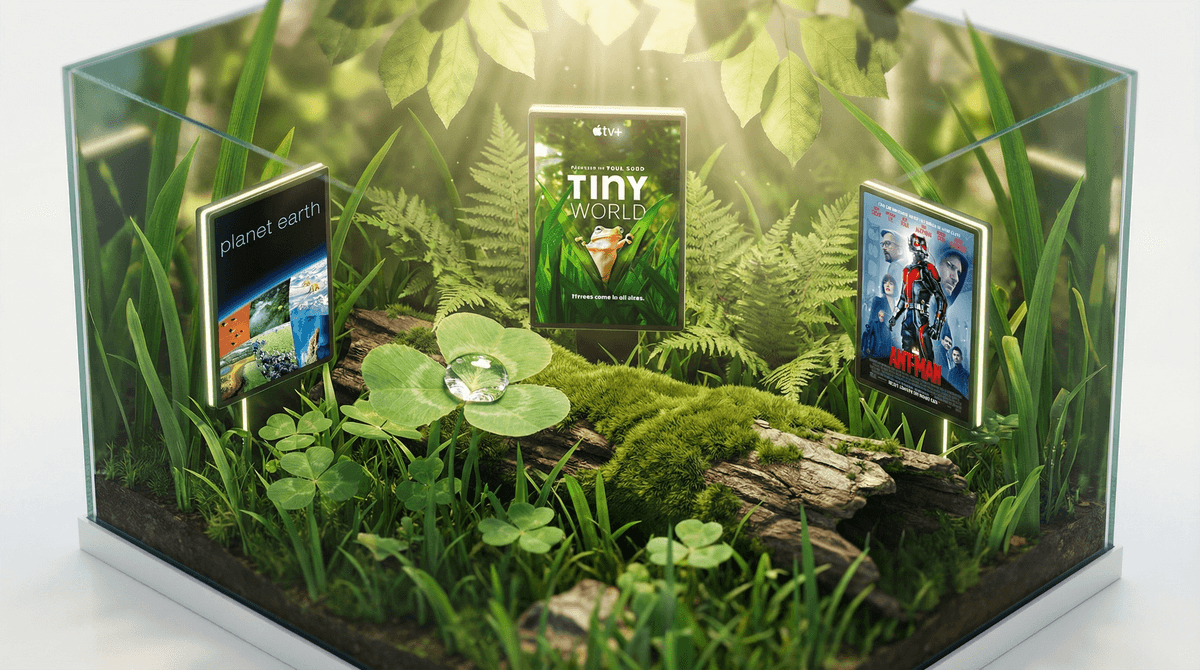
Tiny World is an Apple TV+ nature documentary series that does exactly what it says on the tin: it shows you the world from a very, very small perspective. We're talking about the daily drama of chipmunks, hummingbirds, beetles, frogs, and other creatures you probably walk past without noticing.
The show uses incredible macro photography and slow-motion footage to turn backyards, forests, and coral reefs into epic landscapes. It's narrated by Paul Rudd (yes, Ant-Man himself, which is perfect casting when you think about it), and each episode is about 30 minutes long. There are two seasons available, with episodes organized by habitat type: "Jungle," "Reef," "Savannah," "Garden," etc.
Think Planet Earth but for creatures under six inches tall, with slightly less David Attenborough gravitas and slightly more "aww, look at that little guy!"
Here's the thing about Tiny World: it's genuinely beautiful television that doesn't talk down to kids. The cinematography is stunning—like, genuinely jaw-dropping in a way that makes you wonder "how did they even film that?" The camera work puts you right there with a baby mouse navigating what looks like an impossible journey across a garden (spoiler: it's like three feet, but the stakes feel real).
Paul Rudd's narration strikes a nice balance. He's warm and engaging without being overly cutesy. He treats the animals with respect while still acknowledging the inherent charm of watching a hamster stuff its face with seeds. There's humor, but it's not forced.
The episodes are also perfectly paced for modern attention spans. At 30 minutes, they're long enough to tell a complete story but short enough that you're not committing to a feature-length experience. And unlike some nature documentaries that can feel like homework, Tiny World keeps things moving with actual narrative arcs—you're rooting for that dung beetle to roll his ball home, or that tree frog to find water before the dry season hits.
The Good Stuff:
This is legitimately educational content that doesn't feel like educational content. Kids are learning about ecosystems, animal behavior, survival strategies, and interconnectedness without realizing they're learning. It's the kind of show that sparks curiosity—expect questions about whether you can get a pet pygmy marmoset (the answer is no, but appreciate the interest in primates).
The show also does a nice job of showing the circle of life without being traumatic. Yes, animals eat other animals. Yes, not every creature makes it. But it's handled with appropriate sensitivity for younger viewers. There's no gratuitous violence—just honest nature.
The Reality Check:
While Tiny World is fantastic, it does require Apple TV+, which means another streaming subscription. If you're already drowning in monthly fees, this might be a "wait until we try the free trial" situation.
Also, some kids under 5 might find certain predator-prey moments stressful. There's a scene in the garden episode where a spider catches a bee that made one parent I know have to pause and explain the food chain to a tearful four-year-old. It's nature, but nature can be intense when you're small and the bee is your favorite.
The show does anthropomorphize the animals to some degree—giving them motivations, personalities, and narrative arcs. This makes for compelling television but isn't strictly scientific. If you're raising a future biologist, you might want to occasionally remind them that we can't actually know what the chipmunk is "thinking."
Ages 3-5: This can work, but watch together and be ready to answer questions or fast-forward through tense predator moments. The visuals will captivate them, but the concepts might need explanation.
Ages 6-10: Sweet spot. Old enough to understand the concepts, young enough to be genuinely amazed by the footage. This is the age where Tiny World can spark a real interest in nature, biology, or even photography.
Ages 11+: Still engaging, especially for kids interested in science, nature, or filmmaking. Can be a nice family watch that doesn't feel babyish but also isn't another teen drama.
Here's where we get real: in a community where kids are averaging 4.2 hours of screen time per day (4 hours on weekdays, 5 on weekends), and 92% of families are using TV/streaming regularly, the question isn't really "should my kid watch screens?" It's "what should they be watching?"
Tiny World is the kind of content that makes screen time feel worthwhile. It's not brain rot. It's not YouTube autoplay leading them down weird rabbit holes. It's intentional, high-quality content that actually enriches rather than just occupies.
That said, even great content is still screen time. If your kid is already maxing out their daily limits, Tiny World doesn't get a free pass just because it's educational. But if you're choosing between this and another episode of whatever animated series they've watched seventeen times, Tiny World is the obvious winner.
Tiny World is genuinely excellent family television. It's beautiful, engaging, educational, and sparks the kind of curiosity and wonder that's increasingly rare in kids' media. Paul Rudd is delightful, the cinematography is stunning, and the 30-minute episodes are perfect for modern viewing habits.
Is it worth an Apple TV+ subscription on its own? Probably not. But if you're already subscribed, or if you're looking for something to watch during your free trial, Tiny World should be at the top of your list. It's the rare show that kids will enjoy, parents won't mind watching, and everyone might actually learn something from.
Worth your family's screen time? Absolutely yes.
- Check if you have Apple TV+ access (it often comes bundled with Apple device purchases)
- Start with the "Garden" episode—it's accessible and immediately engaging
- Watch together the first time to gauge your child's reaction to predator-prey dynamics
- Use it as a springboard for outdoor exploration—can you find any of these creatures in your own backyard?
