

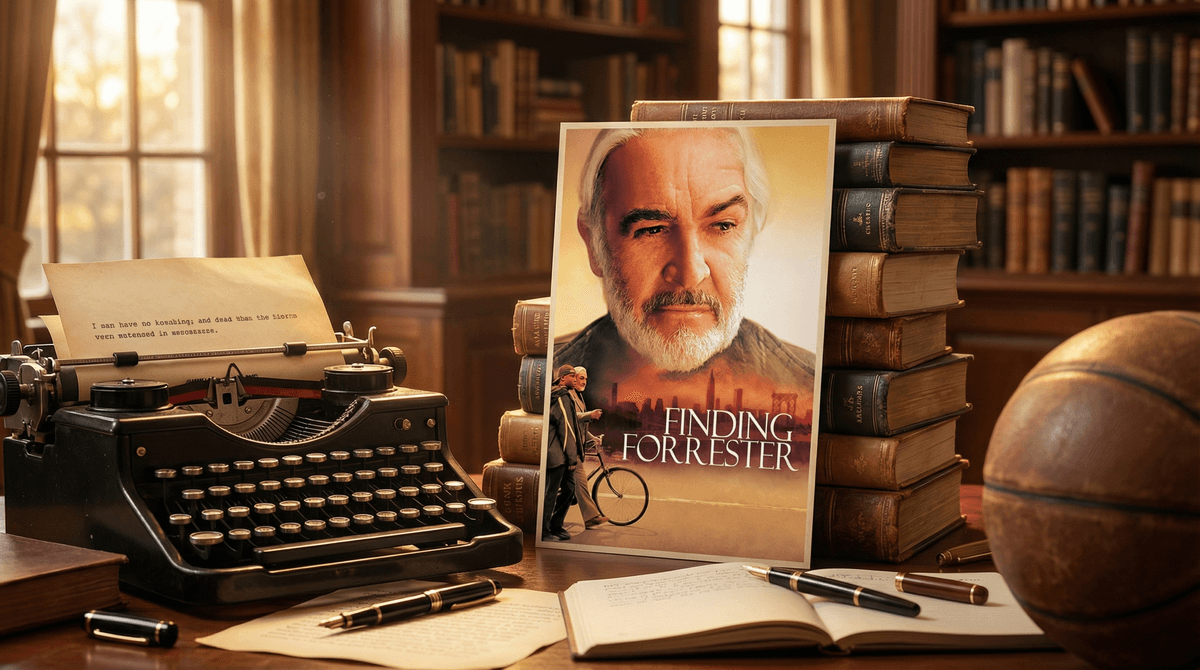
Finding Forrester: A Parent's Guide to This Inspiring Mentor Story
TL;DR: Finding Forrester is a 2000 drama about a reclusive Pulitzer Prize-winning author who mentors a gifted Black teenager from the Bronx. It's rated PG-13 primarily for pervasive language (including multiple F-bombs), some sexual references, and brief violence. The themes—finding your voice, overcoming prejudice, mentorship across race and class—make it powerful viewing for teens 13+, especially those who love writing or feel like outsiders. Just be ready to talk about why all those curse words are actually there (spoiler: they serve the story).
Directed by Gus Van Sant and starring Sean Connery in one of his final roles, Finding Forrester tells the story of Jamal Wallace (Rob Brown), a 16-year-old basketball player and closet intellectual who befriends William Forrester (Connery), a reclusive author who wrote one acclaimed novel decades ago and then disappeared from public life.
After Jamal breaks into Forrester's apartment on a dare and accidentally leaves his backpack behind, Forrester reads his writing and recognizes raw talent. What follows is an unlikely friendship where Forrester becomes Jamal's writing mentor, while Jamal helps pull Forrester back into the world he's been hiding from since the 1960s.
The film explores themes of identity, racism in elite academic spaces, the courage to be yourself, and what it means to truly see and be seen by another person.
The outsider experience is universal. Jamal is constantly navigating different worlds—his Bronx neighborhood where being "too smart" makes him a target, and his new prep school where he's assumed to be there only for basketball. Any teen who's ever felt like they have to hide parts of themselves to fit in will recognize this struggle.
The writing scenes are genuinely inspiring. Unlike many movies about creative pursuits that feel fake, the writing lessons Forrester teaches Jamal are actually useful. "Write your first draft with your heart, rewrite with your head" is advice that English teachers still quote. For teens who love writing or are discovering that passion, watching Jamal find his voice is powerful.
The mentorship feels earned, not sappy. Forrester isn't some magical wise man who fixes everything—he's prickly, damaged, and learning as much from Jamal as Jamal learns from him. Their relationship develops slowly and realistically, which makes it more meaningful when they finally trust each other.
It tackles real issues without being a "message movie." The film addresses racism, classism, and academic gatekeeping through Jamal's experiences at his prep school, particularly with Professor Crawford (F. Murray Abraham), who refuses to believe Jamal could write so well. But it never feels like an after-school special.
This is the big one. The PG-13 rating is almost entirely because of language—specifically, the film uses the F-word multiple times, along with other profanity scattered throughout.
But here's the thing: the language isn't gratuitous. Most of it comes from Forrester, a man who's been isolated for 40 years and uses profanity as both armor and authenticity. When he and Jamal first interact, the cursing is part of Forrester testing whether this kid can handle real talk, not kid-glove treatment.
There's a memorable scene where Forrester explains his use of language: "Fuck is just a word. What matters is the context in which it's used." The film actually uses this moment to discuss how language works, which is pretty meta for a movie getting dinged for language.
Parent move: If your teen is 13-15 and you're on the fence about the language, consider whether they're already hearing these words at school (they are) and whether you'd rather they encounter them in a thoughtful film that treats them as mature viewers, or just out in the wild. For 16+, this shouldn't be a concern at all.
Sexual content: Minimal. There's a brief scene where Jamal kisses a girl at a party, and some teenagers discuss sex in typical teenage ways, but nothing explicit.
Violence: Very brief. There's a moment where Jamal gets into a scuffle with other students, and one scene where Forrester has what appears to be a panic attack in public. Neither is graphic.
Substance use: Some adult characters drink alcohol. No drug use.
Emotional intensity: The film deals with grief, isolation, and racial prejudice. Forrester's backstory involves losing his family in a car accident, which is discussed but not shown. Some scenes of academic discrimination against Jamal can be frustrating and painful to watch.
Ages 13-14: This works if your teen is a strong reader, interested in writing, or has experienced feeling like an outsider. The language will be the deciding factor for many families. The themes are accessible but nuanced enough that some kids this age might miss layers.
Ages 15-17: Prime audience. Teens this age can fully appreciate the complexity of the mentorship, the institutional racism Jamal faces, and the film's exploration of authenticity versus performance. Many high school English teachers show this film (with permission slips for the language).
Ages 18+: Still valuable, especially for young adults heading to college or navigating predominantly white institutions. The film holds up remarkably well.
Sean Connery's performance is a masterclass. This was one of his last major roles, and he brings vulnerability and prickliness in equal measure. Forrester could easily have been a cliché, but Connery makes him feel like a real person with real damage.
It takes writing seriously. So many films about writers show them staring dramatically at typewriters or having sudden inspiration. This film shows the actual work—the rewriting, the reading, the discipline, the fear of being judged. For teens who write, this is validating in a way few films are.
The race and class dynamics are handled thoughtfully. The film doesn't pretend to solve racism, but it shows how it operates in elite spaces—the assumptions, the microaggressions, the way Jamal has to constantly prove himself while white students are given the benefit of the doubt. Professor Crawford's antagonism isn't cartoon villainy; it's the kind of gatekeeping that actually happens.
The ending is bittersweet and honest. Without spoiling, the film doesn't tie everything up in a neat bow. It acknowledges that some things can't be fixed, but that connection and mentorship still matter profoundly.
After watching, try these:
-
"Why do you think Forrester stopped writing after his first book?" This opens discussion about fear of failure, perfectionism, and how trauma affects creativity.
-
"What did you think about how Professor Crawford treated Jamal differently?" Lets your teen process the racism in the film and connect it to their own observations.
-
"Which writing advice from Forrester would you actually use?" Makes the film practical and shows you're interested in their creative pursuits.
-
"Why do you think the friendship worked between Forrester and Jamal?" Explores what makes mentorship valuable and what each person brought to the relationship.
If your teen connects with Finding Forrester, try:
-
Good Will Hunting (R) - Similar mentor-student dynamic, also written by Matt Damon and Ben Affleck. More language and some sexual content, better for 16+.
-
Dead Poets Society (PG) - About finding your voice through literature and poetry. Less edge than Forrester but powerful themes about conformity and authenticity.
-
Freedom Writers (PG-13) - Teacher inspires at-risk students through writing. More focused on the classroom dynamic.
-
The Blind Side (PG-13) - Another cross-race, cross-class mentorship story, though more conventional in its approach.
For teens interested in writing and storytelling , you might also explore books about the writing process.
Finding Forrester is one of those rare films that treats teenagers as intelligent people capable of handling complex themes and real-world language. Yes, there's profanity. Yes, it deals with racism and class barriers. But it does so with nuance and heart, never talking down to its audience.
For teens who love writing, feel like outsiders, or are navigating predominantly white spaces, this film offers both validation and inspiration. The mentorship at its core—two people from completely different worlds helping each other become more fully themselves—is the kind of relationship every teenager deserves to experience.
The PG-13 rating is accurate. If your teen is 13-14, preview it yourself to decide about the language. For 15+, this is absolutely worth watching together and discussing afterward. It's the kind of film that sticks with you and might even inspire a teen to take their writing more seriously—or to reach out to someone different from themselves.
Parent tip: If your teen is inspired by the writing aspects, consider helping them find their own "Forrester"—a writing workshop, a mentor through a community program, or even just dedicated writing time where you take their work seriously. Sometimes all a kid needs is one person who believes in their voice.