

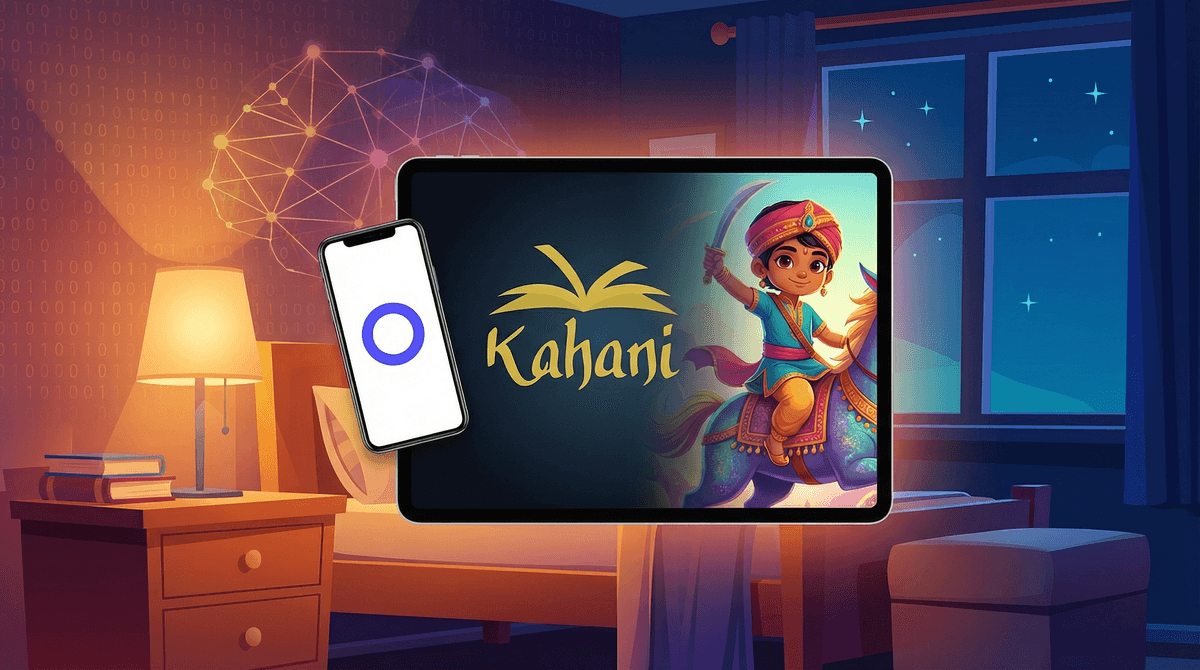
Kahani Kids and AI Storytelling Apps: What Parents Need to Know
AI storytelling apps like Kahani are creating personalized bedtime stories for kids, blending cultural representation with tech innovation. They're genuinely impressive—but come with legitimate questions about screen time, data privacy, and whether we're outsourcing imagination itself. Here's what you need to know before letting AI tuck your kids in.
Quick picks for storytelling alternatives:
- Epic! Books - digital library with read-aloud features
- Libby - free library audiobooks and ebooks
- Story Pirates Podcast - kids' stories brought to life
- Circle Round Podcast - folktales from around the world
Kahani is an AI-powered storytelling app that generates personalized stories for kids, with a specific focus on South Asian culture and representation. The pitch is compelling: your kid becomes the hero of stories that actually reflect their heritage, featuring characters who look like them, celebrate their festivals, and navigate cultural experiences that mainstream media often ignores.
The app uses AI to create custom narratives based on prompts—think "a story about Priya who goes on a Diwali adventure" or "a tale about Rohan learning to make dosa with his grandmother." The stories come with illustrations (also AI-generated) and can be read aloud by the app or by you.
But Kahani isn't alone. There's been an explosion of AI storytelling apps in the past year: Oscar, Storybook, Scarlett Panda, and more. They all promise personalized stories, though most lack Kahani's specific cultural focus.
The representation angle is real. If you've ever tried to find bedtime stories featuring South Asian protagonists that aren't just "explaining Diwali to white audiences," you know the struggle. Kahani fills a genuine gap—stories where being Indian or Pakistani or Bangladeshi is just... normal. Not educational. Not othered. Just part of the story.
The convenience factor is also real. Bedtime is exhausting. The idea of an app that generates fresh stories on demand, customized to your kid's interests, without you having to read "The Very Hungry Caterpillar" for the 847th time? That's appealing.
The tech is genuinely impressive. These AI storytelling apps have gotten remarkably good at creating coherent, age-appropriate narratives. They're not just mad libs—they can handle complex prompts, maintain character consistency, and adapt to feedback.
Screen Time at Bedtime
This is the big one. Every sleep expert and pediatrician will tell you: screens before bed are terrible for sleep quality. The blue light, the engagement, the stimulation—it all works against the wind-down your kid's brain needs.
Yes, you can use night mode. Yes, you can read the stories aloud yourself from your phone. But let's be honest about the usage pattern here: most kids using these apps are staring at a screen right before sleep. That's not ideal.
If you're going to use Kahani or similar apps, treat them like ebooks, not interactive games. Read from your device to your kid, don't hand them the iPad. Better yet, read the story earlier in the evening and save actual books for bedtime.
Data Privacy and AI Training
Here's where it gets murky. When you input your child's name, interests, and cultural background into an AI app, where does that data go? Most of these apps (including Kahani) use that information to improve their AI models.
Read the privacy policies carefully. Look for:
- What data is collected (names, photos, voice recordings?)
- How data is stored and protected
- Whether data is used for AI training
- Whether data is shared with third parties
- How to delete your data
Some apps are more transparent than others. Oscar, for example, has faced scrutiny over data practices. Kahani's privacy policy is relatively standard for the industry, but "standard" still means your kid's information is being used to train AI models.
The uncomfortable question: Are we comfortable with our children's bedtime stories becoming training data for machine learning algorithms?
The Outsourcing of Imagination
This is the philosophical concern, but it's worth considering. Traditional storytelling—whether from books or from a parent's own imagination—requires kids to do cognitive work. They fill in gaps, imagine scenes, create voices for characters in their head.
AI-generated stories with AI-generated illustrations do more of that work for them. The images are right there. The narrative is complete. There's less room for interpretation, less space for a child's imagination to play.
I'm not saying AI stories will rot your kid's brain—that's fear-mongering. But there's something to be said for the cognitive benefits of traditional reading and storytelling that we might be trading away for convenience.
Quality and Cultural Authenticity
AI is getting better, but it's not perfect. These apps can generate stories that are technically coherent but emotionally flat. They can include cultural elements that feel surface-level or stereotypical because the AI is trained on existing content (which often has its own biases).
Kahani does better than most because it was specifically designed with cultural authenticity in mind. But no AI can replace stories written by actual South Asian authors who've lived these experiences. Apps like these should supplement, not replace, books by Sayantani DasGupta, Padma Venkatraman, or Veera Hiranandani.
Ages 3-5: If you use AI storytelling apps at this age, you should be reading aloud from your device, not handing it to your child. The stories should be simple, and you should be prepared to explain or skip parts that don't make sense (AI can be weird). Keep sessions short—10 minutes max.
Ages 6-8: Kids this age can handle more complex narratives, but they still shouldn't be using these apps independently at bedtime. The screen time concern is even more pronounced as their reading skills develop—this is when you want them building the habit of reading physical books.
Ages 9-12: This is where AI storytelling apps might actually have some value beyond bedtime. Older kids can use them as writing prompts, comparing AI-generated stories to their own ideas, or analyzing what makes a story good or bad. But for bedtime? They should be reading chapter books, not staring at screens.
If you like the convenience and cultural specificity of apps like Kahani but want to avoid some of the concerns, consider:
A digital library with thousands of books, including strong South Asian representation. Has read-aloud features but also encourages actual reading. Monthly subscription, worth it if your kids are voracious readers.
Free through your library card. Audiobooks and ebooks, including tons of diverse authors. No AI generation, no data harvesting, just books.
Free videos of actors reading children's books aloud. Not personalized, but high-quality and screen time that feels more justified.
Story Podcasts
Story Pirates, Circle Round, and Wow in the World offer audio storytelling that doesn't require screens. Circle Round specifically features folktales from around the world, including many South Asian stories.
Physical Books (Revolutionary, I Know)
For South Asian representation specifically: The Night Diary by Veera Hiranandani, Pashmina by Nidhi Chanani, anything by Chitra Soundar. Your local library likely has more than you think.
If you do decide to try Kahani or similar apps:
-
Use it as a supplement, not a replacement. One or two AI-generated stories a week? Fine. Every single bedtime? You're missing out on better options.
-
Read the stories yourself first. AI can generate weird, inappropriate, or just plain bad content. Screen it before sharing with your kid.
-
Make it interactive. Use AI-generated stories as conversation starters. "What would you have done differently?" "How would you change the ending?" "What details would you add?"
-
Be transparent about the technology. Depending on age, tell your kids these stories are made by computers. It's a good opportunity to discuss how AI works
 and its limitations.
 -
Set boundaries. No screens in bed. Read from your device to your child, earlier in the evening. End the night with a physical book or conversation.
-
Review privacy settings. Minimize data collection where possible. Use generic names if the app allows. Don't upload photos unless absolutely necessary.
-
Budget appropriately. Most of these apps require subscriptions ($5-10/month). That's the cost of several actual books. Make sure you're getting value.
AI storytelling apps like Kahani represent genuinely innovative technology and fill a real need for cultural representation. The ability to generate personalized stories featuring diverse characters is impressive and valuable.
But. They're not magic. They come with legitimate concerns about screen time, data privacy, and the outsourcing of imagination. They're best used sparingly, as supplements to traditional reading, and with parental involvement.
The representation angle is Kahani's strongest selling point, and if that's what draws you in, that's valid. Just remember that there are also real South Asian authors writing real books with real depth that no AI can match yet.
If you're going to use these apps, do it intentionally. Set boundaries, stay involved, and don't let convenience override what's actually best for your kid's development and sleep.
And maybe, just maybe, try making up your own stories sometimes. They don't have to be good. Kids don't care. The stumbling, the weird plot holes, the way you forget character names—that's all part of it. That's real storytelling, and no AI can replicate the magic of a parent's voice in the dark, making stuff up as they go.
-
Trying Kahani? Download it, but commit to reading the stories aloud from your device rather than handing it to your kid. Try it for a month and honestly assess whether it's adding value or just adding screen time.
-
Want alternatives? Start with Libby (free!), explore story podcasts for kids, and check out books with South Asian protagonists.
-
Concerned about AI and kids? Learn more about AI literacy for children
and how to talk about technology in age-appropriate ways. -
Still have questions? Compare AI storytelling apps for kids
or discuss bedtime routines without screens.