

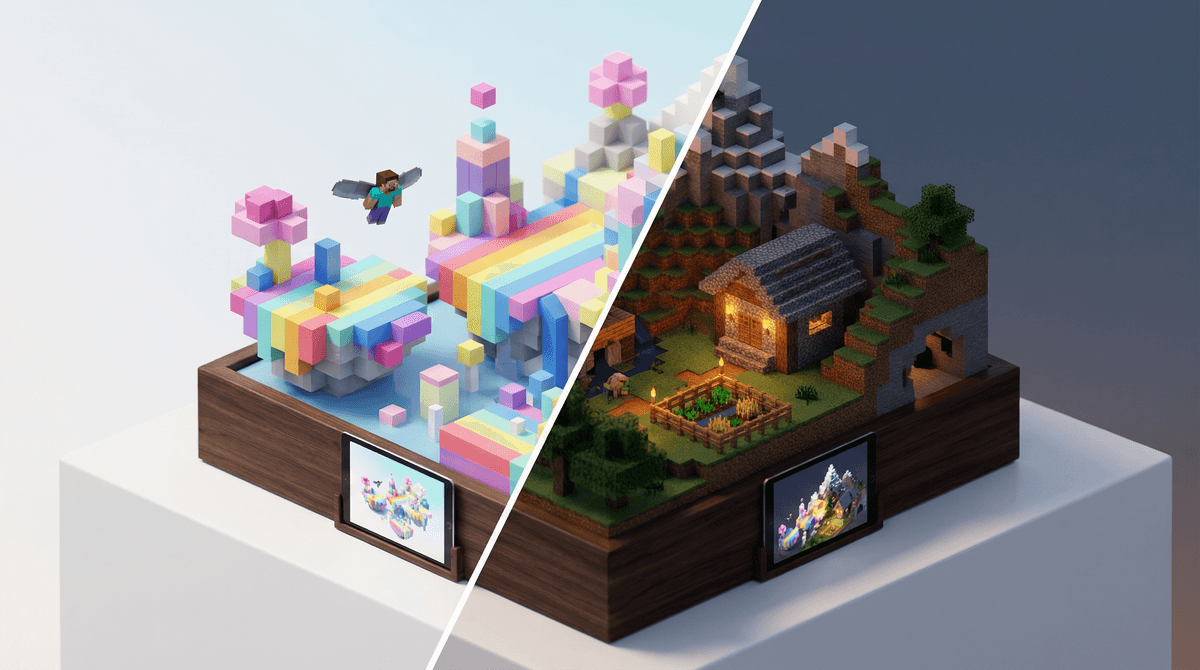
If your kid plays Minecraft, you've probably heard them talk about "Creative" or "Survival" mode like they're completely different games. And honestly? They kind of are.
Survival Mode is the original Minecraft experience: you spawn in a randomly generated world with nothing, and you have to gather resources, craft tools, build shelter, find food, and literally survive. There are monsters (called "mobs") that come out at night. You can die. You can lose all your stuff. It's a game about resource management, planning, and overcoming challenges.
Creative Mode is basically Minecraft with god mode turned on. Unlimited resources, you can fly, nothing can hurt you, and you can instantly break any block. It's pure sandbox creativity—think digital LEGOs with no instruction manual and infinite pieces.
Both modes use the same blocky world, the same building mechanics, the same core game. But the experience? Totally different.
Survival Mode appeals to kids who:
- Love a challenge and the satisfaction of earning progress
- Enjoy the risk/reward dynamic (should I explore that cave or play it safe?)
- Want to feel accomplished ("I built this base from NOTHING")
- Like games with clear goals and progression systems
- Thrive on the adrenaline of narrowly escaping a Creeper explosion at 2% health
Creative Mode appeals to kids who:
- Want to build elaborate structures without grinding for materials
- Prefer low-stress, meditative gameplay
- Love architectural design or artistic expression
- Want to recreate things from their imagination (or YouTube tutorials)
- Get frustrated by setbacks and prefer uninterrupted creativity
Here's the thing: most kids eventually play both. They'll spend hours in Survival building up resources and establishing a base, then switch to Creative to plan out a massive project, then bring those ideas back to Survival to build "for real."
Let's be real about the learning here, because both modes have genuine educational value—and both have potential downsides.
Survival Mode teaches:
- Resource management: You have limited inventory space and materials. What do you prioritize?
- Risk assessment: Is it worth venturing out at night for those resources?
- Planning and delayed gratification: You can't build that castle until you've mined enough stone
- Problem-solving under pressure: A Skeleton is shooting you and you're almost dead—what do you do?
- Resilience: You died and lost your stuff. Time to start over.
The downside? Some kids get genuinely stressed by Survival Mode. The fear of losing progress can create anxiety, and the grind for resources can feel like... well, a grind. If your kid is playing Survival and seems tense or frustrated most of the time, that's worth noticing.
Creative Mode teaches:
- Spatial reasoning: Planning three-dimensional structures
- Design thinking: How do I turn this idea in my head into something buildable?
- Experimentation without consequences: Try wild ideas, see what works
- Artistic expression: Some kids build pixel art, recreate famous buildings, or design entire cities
- Project completion: Without survival pressures, kids can actually finish ambitious builds
The downside? Creative Mode has no built-in goals, which means some kids just... wander aimlessly. They'll ask to play Minecraft, then spend 30 minutes flying around doing nothing in particular. Not harmful, but not particularly valuable either.
Ages 5-7: Start with Creative Mode, probably on Peaceful difficulty (no monsters even if they accidentally switch modes). At this age, it's really just digital block play. They're learning controls, spatial concepts, and basic building. Think of it like Duplo blocks—the value is in the open-ended construction play.
Ages 8-10: This is prime Survival Mode age. They're old enough to handle the challenge, learn from setbacks, and feel genuinely proud of their accomplishments. Many kids this age love the structure that Survival provides—there are clear goals (get better tools, build a house, defeat the Ender Dragon eventually) in a way that Creative doesn't offer.
Ages 11+: Most kids this age bounce between modes depending on their mood and project. They might run a Survival world with friends but use Creative for solo building projects. This is actually pretty healthy—they're choosing the right tool for what they want to accomplish.
Here's where it gets interesting: most kids aren't playing solo anymore. They're in multiplayer worlds (called "servers" or "realms") with friends or strangers.
Survival multiplayer can be amazing—kids collaborate on builds, share resources, create little economies, and work together to overcome challenges. It can also be a source of drama when someone "griefs" (destroys) another player's build or steals from their chest.
Creative multiplayer is generally lower-stakes, but can still have issues. Some servers have building competitions or collaborative projects, which can be genuinely cool. Others devolve into kids just flying around showing off.
If your kid is playing multiplayer, understanding Minecraft multiplayer safety is worth your time. The game itself is fine—it's the player interactions that need monitoring.
You can switch between modes anytime. If your kid is getting frustrated in Survival, they can switch to Creative (or Peaceful mode, which keeps the survival mechanics but removes hostile mobs). If Creative feels aimless, they can start a Survival world. There's no wrong choice here.
"Cheating" is a weird concept in Minecraft. Some kids feel like Creative Mode is "cheating" compared to Survival. Other kids switch to Creative mid-Survival game to grab resources when they're frustrated. Here's my take: it's a sandbox game with no competitive element in single-player. If switching modes makes it more enjoyable, that's fine. The only time this matters is in multiplayer, where server rules should be respected.
YouTube tutorials often use Creative Mode. If your kid is watching Minecraft YouTube videos and wondering why they can't do the same things, it's probably because the YouTuber is in Creative. This can be frustrating for kids who don't understand the difference yet.
The "goal" is whatever your kid decides. Neither mode has a mandatory objective (though Survival has an optional "beat the game" path involving the Ender Dragon). Some kids play for years without ever fighting the Dragon. They're building, exploring, creating. That's the point.
Creative Mode and Survival Mode aren't better or worse—they're different tools for different moods and goals.
Go with Survival if your kid enjoys challenge, wants a sense of progression, and doesn't get overly frustrated by setbacks. The learning around resource management and persistence is real.
Go with Creative if your kid wants pure building freedom, gets stressed by the survival elements, or has a specific ambitious project in mind.
Let them choose both as they get older and understand what they're in the mood for. The beauty of Minecraft is that it can be a challenging survival game, a creative building tool, or both depending on the day.
And if you're trying to figure out if Minecraft is even right for your family in the first place, check out our complete Minecraft parent guide for everything you need to know.
- Try watching your kid play both modes for 15 minutes each. You'll immediately see the difference in pace and purpose.
- Ask which mode they prefer and why. Their answer will tell you a lot about what they're getting out of the game.
- If they're stuck in Creative doing nothing, suggest a building challenge or project. Sometimes kids need a little structure even in the unstructured mode.
- If Survival is causing genuine stress, it's okay to dial it back. Games should be fun, not anxiety-inducing.
Minecraft is genuinely one of the better games out there for kids. Understanding these two core modes helps you see what your kid is actually doing in those blocky worlds—and whether it's just screen time or something more valuable.