

If you've ever whispered "goodnight room, goodnight moon" to a drowsy toddler, you've experienced the quiet power of Margaret Wise Brown. She wrote Goodnight Moon in 1947, and somehow—somehow—it still works its sleepy magic on kids in 2026. No screens, no interactivity, no gamification. Just a bunny saying goodnight to literally everything in his room, including mush.
And it works.
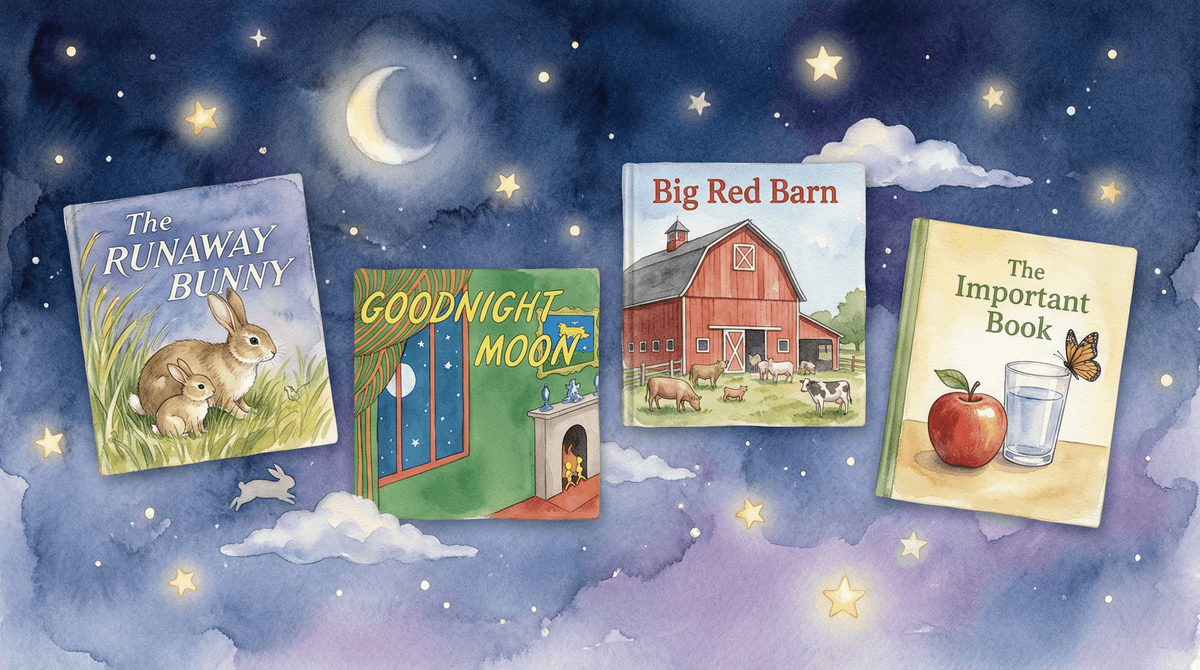
Brown died young at 42, but in her brief career she revolutionized children's literature by doing something radical: she actually paid attention to how children experience the world. She wrote over 100 books, including The Runaway Bunny and The Important Book, but Goodnight Moon became the bedtime bible for a reason that's worth understanding—especially if you're trying to wind down a kid who's been overstimulated by Bluey and Minecraft all day.
Here's the thing about Margaret Wise Brown: she understood rhythm, repetition, and the actual cognitive needs of young children in a way that feels almost impossibly ahead of her time.
She wrote for the child's internal experience, not the parent's entertainment. There's no clever wordplay for adults, no winking pop culture references, no attempt to make bedtime "fun." Goodnight Moon is deliberately boring in the best possible way. It's a systematic tour of a room that gets progressively darker and quieter. The rhythm is hypnotic. The repetition is soothing. It's basically a literary weighted blanket.
Brown studied education and child development, and she was part of a progressive movement that believed children needed books that reflected their actual sensory world—not moralistic tales or overly complex narratives. She wrote about bunnies and kittens and boats and mittens, but really she was writing about the feeling of being small and noticing things.
The pacing is genuinely genius. Each "goodnight" takes a little longer. The room gets darker with each page turn. By the end, even the mush gets a goodnight, and somehow that's not ridiculous—it's exactly what a sleepy child would do. Kids love saying goodnight to absurd things. Brown knew that.
If you're reading Goodnight Moon for the 847th time and wondering if there's something better out there—something more educational, more engaging, more something—I'm here to tell you: this is it. This is the thing.
It's not stimulating, and that's the entire point. In a digital world where even "educational" apps are engineered to trigger dopamine hits, Margaret Wise Brown's work is the antidote. There's no flashing, no rewards, no progression system. Just a bunny, a room, and the same words every single night.
And kids crave that predictability, especially at bedtime. The sameness is soothing. The ritual matters. You're not failing as a parent if your kid wants to hear Goodnight Moon every night for six months straight—you're actually giving them exactly what their developing brain needs.
Her other books are worth exploring too. The Runaway Bunny is a beautiful meditation on unconditional love (though some parents find the mother bunny's pursuit a bit... intense). The Important Book teaches observational skills in a way that feels effortless. Big Red Barn has that same rhythmic quality that makes kids feel safe and sleepy.
Brown also wrote under pseudonyms and collaborated with illustrators like Clement Hurd (who did Goodnight Moon) and Garth Williams. If your kid loves the vibe, there's a whole catalog to explore.
Look, I get it. Physical books feel quaint when your 4-year-old can ask Alexa to play Bluey or your 7-year-old is building elaborate worlds in Roblox. But bedtime is one of those moments where old technology is actually superior technology.
Margaret Wise Brown's books don't have blue light. They don't auto-play the next episode. They don't have in-app purchases or friend requests or algorithm-driven recommendations. They just... end. And then you close the book, turn off the light, and your kid goes to sleep.
That's not nostalgia talking—that's neuroscience. The wind-down routine matters. The predictable rhythm matters. The physical closeness of reading together matters. Research consistently shows that reading physical books before bed improves sleep quality and parent-child bonding in ways that screen-based stories simply don't replicate.
Margaret Wise Brown figured out something in the 1940s that we're still trying to remember in 2026: children don't need constant stimulation. They need rhythm, safety, and someone who notices the world with them.
Goodnight Moon isn't a great book because it's educational or innovative or award-winning (though it is, quietly, all of those things). It's great because it does exactly one thing perfectly: it helps a child transition from awake to asleep in a way that feels gentle and inevitable.
In a world where everything is optimized for engagement and retention and watch time, Margaret Wise Brown's work is a reminder that sometimes the best thing you can do for your kid is bore them in exactly the right way.
So go ahead—say goodnight to the mush one more time. It's working.
- Start simple: If you don't own Goodnight Moon yet, grab a copy. The board book version is indestructible.
- Build the ritual: Read it at the same time every night. Same spot, same rhythm. Let it be boring. That's the magic.
- Explore her other work: The Runaway Bunny, Big Red Barn, and The Important Book all have that same soothing quality.
- Protect the wind-down: If you're struggling with bedtime battles, learn more about screen-free bedtime routines that actually work.