

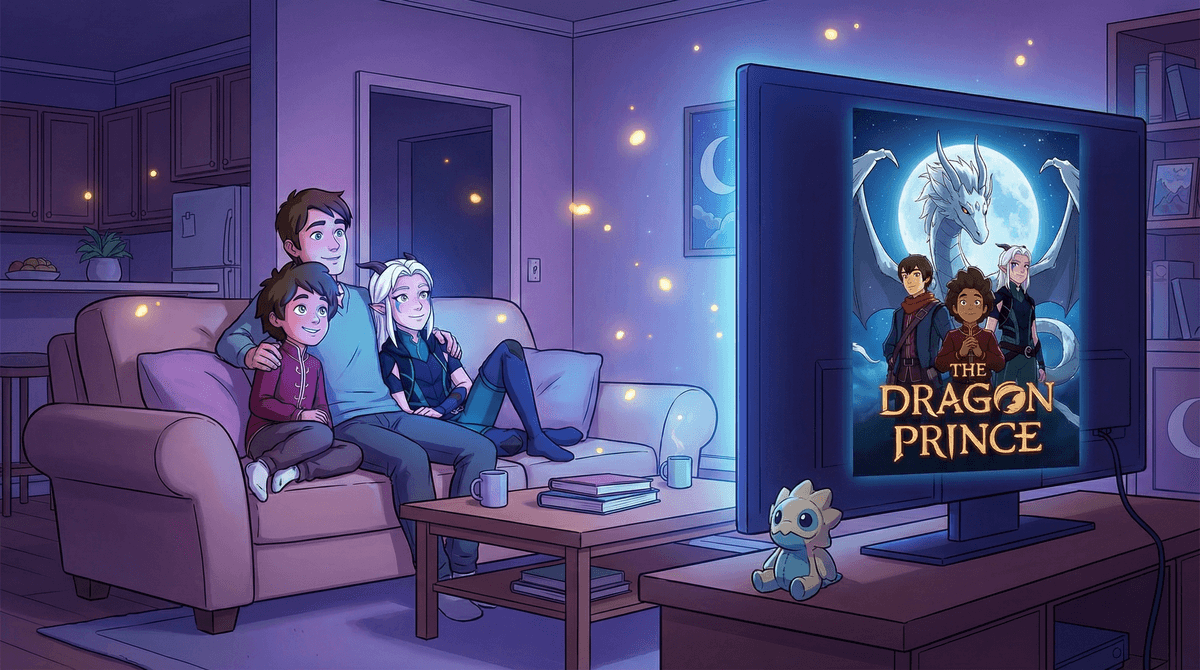
The Dragon Prince: A Parent's Guide to Netflix's Fantasy Epic
TL;DR: The Dragon Prince is a thoughtful fantasy series from the creators of Avatar: The Last Airbender that's genuinely good for ages 7+. It has mild fantasy violence and emotional intensity, but zero explicit content. If your kid loved Avatar or wants something with actual storytelling (not just gags), this is a solid pick. About 40% of Screenwise families use Netflix for kids' content, and this is one of the shows worth that screen time.
The Dragon Prince is a Netflix-original animated fantasy series (2018-2024) that follows two human princes—Callum and Ezran—and a young elf assassin named Rayla as they try to stop a war between humans and the magical world of Xadia. The twist? They're returning a dragon egg to its mother, which could be the key to peace between the two worlds.
Created by Aaron Ehasz and Justin Richmond (Ehasz was head writer for Avatar: The Last Airbender), the show brings that same blend of adventure, humor, and genuine moral complexity. It's not dumbed down, it doesn't talk down to kids, and it actually trusts young viewers to handle nuanced themes about prejudice, responsibility, and the consequences of power.
The animation style is distinctive—a 3D style that mimics 2D hand-drawn animation. Some people love it, some find it choppy in the early episodes (it gets smoother in later seasons). Your mileage may vary.
The worldbuilding is legitimately cool. There are six types of magic (sun, moon, stars, sky, earth, ocean), different magical creatures, and a whole political system to explore. Kids who love fantasy lore will eat this up.
The characters actually grow. Callum starts as a goofy stepbrother who can't do magic, and over the series becomes a powerful mage who has to wrestle with what kind of magic is okay to use. Ezran goes from a kid who talks to animals to a king making impossible choices. Rayla evolves from an assassin raised to hate humans into someone who questions everything she was taught.
It's funny without being annoying. There's humor (a lot of it from the talking parrot Bait and the sarcastic elf Rayla), but it doesn't undercut the serious moments. The show knows when to be silly and when to let emotional beats land.
Representation matters here. There are characters with disabilities (General Amaya is deaf and communicates through sign language), LGBTQ+ relationships portrayed as completely normal, and diverse casting across the board. For kids growing up in 2026, this just feels like the world they live in.
Let's be specific about what "mild fantasy violence" means, because that phrase can cover a lot of ground.
Violence/Action: There are sword fights, magical battles, and characters die (mostly off-screen or implied). The show doesn't shy away from the reality that war has casualties. In one memorable scene, a character uses "dark magic" which involves harvesting magical creatures for power—it's portrayed as morally wrong and visually unsettling (dark veins, corrupted appearance).
The IMDb parental guide rates violence as "Mild," and that feels accurate. This isn't graphic—no blood, no gore—but battles have stakes and consequences. A main character's parent dies early in the series (shown in flashback). Another character loses their sight in battle.
Emotional Intensity: Some episodes deal with heavy themes—grief, betrayal, the weight of leadership. There's a storyline about a character being possessed/corrupted that might be scary for younger kids. The show doesn't wrap everything in a bow; sometimes characters make mistakes with lasting consequences.
Romance: There are age-appropriate romantic relationships, including a same-sex couple in later seasons. A few kisses, hand-holding, clear mutual affection. Nothing beyond PG territory.
Language: Clean. No profanity.
Substance Use: None. Zero alcohol, drugs, or smoking.
Ages 7-9: This is the lower end of appropriate. Kids in this range who've handled Avatar: The Last Airbender or similar fantasy content will likely be fine, but you'll want to watch together. The emotional themes (loss, responsibility, moral complexity) might need some unpacking. The battle scenes could be too intense for particularly sensitive kids.
Ages 10-12: Sweet spot. Kids this age can fully engage with the moral questions the show raises. They'll pick up on the political intrigue, understand the nuances of the "dark magic vs. primal magic" debate, and appreciate the character development. This is the age where kids start thinking about justice, fairness, and "what would I do in that situation?"—and The Dragon Prince gives them a lot to chew on.
Ages 13+: Still engaging for teens, especially those who enjoy fantasy worldbuilding and character-driven stories. The themes about power, prejudice, and breaking cycles of violence have real-world parallels that older kids will recognize and want to discuss.
This is a slow burn. The first season is nine episodes of 25 minutes each—basically a long movie. The story takes time to set up, and the payoffs come later. If your kid is used to the rapid-fire pacing of YouTube or TikTok content, this might feel slow at first. That's actually a feature, not a bug. Read more about why slower-paced content matters for attention development .
.
The "dark magic" storyline is genuinely interesting. One of the main antagonists uses dark magic, which requires killing magical creatures to harvest their power. The show doesn't make this black-and-white—humans were driven to dark magic because they couldn't naturally do magic like elves and dragons could. It raises questions about survival, desperation, and whether the ends justify the means. Great conversation starter.
Representation is baked in, not tokenized. General Amaya's deafness isn't a "special episode" thing—she's a badass military commander who communicates through an interpreter, and the show treats sign language as just another language. The LGBTQ+ relationships aren't announced with fanfare; they just exist. For families raising kids to see diversity as normal, this is how it's done.
It's complete. Seven seasons, story wrapped up. You're not getting your kid invested in something that ends on a cliffhanger with no resolution. (Looking at you, every other Netflix show that gets cancelled after two seasons.)
If you're trying to figure out where this fits in your family's Netflix rotation:
- More mature than: Bluey, Hilda, Kipo and the Age of Wonderbeasts
- Similar level to: Avatar: The Last Airbender, The Owl House
- Less intense than: Arcane, Castlevania
If your kid loved Avatar, this is the obvious next step. If they're into Percy Jackson or other middle-grade fantasy, the themes will resonate.
According to Screenwise data, families average about 4.2 hours of screen time daily (4 hours on weekdays, 5 on weekends). About 40% of families use Netflix regularly for kids' content, and another 40% use it occasionally.
Here's the thing: not all screen time is created equal. A 25-minute episode of The Dragon Prince—with its character development, moral complexity, and storytelling craft—is a different experience than 25 minutes of random YouTube shorts or mindless mobile games.
If you're going to "spend" some of your family's screen time budget on TV, this is the kind of content that actually gives something back. It sparks conversations, builds vocabulary, introduces complex ideas in accessible ways, and models healthy relationships and conflict resolution.
After watching episodes together (especially in seasons 2-3 when the moral questions get thornier):
- "Viren thinks he's saving humanity by using dark magic. Do you think he's right that humans needed it to survive?"
- "Rayla was raised to believe humans were evil, but then she met Callum and Ezran. Has something like that ever happened to you—where you learned someone wasn't what you expected?"
- "If you were Ezran, would you have made the same choice about [spoiler situation]? What would you have done differently?"
- "The show talks a lot about breaking cycles—not repeating the mistakes of the past. What does that mean?"
The Dragon Prince is one of the best family fantasy series available right now. It's thoughtfully made, age-appropriate without being babyish, and trusts kids to handle complex themes. The mild fantasy violence and occasional emotional intensity mean it's not for everyone under 7, but for elementary and middle school kids who are ready for real storytelling, this is a winner.
Common Sense Media and PluggedIn both give it positive reviews, praising the character development, diverse representation, and moral depth while noting the battle scenes that might be too much for younger viewers. Both sources recommend it for families who want fantasy with substance.
Is it perfect? No. The animation style is polarizing, and the early episodes can feel slow if your kid is used to faster-paced content. But those are minor quibbles compared to what the show gets right: compelling characters, genuine stakes, moral complexity, and a complete story that sticks the landing.
If you're looking for something to watch together that will actually give you things to talk about afterward, start here. And if your kid gets hooked, you've got seven seasons to work through—which, given that it's a complete story with a satisfying ending, is a gift in the current streaming landscape.
Next Steps: Watch the first three episodes together (they're essentially a movie that sets up the whole series). If your kid is engaged and not too freaked out by the action, keep going. If it's too intense, bookmark it for a year from now and try Hilda or Kipo instead.
Want to explore more fantasy shows for kids or dig into what makes Avatar-style storytelling so effective? We've got you covered.