

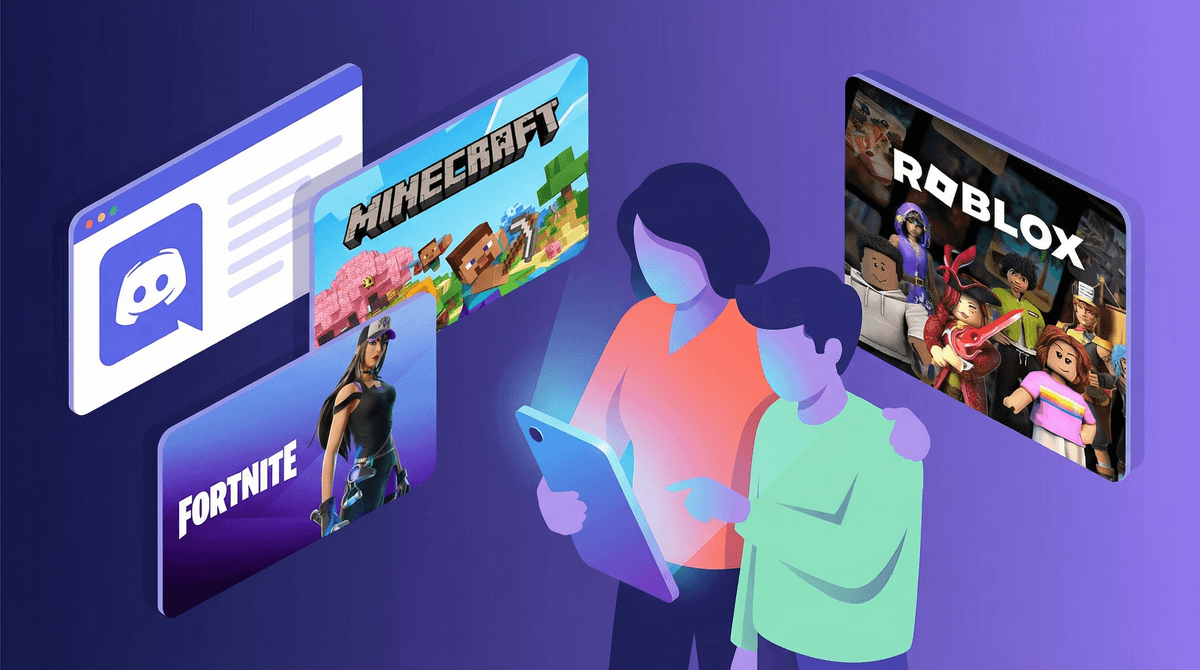
Discord's terms of service are crystal clear: you must be at least 13 years old to use the platform. In some countries (like South Korea and the Netherlands), the minimum age is even higher—15 or 16, depending on local digital privacy laws.
But here's the thing every parent needs to know: Discord's age verification is basically the honor system. When you sign up, you enter your birthdate. That's it. No ID check, no parental consent form, no verification email to a parent. Just a date picker and a promise.
So yes, technically Discord requires users to be 13+. In practice? Plenty of younger kids are on there, and Discord knows it.
Discord started as a platform for gamers to voice chat while playing together, but it's evolved into something much bigger. Think of it as a hybrid between a group chat app, a gaming community hub, and Reddit—all rolled into one.
Kids want Discord because:
- Their gaming friends are there - If your kid plays Minecraft, Roblox, or Fortnite, their squad is probably coordinating on Discord
- It's where communities live - Fan groups, hobby communities, study groups—Discord servers exist for literally everything
- Voice chat is seamless - Way better than game-based voice chat, and more flexible than FaceTime
- It feels more mature - Discord doesn't have the "kid app" stigma of something like Messenger Kids
The platform has over 150 million monthly active users, and a significant chunk are teens and tweens. Your kid isn't wrong that "everyone" is on it—in their world, they might actually be right.
The 13+ requirement isn't arbitrary—it's tied to COPPA (Children's Online Privacy Protection Act), which restricts how companies can collect data from kids under 13. But does turning 13 magically make Discord safe? Not really.
Discord is fundamentally an open platform. Unlike games with built-in chat restrictions, Discord is designed for unrestricted communication. Anyone can:
- Send direct messages to your child
- Invite them to new servers
- Share images, videos, links, and files
- Voice or video chat
There's no algorithm curating content. There are no training wheels. It's the internet in its rawest form—which can be amazing for the right kid at the right age, and genuinely dangerous for others.
Here's my honest take: Even for 13-year-olds, Discord requires a level of digital literacy and judgment that not every kid has. The question isn't just "how old is my child?" but "how equipped is my child to navigate unmoderated online spaces?"
Discord does have safety tools, but you need to know they exist and how to use them:
Privacy Settings:
- You can restrict who can send friend requests (everyone, friends of friends, or server members only)
- You can disable DMs from server members entirely
- You can block users and leave servers anytime
Content Filters:
- Discord has a "Safe Direct Messaging" setting that automatically scans and deletes explicit images
- There are three levels: scan DMs from everyone, scan DMs from non-friends, or don't scan at all
- Spoiler alert: kids can turn these off themselves
Server Moderation:
- Individual servers can have their own rules and moderators
- Some servers are well-moderated and genuinely safe spaces
- Others are... not
- There's no way for you to vet a server before your kid joins unless you're in there with them
The Big Gap: Discord has no parental controls in the traditional sense. There's no parent dashboard, no screen time limits, no content restrictions you can set from your device. If your child has a Discord account, they have full access to everything Discord offers.
Ages 10 and under: Hard no. The platform isn't designed for this age group, and the risks far outweigh any benefits. If they need to chat with gaming friends, look at alternatives like Messenger Kids or in-game chat with heavy parental oversight.
Ages 11-12: Probably not, unless you're willing to be very involved. We're talking: you have the login, you approve every server, you periodically check messages, and your kid understands why these boundaries exist. Even then, know that you're operating outside Discord's TOS, which means if something goes wrong, you have zero recourse.
Ages 13-14: This is where it gets real. If your kid is 13+ and wants Discord, it's worth having a serious conversation. Some kids are ready; others aren't. Consider:
- Do they already navigate social media responsibly?
- Can they identify and report inappropriate behavior?
- Will they come to you if something feels wrong?
- Are they joining for a specific, moderated community (like a school esports team) or just "to be on Discord"?
If you say yes, start small. Maybe they join one or two specific servers you've vetted together. Set up their privacy settings together. Check in regularly—not as surveillance, but as ongoing conversation.
Ages 15+: At this point, most teens have the digital literacy for Discord, though that doesn't mean it's risk-free. The focus shifts from "should they be on it?" to "do they know how to handle the weird stuff they'll inevitably encounter?"
Skip the fear-mongering. Your kid has probably heard that "Discord is dangerous" from school or friends, and if you lead with that, you'll lose credibility fast.
Instead, try something like:
"I know Discord is where a lot of your friends hang out, and I get why you want to be there. Here's the thing—Discord is designed for older users, and it doesn't have the same safety features as [other apps they use]. That doesn't mean it's bad, but it does mean we need to be thoughtful about how you use it."
Then ask questions:
- Which friends are you trying to chat with?
- What servers do you want to join?
- Have you seen anything on Discord that made you uncomfortable?
- What would you do if a stranger messaged you?
Make it a conversation, not an interrogation. The goal is to understand their world while helping them build judgment.
Discord's age requirement is 13+, but age is only part of the equation. The real question is whether your child has the digital maturity to navigate an essentially unmoderated platform—and whether you're ready to support them in doing so.
If you decide your child isn't ready for Discord yet, that's completely valid. If you decide they are ready with guardrails, that's valid too. There's no one-size-fits-all answer here, and any parent who tells you otherwise is lying.
What matters is that you're making an informed, intentional decision based on your specific kid and your family's values—not just defaulting to "everyone else is doing it."
If you're leaning toward allowing Discord:
- Set it up together and configure privacy settings before they start using it
- Learn how to set up Discord safety settings

- Agree on which servers they can join (and consider joining them yourself)
- Establish a check-in routine—not snooping, but ongoing dialogue
- Make sure they know how to block, report, and leave servers
If you're saying not yet:
- Explain your reasoning clearly (not just "because I said so")
- Offer alternatives that meet their actual need (gaming chat, friend communication, community connection)
- Revisit the conversation in 6 months—kids develop fast at this age
If you're not sure:
- That's okay! Get answers for your specific situation
- Talk to other parents in your kid's friend group
- Consider a trial period with heavy involvement
The fact that you're reading this guide means you're already doing the hard work of intentional parenting in a digital world. Trust your gut, stay curious, and remember: you can always adjust course as you learn more.