

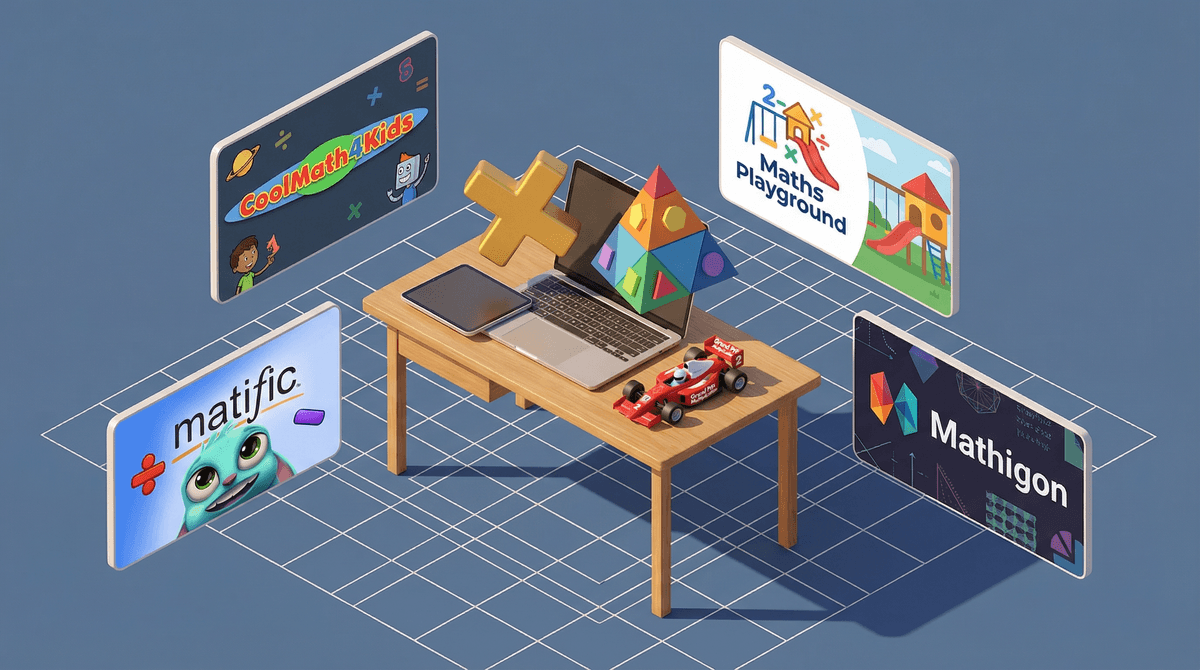
The Best Websites for Math Games: Where Practice Actually Feels Like Play
TL;DR: If you're hunting for math practice that doesn't feel like pulling teeth, these five sites consistently deliver: CoolMath4Kids for clean, ad-free skill drills; Math Playground for logic puzzles and problem-solving; Matific for comprehensive curriculum alignment; Mathigon for story-driven conceptual learning; and MathGames.com for a massive arcade of free challenges. Each takes a different approach, so you can match your kid's learning style—whether they want quick multiplication races or deep dives into the "why" behind the math.
Math homework battles are real. But here's what's also real: when the right game clicks, kids will voluntarily practice multiplication tables for 20 minutes straight. The trick is finding sites that balance genuine learning with actual engagement—not just digital worksheets dressed up with cartoon characters.
The good news? A handful of websites have figured this out. They're curriculum-aligned, safe, and—crucially—fun enough that kids don't realize they're doing math. Here's what you need to know about each one.
Best for: Quick, focused skill practice (K-6)
Cost: Free, ad-free
This is the site parents remember from their own childhood, and it's still going strong. CoolMath4Kids organizes games by both topic (addition, subtraction, fractions, geometry) and grade level, making it dead simple to find exactly what your kid needs to practice.
The standout titles here are the racing and adventure games that turn fact fluency into competition: Grand Prix Multiplication has kids answer times tables to fuel their race car, Alien Addition makes mental math the key to defeating invaders, and Dirt Bike Fractions requires quick fraction comparisons to navigate obstacle courses.
What makes this site work is its clean design—no distracting ads, no autoplay videos, just straightforward games that load fast and get to the point. If your third-grader needs to nail their multiplication facts before the timed test next week, this is your go-to.
Parent tip: The games are short (5-10 minutes each), which makes them perfect for "just one more game" situations that actually add up to meaningful practice.
Best for: Problem-solving and logic (K-6)
Cost: Free (with ads)
Where CoolMath4Kids focuses on fact fluency, Math Playground goes deeper into conceptual thinking. Their "purposeful play" approach means games that require kids to actually understand what they're doing, not just memorize answers.
The Math Stories section is particularly clever—these are word problems disguised as interactive puzzles where kids manipulate objects on screen to solve scenarios. The Brain Boosts section targets spatial reasoning and logic, with games that feel more like brain teasers than math drills.
For multiplication and division practice, Times Table Duck and Division Derby are solid choices that work similarly to CoolMath4Kids' racing games. But Math Playground's real strength is its searchable library—you can filter by grade, skill, or even game type (logic, geometry, algebra) to find exactly what fits your kid's current challenge.
Parent tip: The site includes teacher-curated content, which means you're not just getting random games—these are specifically designed to hit curriculum standards.
Best for: Comprehensive, school-aligned learning (Ages 4-15)
Cost: Subscription (free trial available)
If you want something more structured—basically a full math curriculum in game form—Matific is worth the investment. With over 1,000 interactive activities aligned to common standards and available in 50+ languages, this is the closest you'll get to replicating what happens in a good math classroom.
Matific's games are built by math education experts, and it shows. The progression is thoughtful, the activities scaffold properly, and the platform adapts to your child's performance. It's particularly strong for families who want to supplement school math or bridge learning gaps without hiring a tutor.
The downside? It's subscription-based (though you can try it free). But if your kid is struggling with math or you're homeschooling, the depth here makes it a solid value.
Parent tip: Because Matific covers ages 4-15, it works for families with multiple kids at different levels—one subscription, multiple learners.
Best for: Curious kids who want to understand concepts
Cost: Free
Mathigon calls itself "The Mathematical Playground," and that's accurate—this is where kids go when they want to explore the why behind the math, not just drill the facts.
The site blends interactive puzzles with narrative explanations, so kids aren't just solving problems—they're discovering mathematical principles. It's more exploratory and less structured than the other sites here, which makes it perfect for kids who love logic puzzles or who get frustrated when they don't understand the reasoning behind a formula.
This isn't the site for quick times table practice. But if your kid is the type who asks "but why does multiplication work that way?" or gets excited about patterns and connections, Mathigon will keep them engaged for hours.
Parent tip: Great for kids who are already strong in math and want enrichment, or for kids who struggle with rote memorization but thrive with conceptual understanding.
Best for: Variety and arcade-style fun (All grades)
Cost: Free
Formerly "Math Jam," MathGames.com is basically a massive arcade of math challenges. The library is huge—hundreds of games across all grade levels, from simple addition for kindergarteners to complex logic games for middle schoolers.
Popular titles include Fireboy & Watergirl (a two-player logic game that requires strategic thinking) and Duck Life 4 (where you train a duck through math challenges). The site lets you filter by grade or skill, and it even includes printable worksheets if you want offline practice.
The trade-off here is less curation—there's more quantity than carefully designed progression. But if your kid is the type who gets bored easily and wants lots of options, this site delivers.
Parent tip: The variety makes this great for summer practice when you want to keep skills fresh without the pressure of "this is your assignment."
Best for: Full-curriculum game-based learning (Preschool-5)
Cost: Subscription (free version available with limits)
SplashLearn combines a complete math curriculum with a game-based interface, making it a strong middle ground between Matific's structure and MathGames.com's variety. Parents can explore content by grade and subject, and the platform keeps things fresh with seasonal "Summer Games" and monthly themed content.
The free version gives you limited access; the subscription unlocks the full curriculum and adaptive learning features. It's a good fit for families who want more than drill-and-practice but don't need the depth of Matific.
Here's the reality: according to Screenwise data, kids are averaging 4.2 hours of screen time daily (4 hours on weekdays, 5 on weekends). About 45% of families report laptop usage, and 50% allow unsupervised tablet time.
Math game sites can be part of healthy screen time—especially when they're replacing passive consumption. Twenty minutes of Math Playground problem-solving is fundamentally different from twenty minutes of random YouTube scrolling.
That said, these sites work best as supplements, not replacements for hands-on learning. If your kid is spending an hour daily on math games but never touches manipulatives or real-world math problems, that's worth rebalancing.
Ages 4-6 (K-1):
Start with CoolMath4Kids' early games or SplashLearn's preschool section. Keep sessions short (10-15 minutes) and sit with them—these ages need help navigating interfaces and staying on task.
Ages 7-9 (2nd-4th grade):
This is the sweet spot for most of these sites. Math Playground and CoolMath4Kids work great for building fluency, while Mathigon can challenge advanced learners.
Ages 10-12 (5th-6th grade):
Older elementary kids often enjoy MathGames.com' variety and Mathigon's deeper explorations. If they're struggling, Matific can help fill gaps without feeling babyish.
Ages 13+:
Most of these sites cap at 6th grade, though Mathigon and Matific extend into middle school. For older kids, you might want to explore Khan Academy or more advanced coding platforms that incorporate mathematical thinking.
All five main sites here are safe and established:
- CoolMath4Kids is completely ad-free
- Math Playground, MathGames.com, and SplashLearn have ads but no user-generated content or chat features
- Matific and Mathigon are closed systems with no social features
None require personal information beyond email for account creation (and even that's optional on some). There's no risk of your kid stumbling into inappropriate content or interacting with strangers.
The best math game site for your family depends on what you need:
- Quick skill practice? → CoolMath4Kids
- Problem-solving depth? → Math Playground
- Full curriculum support? → Matific
- Conceptual exploration? → Mathigon
- Maximum variety? → MathGames.com
You don't have to pick just one—bookmark a few and rotate based on what your kid needs that week. The goal isn't to gamify every aspect of math learning, but to have solid options for when practice needs to happen and motivation is low.
And honestly? When your kid asks for "just five more minutes" to finish a multiplication race, you've won.
Try this: Pick one site from the list above and spend 10 minutes exploring it together. Let your kid choose a game that looks interesting, then watch how they engage with it. That'll tell you way more than any review about whether it's the right fit for your family.
Want to dig deeper into how to balance educational screen time or explore other educational websites for kids? Screenwise can help you figure out what works for your specific situation.